





 Portuguese
  English
  Spanish
  5 min of reading
  0 comments


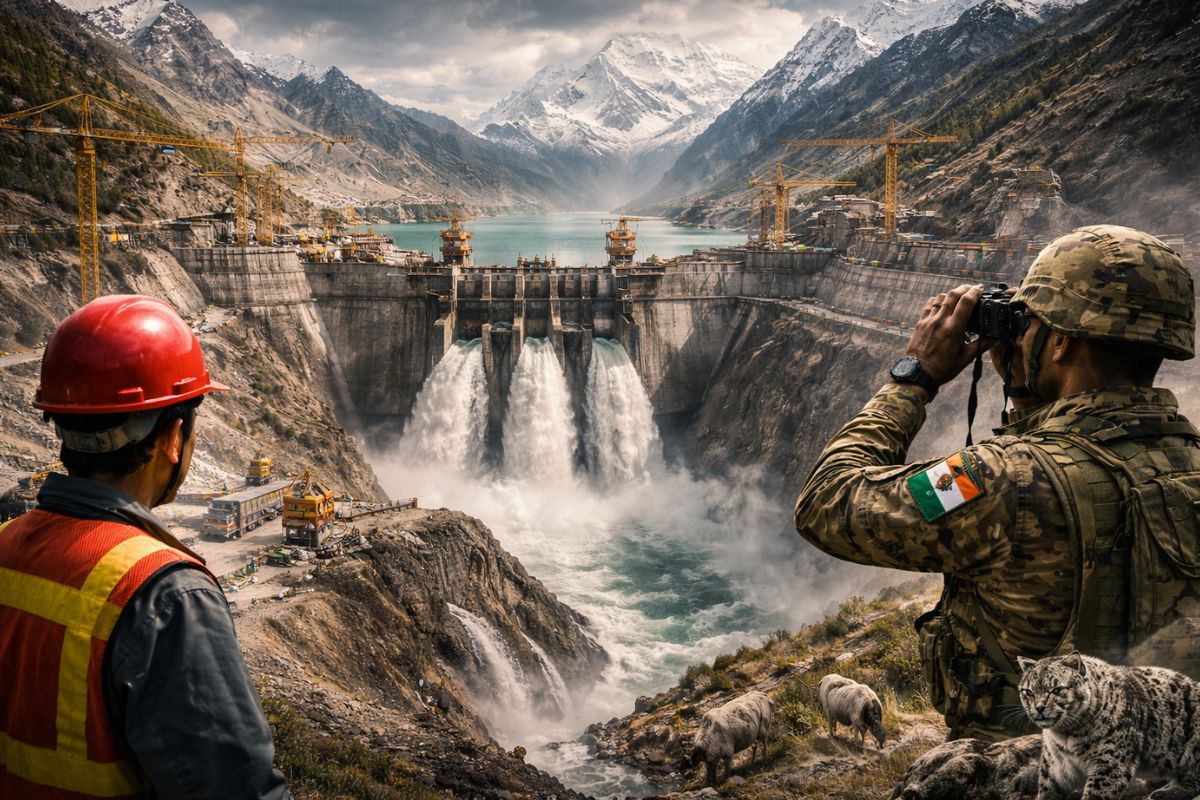
With A Mega Hydroelectric Power Plant In Cascade On The Yarlung Tsangpo River, China Invests R$ 925.4 Billion To Generate 70 Gigawatts, Strengthen Internal Energy Security And Raises Tension With India, Bangladesh, Rivers, Earthquakes, Rare Biodiversity And High-Risk Works In Seismic Area, With Potential Long-Lasting Impacts On Shared Regional Water.
On December 21, 2025, the construction of a mega hydroelectric power plant in cascade on the lower stretch of the Yarlung Tsangpo River in Tibet was detailed as the largest hydropower project in China, with an estimated investment of 1.2 trillion yuan, approximately US$ 167 billion, equivalent to about R$ 925.4 billion, and a projected capacity of 70 gigawatts.
The plant, planned to take advantage of a drop of about 2,000 meters concentrated over approximately 50 kilometers, aims to generate around 300 billion kWh per year, integrating Tibet into the national power grid, supplying Chinese industrial centers, and repositioning the country in the global debate on energy transition and reducing coal use.
Where The Mega Hydroelectric Power Plant Will Be Built And Why The Location Is Strategic

The mega hydroelectric power plant will be installed in the Nyingchi region, in southeastern Tibet, in an area of extremely rugged terrain.
-
Live fence that saves on construction: Virginia jasmine grows up to 60 cm per year, reaches 10 m, and closes the yard with a dense and fragrant green wall, without aggressive roots and with simple, inexpensive, and quick pruning.

-
This is the cost to build a simple 60 m2 house in 2026, including contingencies, foundation, finishing, labor, and hidden fees.

-
Amphibious houses with a floating dock system gain global attention by revealing technology that allows homes to rise with floods and avoid losses in high-risk areas.

-
Between tunnels, bridges, and billions in investment, Istanbul is preparing to receive a 125-kilometer railway that crosses continents, enhances the circulation of goods and passengers, and changes the strategic outlook of Turkish transportation.

There, the Yarlung Tsangpo River forms a large deep valley, combining a steep drop in altitude with significant hydropower potential still little explored on an industrial scale.
The plan envisions a cascade dam complex, and not merely a single structure, designed to exploit the maximum possible drop in sequence.
This configuration multiplies the generation capacity along the river course and transforms the area into one of the main electric production hubs of the country.
In addition to the energy component, the project is seen in Beijing as a tool for physical integration of Tibet into national infrastructure, with new roads, transmission lines, and logistical reinforcement in remote highland areas.
The construction of permanent access for heavy machinery, teams, and materials is an essential part of the timeline and expands state reach in a sensitive geopolitical region.
How Much The Mega Hydroelectric Power Plant Can Generate And What Role It Will Have In The Chinese Energy Matrix
According to official projections, the mega hydroelectric power plant in Tibet can reach about 70 gigawatts of installed capacity, surpassing several large power plants already in operation around the world.
In terms of annual production, the goal is to reach approximately 300 billion kWh, a volume sufficient to sustain both local consumption and supply to large industrial hubs in other provinces.
Chinese authorities present the undertaking as a centerpiece to strengthen internal energy security and gradually reduce dependence on coal-fired power plants, aligning the country with greenhouse gas emissions reduction targets.
The idea is to use the stable generation from the mega hydroelectric power plant as a basis to enable the closure of some of the older, more polluting plants.
In official rhetoric, the mega hydroelectric power plant is an example of how large projects can be used to accelerate the energy transition.
At the same time, experts remind that concentrating so much power in a single water corridor creates new types of systemic risk, requiring operation and emergency plans compatible with the scale of the undertaking.
Why The Mega Hydroelectric Power Plant Raises Alerts In India And Bangladesh
The Yarlung Tsangpo River, which feeds the mega hydroelectric power plant, becomes the Brahmaputra upon crossing the border into India and proceeding towards Bangladesh.
The watercourse is vital for water supply, agricultural irrigation, and electric generation in these countries, making any dam on its upstream course an immediate regional concern.
In New Delhi, water security analysts warn of the risk of changes in water volume and seasonality, especially during periods of severe drought or extreme floods.
The operation of large reservoirs on Chinese territory can alter flow peaks, reduce flows at critical moments, and increase the sense of vulnerability in areas already prone to flooding and climate disasters.
The lack of transparency regarding the operation regime of the mega hydroelectric power plant, monitoring data, and emergency protocols breeds additional distrust.
In parallel, the project’s area of influence approaches border dispute zones, such as Arunachal Pradesh, where China and India have historical disagreements.
In this context, large reservoirs are also seen as strategic assets in the event of a diplomatic crisis, and not just as energy infrastructure.
Environmental Risks, Earthquakes And Engineering Challenges In The Tibetan Plateau
The region chosen for the mega hydroelectric power plant is described as ecologically fragile, with high biodiversity and the presence of endemic species still little studied.
The flooding of valleys and slopes can cause loss and fragmentation of habitat, isolating animal and plant populations and altering the long-term ecological dynamics in a corridor that currently functions as a refuge for high-altitude flora and fauna.
There are also concerns about changing the natural flow of the river, which can affect migratory fish and the entire set of aquatic ecosystems downstream.
Water and sediment retention in large reservoirs tends to transform water quality, temperature, and nutrient transport, with cumulative impacts over the decades.
From a geological standpoint, the area presents significant seismicity and landslide risk, making the engineering project even more sensitive.
Experts highlight the potential for accelerated erosion, landslides, and increased sedimentation in reservoirs, issues that can shorten the lifespan of structures and require ongoing investments in monitoring and maintenance.
Additionally, construction at high altitudes poses considerable logistical challenges.
Transporting heavy equipment, concrete, steel, and skilled labor to the heart of the Tibetan plateau increases costs, complexity, and operational risk margin, requiring careful planning of all stages of the timeline.
Jobs, Regional Development And Dispute Over The Benefits Of The Mega Hydroelectric Power Plant
When presenting the mega hydroelectric power plant to the domestic audience, Chinese authorities emphasize the potential to generate thousands of direct and indirect jobs in construction, metallurgy, transportation, and related services.
The project is communicated as a vector of regional development, capable of attracting investments to currently isolated areas and increasing local tax revenue.
The robust supply of electricity is expected to reduce supply bottlenecks, create conditions for new industries to establish in the vicinity, and integrate Tibet into strategic infrastructure corridors.
The promise is that the region will cease to be merely a remote frontier and will occupy a more central place in national production and logistics chains.
At the same time, the question of how the gains will be distributed remains open.
The effective sharing of benefits between Tibet and other provinces depends on regulatory decisions, socio-environmental compensation mechanisms, and the capacity of local communities to influence public policy design.
Without this, there is a risk that the territory will bear most of the environmental and social impacts while the largest share of income is captured in other centers.
Given a project of this scale, which combines the promise of clean energy, geopolitical tension, and complex environmental risks, in your opinion, what weighs more in evaluating the mega hydroelectric power plant in Tibet: the potential to generate 70 gigawatts or the possibility of triggering long-lasting water and security problems for the entire Brahmaputra region?







-

-

2 pessoas reagiram a isso.