






 Portuguese
  Spanish


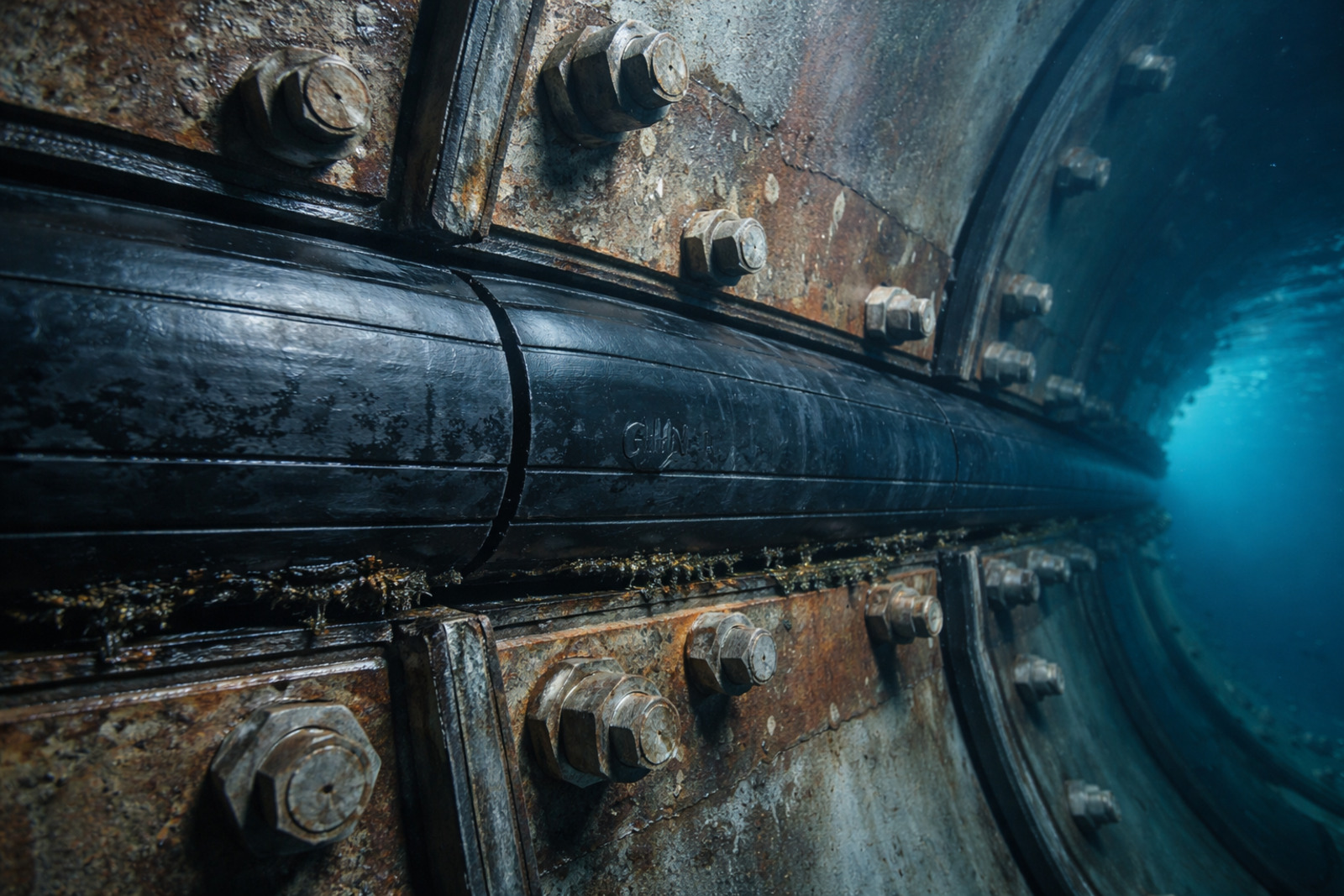
Research in China shows that the GINA joint of submarine tunnel loses strength with salt water, continuous compression, and reduces the safety margin
The rubber seal that separates the sea from the interior of a submarine tunnel may lose performance much earlier than expected, a study with material taken from the Yuliangzhou tunnel in China showed, recording a 67.66% drop in sealing capacity.
Decline in rubber sealing capacity
The study, conducted by Shijiazhuang Railway University, analyzed the GINA joint, the main watertight seal of the tunnel.
The tests evaluated what happens to the rubber after decades compressed between steel joints and submerged in salt water.
-
Trump Signs Orders to Develop Quantum Computer and Bolster U.S. Systems Against Encryption-Breaking Attacks

-
Breakthrough in Clean Energy: Scientists Develop Battery-Free Artificial Photosynthesis Using Only Sunlight to Generate Chemical Energy
-
Revive Old Photos: Gemini’s Little-Known Feature Uses AI to Restore Damaged Images in Seconds with a Professional Six-Step Recovery Process

-
Young Brazilian Inventor Develops Microplastic Filter, Wins Scholarship to Study in China, and Implements Solution to Improve Water Quality in Southern Brazil


The conclusion was that the combination of continuous compression and seawater accelerates deterioration.
The researchers stated that the safety of waterproofing over 100 years is directly determined by the GINA joint.


Review of projections
Previous models, based only on exposure to seawater, estimated that the joint would retain about 2.32 megapascals of sealing pressure after 100 years.
With the inclusion of prolonged compression, the projection dropped to 1.51 megapascals.
The reduction represents a 35% lower forecast. This difference matters because the GINA joint is the last line of defense against leaks in submerged tunnels formed by prefabricated sections that are sunk and joined underwater.
Once closed, the joint remains compressed between steel faces. This constant compression creates the contact stress that prevents seawater from entering, a factor that had not been fully considered in previous assessments.
To replicate real conditions, the team developed a compression testing device. With mechanical stress added to the marine environment, the aging of the rubber appeared more quickly and more deeply.
Harder material, worse sealing
The tests showed a paradox. Over time, the hardness of the joint increased by 14.18% and the density rose by 5.88%, characteristics that could suggest greater resistance in a routine visual inspection.
In practice, the material lost the ability to keep the submarine tunnel dry. The team reported structural degradation, with the breaking of molecular chains and weakening of the internal polymer network that helps the rubber recover after compression.
The temperature at which the rubber hardens also increased by about 5.8 degrees Fahrenheit.
The loss of sealing strength followed three stages: rapid initial decline, slower constant reduction, and a final phase of gradual deceleration.
In accelerated aging tests, internal changes were detected within 90 days. The result indicates that a significant part of the performance loss may occur before the end of the projected lifespan for the sealing.
Most vulnerable point and remaining margin of rubber sealing
The lower edge of the GINA joint experiences less contact stress and becomes the most vulnerable area. Even with the piece visibly present, the elasticity needed for waterproofing may already be compromised.
Previous work on the same tunnel showed that the sealing begins to fail when the gap between sections exceeds approximately 4.7 cm. The rotation also exacerbates the problem by reducing pressure on the lower edge.
Despite the decline, the joint remains above the minimum pressure needed to prevent leaks. The study identified 0.61 megapascals as the waterproofing limit, while the projection for 100 years was 1.51 megapascals.
The result indicates operation within the defined limits, but with a smaller margin than expected.
For those responsible for the tunnels, this turns the 100-year mark into a more attentive maintenance and inspection schedule.
The authors pointed out that inspections need to focus less on hardness and more on the joint’s ability to withstand sufficient pressure.
Maintenance teams should first look at the lower edge, while designers can review rubber compositions and compression targets.
With information from Daily Galaxy.




Be the first to react!