





 Portuguese
  English
  Spanish
  5 min of reading
  0 comments


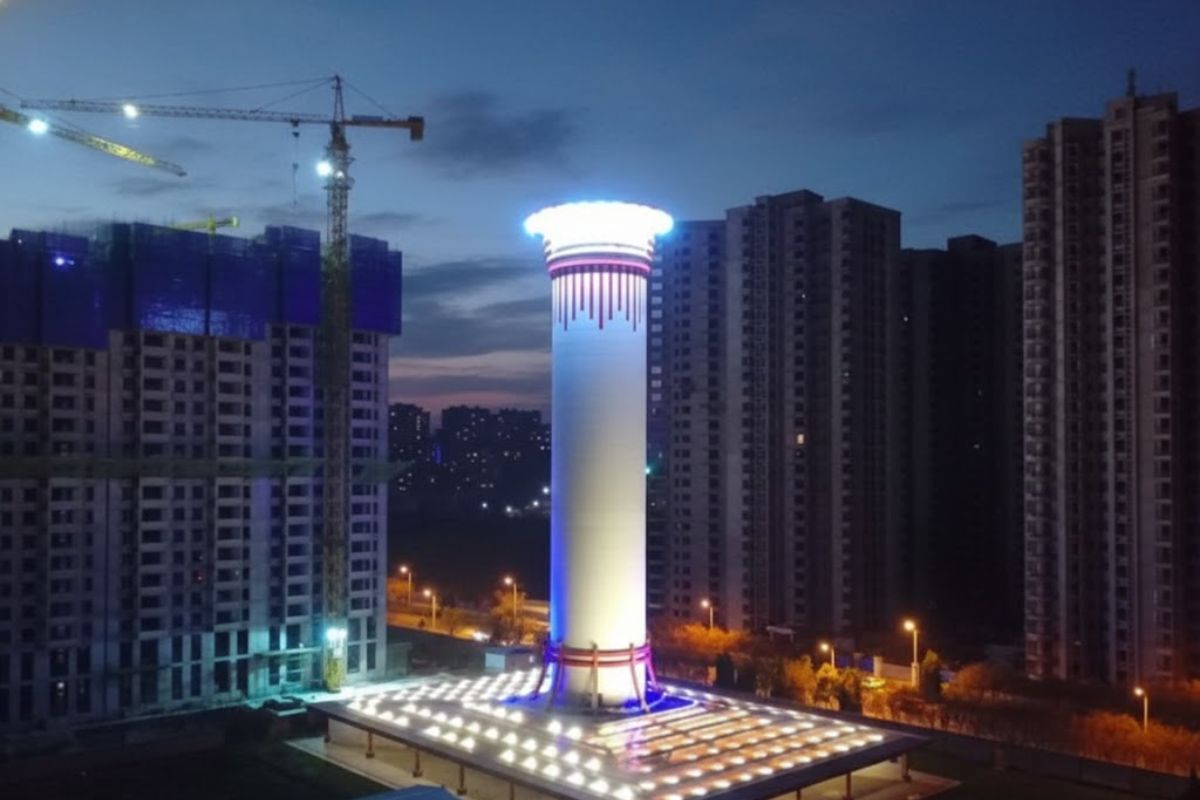
Presented As The Largest Air Purifier In The World, The Chinese Structure Combines Solar Greenhouses And Vertical Filtration To Reduce Smog In 10 Km², With An Average Decrease Of 15% In PM2.5 And Daily Production Above 10 Million M³, While Scientists Plan Metropolitan Scale For Other Cities In The Future.
The largest air purifier in the world in experimental operation in Xi’an, Shaanxi province, has repositioned the debate on urban pollution control in China by proposing a large-scale physical solution: capturing contaminated air, heating it with solar energy, and returning it filtered to the local atmosphere.
Led by researchers from the Institute of Earth Environment of the Chinese Academy of Sciences, the project moved from a deployment phase to a monitored validation stage, with preliminary data indicating daily production above 10 million m³ of clean air and a noticeable reduction in fine particles in critical urban areas.
How Xi’an Became A Laboratory For A Real-Scale Atmospheric Solution

The tower was completed in 2016, but the public presentation of the first results occurred in January 2018, when the project gained national and international visibility. The gap between construction and disclosure was not a detail: it marked the transition from an engineering installation to an urban experiment accompanied by environmental performance metrics.
-
Scientists drilled nearly 8,000 meters into the ocean floor above the fault that caused the 2011 tsunami in Japan and discovered that a layer of clay 130 million years old was responsible for making the wave much worse than any model had predicted.

-
Thousands of years after causing the largest eruption of the Holocene, one of the world’s largest supervolcanoes is rebuilding itself beneath the sea south of Japan, receiving new magma and alarming scientists with its transformation.

-
China has activated a magnet 700,000 times more powerful than the Earth’s magnetic field that operates for over 200 consecutive hours while consuming little energy, and now the world wants to know what Beijing plans to do with this technology in 2026.
-
Mercado Livre has started selling medications in Brazil with delivery in up to 3 hours, and the project that launches in São Paulo may expand to the entire country, transforming the way millions of Brazilians buy medicines.


Xi’an suffers from severe pollution episodes, especially in winter, when urban heating historically linked to coal raises particulate matter in the air.
This context explains why the city was chosen: testing a structure of this size in an area already pressured by smog allows for clearer observation of whether air quality gains are merely occasional or operationally consistent.
Engineering Of The System: Solar Greenhouses, Convection And Vertical Filtration

The operation is based on a relatively simple physical logic, but applied at an unusual scale. Polluted air is directed to greenhouses installed around the base of the tower; in the pilot, this area is described as close to half a football field. Solar radiation heats the air in these greenhouses, generating an upward current.
As the heated air rises through the structure, layers of filtration come into action along the internal column, before being released back into the atmosphere.
The claimed operational advantage is relatively low electric consumption, as the heating stage uses solar energy as the main driving force. Even in cold months, operators report maintaining functional efficiency due to coatings that improve radiation absorption on the surfaces of the greenhouses.
What The Preliminary Numbers Show And What They Still Do Not Close

The initial results indicate that the tower has been generating more than 10 million m³ of clean air per day since the start of observed operation. In the monitored area of approximately 10 km², smog ratings have dropped to moderate levels even on days of heavy pollution, a scenario that was previously associated with conditions considered dangerous.
The responsible team installed more than a dozen monitoring stations to measure the real impact on pollutant concentration. The average decrease in PM2.5 during intense episodes was 15%, a number that is technically relevant for public health. Nevertheless, the researchers themselves classify the data as preliminary, as the experiment is ongoing and requires longer series to differentiate structural effect, climatic variation, and urban seasonality.
Who Is Leading The Project And Why The Proposal Advances To 500 Meters
The technical leadership is associated with scientist Cao Junji and the team from the Institute of Earth Environment. The proposal was not conceived as an isolated solution for a neighborhood but as a proof of concept for larger versions in other Chinese cities. In other words, Xi’an functions as a testing stage before a leap in scale.
The expansion plan envisions a tower 500 meters tall and 200 meters in diameter, surrounded by greenhouses covering almost 30 km². The declared expectation is to achieve the capacity to purify most of the air in a small city. If confirmed in continuous operation, this architecture would change the level of urban atmospheric control, moving from scattered measures to a centralized infrastructure of territorial impact.
Where Are The Technical Limits And The Most Difficult Questions
Even with promising performance, the technology faces critical issues. The first is replicability: cities with distinct geography, different wind dynamics, and varied emission patterns may respond unevenly to the same tower design. The second is urban integration, as giant structures require area, planning, and coordination with transportation, heating, and industry policies.
There is also the systemic energy point. The project reduces the dependence on electricity to move air in the local process but does not eliminate, by itself, the source of emissions. Purifying ambient air and cutting emissions at the source are complementary strategies, not equivalent. Without simultaneous progress in energy matrix and industrial control, the tower tends to alleviate urban symptoms without fully resolving the pollution cycle.
Urban Scale, Public Health And The Next Chapter Of This Technology
The experience of Xi’an reintroduces an old idea in a contemporary version: using physical infrastructure to treat urban atmosphere almost like a water system, with capture, processing, and return. The difference lies in the volume and modern monitoring instrumentation, which allows for more spatially precise evaluation of effects on PM2.5.
The strategic value of the project lies less in the symbolic impact of being called the largest air purifier in the world and more in the practical question it imposes on large cities: how much can a concentrated intervention reduce population exposure when the problem is diffuse, continuous, and multi-causal? This answer depends on operating time, data transparency, and comparison with other environmental policies.
If a tower of this kind were proposed for a Brazilian metropolis, would you support its implementation as an emergency measure against smog or would you prioritize direct investment in cutting emissions at the source? In which city should this discussion begin and why?








-

-

-

-

-

12 pessoas reagiram a isso.