






 Portuguese
  Spanish
  3 min of reading
  0 comments


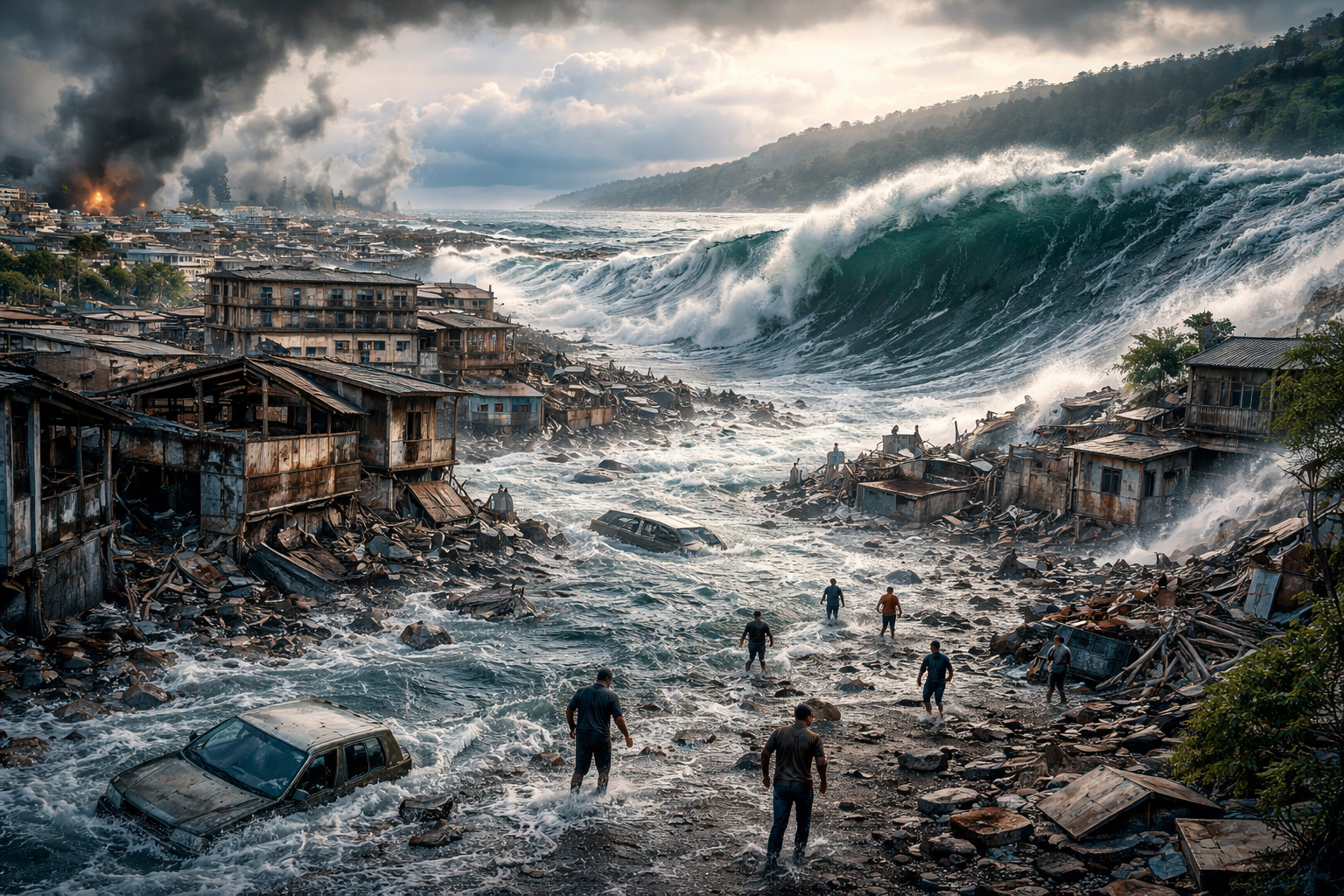
The tragedy of the Valdivia earthquake caused a global tsunami and led to the creation of an international system that still influences risk monitoring
The Valdivia earthquake in 1960 was the most powerful ever recorded and changed the way the world deals with natural disasters. The scale of the event led countries to create a joint monitoring system in the Pacific Ocean.
The force of the tremor and its effects crossed borders, reaching regions thousands of kilometers away. The impact revealed the need for international cooperation to protect coastal populations.

The creation of this system was coordinated by UNESCO, an international organization focused on scientific and educational cooperation, responsible for bringing countries together around ocean monitoring.
-
He started with a jigsaw, his father’s screwdriver, and many drawings made during classes; years later, the young man who built a roller coaster in his own backyard went viral on the internet, was hired by Cacau Park, and now coordinates Brazilian and foreign professionals in the installation of an attraction weighing 737 tons, 55 meters high, one kilometer long, featuring moments of zero gravity and a speed of 120 km/h, in a journey that turned curiosity, calculations, and persistence into a professional career.

-
Between Egypt and Sudan, Bir Tawil is no man’s land that neither country wants on paper, but in practice has gold mining, nomadic tribes, and even fake “kings.”

-
Swimming champion Shavarsh Karapetyan dove about 40 times into a frozen lake in Armenia to rescue a sunken bus, saved 20 lives, and lost his career because of it.
-
Júlia Pimentel, an 11-year-old from Minas Gerais, independently invented a new formula to calculate the square root using simple addition and multiplication, and her method was published in one of the most important mathematical scientific journals in Brazil.


The largest earthquake in history caused wide-scale destruction
The tremor occurred on May 22, 1960 and reached a magnitude of 9.5, the highest ever recorded. The epicenter was near the city of Valdivia, in southern Chile.
More than 1,600 people died and about 2 million were left homeless, highlighting the severity of the disaster. The destruction was immediate and affected several cities in the region.
The infrastructure suffered severe damage. More than 58,000 homes were destroyed, leaving thousands of families without shelter.
Tsunami crossed the Pacific and hit distant countries
The earthquake triggered a planetary-scale tsunami, capable of crossing the entire Pacific Ocean. The phenomenon surprised with its speed and reach.
In Hawaii, the waves arrived about 15 hours later, causing significant destruction. In Japan, the impact occurred after 22 hours, with over a hundred deaths recorded.
This scenario showed that seismic events can generate global consequences, even when they occur at a single point on the planet.
The international system began to monitor the ocean in real time
The need for a rapid response led to the creation, in 1965, of the Pacific Tsunami Warning and Mitigation System. The initiative brings together 46 countries.
Participants share seismic, oceanic, and meteorological data in real time. The goal is to quickly identify potential tsunamis and issue alerts for at-risk areas.
The structure was organized by UNESCO, an international entity that coordinates scientific actions among countries, consolidating a model of cooperation that remains active.
Scientific advances changed the understanding of the Earth
The earthquake also propelled the evolution of seismology. The enormous energy released allowed for deeper studies of the planet’s internal structure.
Researchers began to better understand the propagation of seismic waves, contributing to the development of more efficient forecasting models.
These advances helped improve global strategies for mitigating natural disasters.
Environmental effects aggravated the crisis in Chile
In addition to the tremor and the tsunami, other events amplified the damage. Landslides blocked rivers near Valdivia, increasing the risk of flooding.
The disaster also triggered the eruption of the Puyehue volcano, intensifying the environmental and humanitarian crisis.
These chain effects highlighted how major earthquakes can generate multiple and prolonged impacts.
Indirect influence reached Brazil
Even outside the Pacific, Brazil was indirectly impacted. The country is not part of the warning system, as it is in the Atlantic, a region with lower seismic activity.
Still, the technological and scientific advances derived from the system influenced risk management policies in various parts of the world.
The global experience reinforced the importance of prevention and continuous monitoring, even in regions considered less vulnerable.
The Valdivia earthquake remains one of the most significant events in modern history. It showed that natural disasters can cross borders and affect the entire planet.
Decades later, the system created after the tragedy remains active, monitoring the ocean and helping to reduce risks for millions of people.
Did you like the content? Share it with others and leave your comment about this event that changed the way the world perceives natural risks.


Be the first to react!