





 Portuguese
  English
  Spanish
  5 min of reading
  0 comments


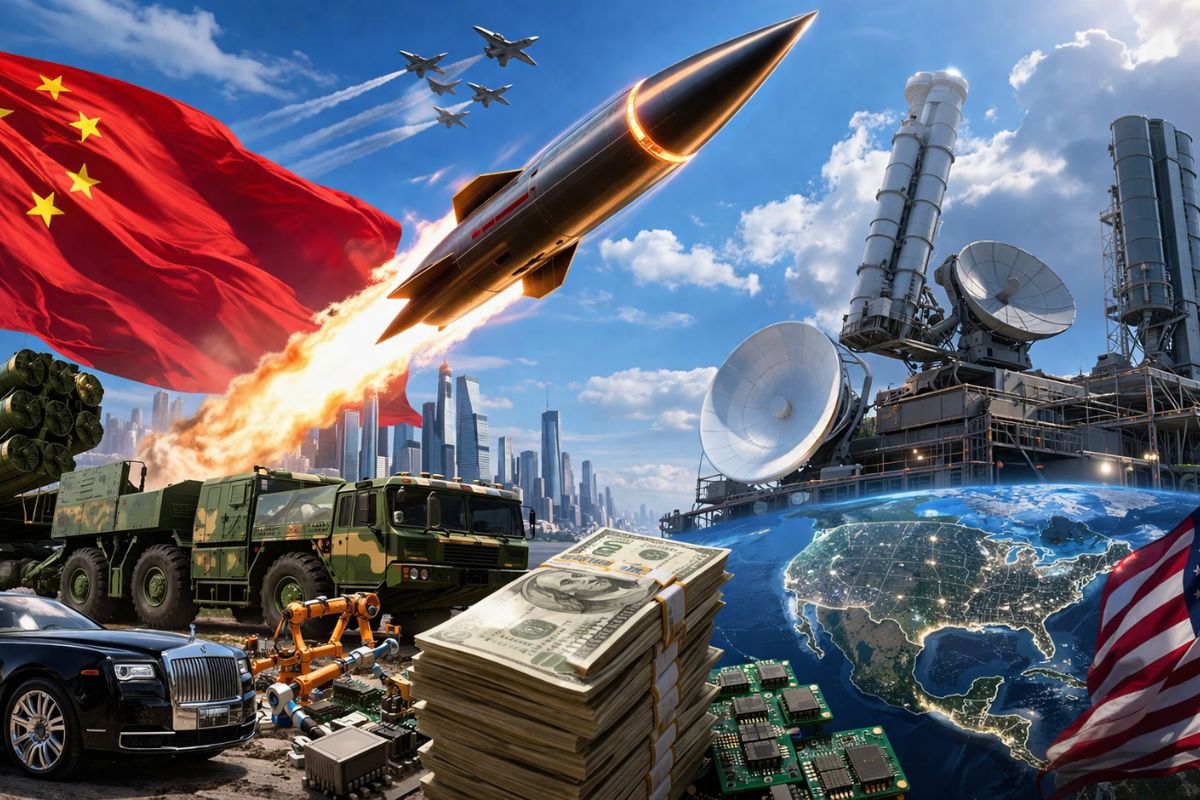
China has developed the YKJ-1000, a mass-produced hypersonic missile made with components from the civilian industry that costs the equivalent of a luxury car, while intercepting it requires defense systems that cost dozens of times more, creating a military asymmetry that the United States does not know how to resolve
China has introduced a silent but profound change in the logic of modern warfare. The YKJ-1000 hypersonic missile is capable of traveling at Mach 7, seven times the speed of sound for over a thousand kilometers and costs about $99,000, the equivalent price of a Tesla Model X. According to the portal Xataka, for the first time, a high-performance weapon has ceased to be exclusive and expensive to become something that can be mass-produced using components from the civilian industry.
The problem for the United States is not that China has developed another hypersonic missile, but how much it costs. Intercepting a single threat of this type with systems like the Patriot, the SM-6, or THAAD can cost millions of dollars per attempt. In other words, destroying the missile costs dozens of times more than manufacturing it. This creates a military equation where the attacker always wins in economic terms, and the defender needs to spend disproportionate amounts just to survive. It is this asymmetry that is keeping the Pentagon awake at night.
Why the price of China’s missile changes everything in modern warfare

The challenge that China has imposed is not technological but economic. Hypersonic missiles exist in various arsenals. What no other country had managed was to manufacture one with Mach 7 performance for $99,000.
-
100% Brazilian technology transforms agricultural waste into a meat-scented ingredient using fungi from the Amazon rainforest. The process does not use excessive water or chemicals, and it also increases the nutritional value of the final product.

-
Psychology reveals that adults who avoid conflicts at all costs are not balanced individuals, but rather children who learned in the worst way that expressing emotions brought punishment and now live paralyzed by the fear of expressing themselves.

-
Goodbye pet hair on clothes: a washer with an internal filter promises to remove up to 5 times more hair than regular machines and uses an XL trap dryer system to capture what remains.

-
The most overlooked waste in the electricity bill doesn’t come from the refrigerator or the air conditioner; it escapes through almost invisible cracks in doors and windows, operating all day long and can steal up to 20% of the energy used for climate control, while a low-cost seal takes just a few hours to eliminate this loss.


China succeeded because it used civilian materials, commercial supply chains, and components that were already available on the market, eliminating the need for billion-dollar military programs with years of development.
The consequence is brutal for those who need to defend themselves. Imagine a scenario where China launches hundreds of these missiles simultaneously.
Each interception costs millions; each attacking missile costs the price of a car. Even if the defense system works with 90% accuracy, the 10% that get through generate strategic impact, and the defender spent a fortune to stop the other 90%.
Defense simply becomes unsustainable against massive attacks, and that is exactly the point.
How China turned a hypersonic missile into a mass-produced product
Unlike traditional military programs where each unit is practically handcrafted, takes months to produce, and costs millions, the YKJ-1000 was designed from the outset for large-scale manufacturing.
China not only reduced the cost of the missile; it industrialized its production, treating it as a mass-produced product and not as an experimental piece for limited use.
This opens up scenarios that were previously unthinkable. Hundreds or thousands of these missiles can be produced at an accelerated pace and deployed quickly, without requiring absolute precision in each shot.
The logic is one of saturation: overwhelming adversary defenses by volume, not sophistication. China understood that in modern warfare, not every missile needs to hit the target; it is enough that some succeed to generate a disproportionate strategic impact.
The invisible launchers that make China’s missile even more dangerous
China’s innovation is not limited to the missile itself. The YKJ-1000 can be launched from platforms hidden in shipping containers, ordinary trucks, or industrial facilities that blend in with civilian infrastructure. This eliminates any predictability about the origin of the attack; the missile can come from any point within the operational range without prior warning.
For the United States and its allies, this feature is a logistical nightmare. Missile defense systems rely on intelligence about launch positions to function effectively. When China hides its launchers within global civilian logistics, warfare ceases to have defined fronts.
The attacker can appear anywhere, and the defender needs to protect everything at once, which is physically and financially impossible.
The combination of China’s cheap missiles with swarms of drones
The YKJ-1000 does not operate alone. China has concurrently developed advanced drones like the TM-300, capable of high-speed flight and with stealth capabilities, also designed for mass production.
The combination of cheap hypersonic missiles with swarms of drones creates a scenario where even sophisticated defenses can be overwhelmed simply by the volume of simultaneous threats.
This strategy reverses a premise that has dominated Western military doctrines for decades: that technological superiority guarantees an advantage on the battlefield.
China is demonstrating that quantity produced at low cost can prevail over expensive and limited systems. It is not necessary to have the most advanced missile in the world; it is enough to have the cheapest one that still works, and to produce it in quantities that the adversary cannot keep up with.
What this means for the global military balance and for the United States
The lesson that China is imposing on the military world has already appeared in Ukraine and now echoes in the Iranian scenario: the strategic advantage is migrating from those who possess the most advanced weapons to those who can produce them faster and at a lower cost than the adversary can defend.
This change is structural and cannot be resolved with a new $50 billion defense program.
For the United States, the dilemma is existential in terms of military doctrine. The American model was built on the premise of qualitative superiority—each system more expensive, more precise, more capable than that of the adversary.
China has inverted this logic with a missile that costs $99,000 and travels at Mach 7. The question that Washington needs to answer is not how to intercept the YKJ-1000, but how to compete in a war where the cost of the attack is a fraction of the cost of defense and where traditional military responses simply do not add up.
What do you think: is China’s strategy of mass-producing cheap missiles the future of warfare, or will the United States find an answer?







Seja o primeiro a reagir!