





 Portuguese
  English
  Spanish
  6 min of reading
  0 comments


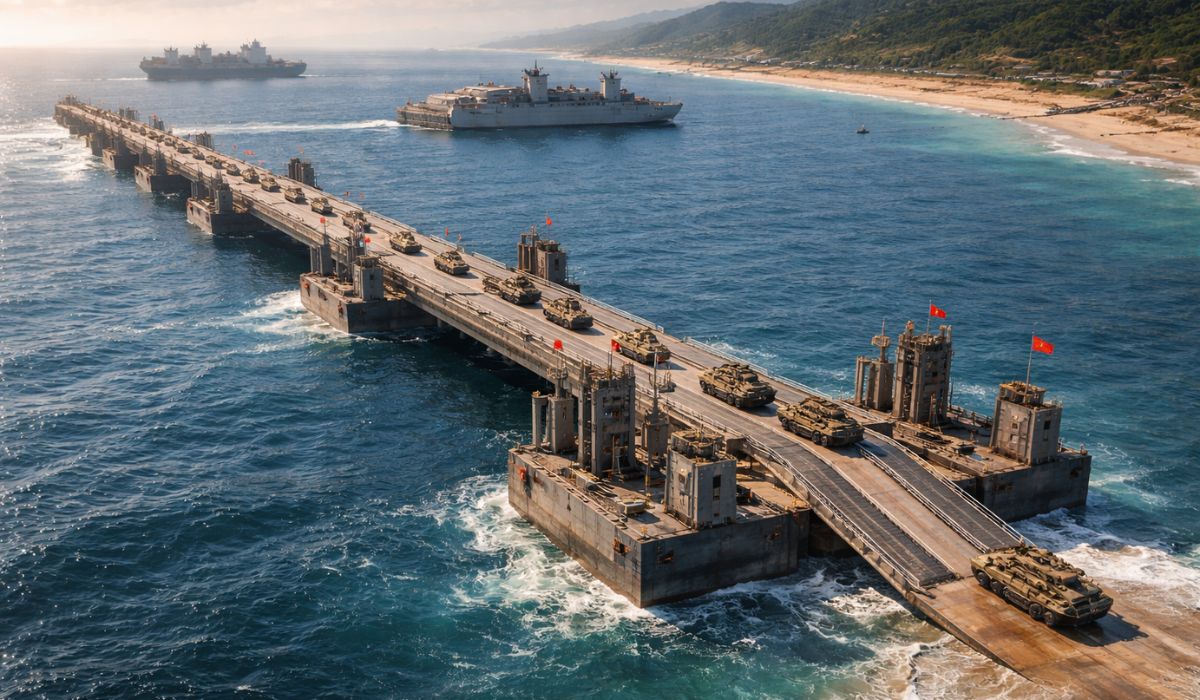
A sequence of modular platforms seen on the Chinese coast rekindled interest in rare naval solutions, combining offshore engineering, coastal logistics, and military use in an uncommon configuration, observed with international attention.
Satellite images and test records in southern China highlighted a modular naval system that allows vessels to connect to form a mobile pier of hundreds of meters.
According to analyses from the U.S. Naval War College and industry observers, the structure was designed to transfer heavy vehicles from ships positioned in deeper waters to the coastal area, without relying on a conventional port.
The official designation of these platforms has not been publicly confirmed.
-
Neither green in the fridge nor overripe forgotten in the fruit bowl: this is the correct way to store bananas.

-
Kitchens are replacing old items with a faster, more economical, and precise electric version for daily preparation.

-
The air fryer entered Brazilian homes so quickly that the government began to measure its impact on energy, and the progress up to 2050 is already outlined.

-
Millions of people have been consuming cocoa for centuries without knowing that this ancestral fruit contains flavanols that scientists link to improved blood flow and measurable effects on attention and memory.

Still, analysts have begun using the name Shuiqiao, a term translated as “water bridge,” to refer to the set observed in 2025.
In studies released so far, the family appears in three main variants, associated with hull length: Shuiqiao-110, Shuiqiao-135, and Shuiqiao-185.
According to these analyses, the three versions can be combined to form a relocatable pier of about 820 meters.
There are also previous records of a smaller unit, treated by experts as a likely prototype.
The attention surrounding these vessels is not only due to their size but also to the technical problem they seek to solve: how to transport armored vehicles, trucks, and other heavy equipment from water to land in locations without available port infrastructure.
How the Chinese modular structure works
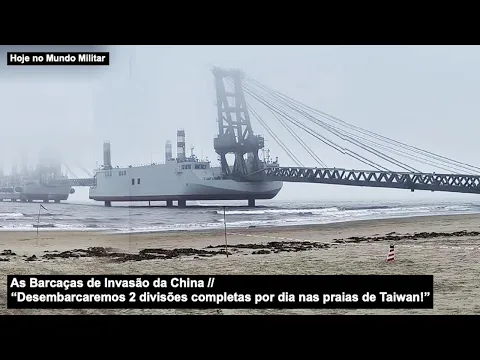
Although they are often described as barges, images analyzed by experts indicate that the design may go beyond that.
The studies mention the presence of elements typical of self-propelled vessels, such as a bridge, exhaust, and sensors, which suggests greater mobility and repositioning capability than observed in merely towed structures.
In practice, this expands the possibilities for employing the system.
Instead of functioning as a nearly fixed temporary installation, the structure can be reorganized according to the coastal terrain and sea conditions, according to assessments published by naval analysts.
The modularity is one of the most cited points in the technical descriptions already released.

Another central aspect is the stabilization mechanism.
The platforms follow the principle of jack-up units, common in offshore operations.
Upon reaching the desired point, each module lowers long legs to the seabed and raises part of the hull above the wave line, which helps keep the ramps in a more stable position for vehicle passage.
The smaller variant, referred to as Shuiqiao-110 by independent observers, has been described with a reduced draft and without docking points for ferries.
Due to this configuration, experts assess that it would be used closer to the beach, acting as the final link between the larger units and the sandy area.
The longer modules would remain positioned further out, receiving ships and forwarding the cargo onward.
This arrangement creates a kind of continuous corridor over the water.
Roll-on/roll-off type vessels, used to transport vehicles, approach the larger units.
From there, trucks, cars, and armored vehicles proceed via telescopic ramps and connected platforms to the final section of the structure, where disembarkation can be completed.
The relationship with the artificial ports of World War II
The most frequent comparison made by researchers is with the artificial ports Mulberry, set up by the Allies in World War II to support the operation in Normandy after D-Day.
In that context, the logic was similar: to create a temporary alternative for the disembarkation of troops, vehicles, and supplies when there was no deep port available in Allied hands.
The difference, according to recent studies, lies in the combination of this historical logic with modern naval mobility solutions.
Instead of reproducing a fixed temporary port, the system observed in China has been described as a reconfigurable maritime corridor, capable of operating alongside civilian ferries adapted to transport military vehicles.
This integration between civilian and military means frequently appears in analyses on the subject.
In public sources, experts highlight that roll-on/roll-off type ferries play an important role because they allow for the rapid transfer of heavy loads.
Thus, disembarkation does not depend exclusively on amphibious boats or smaller means making repeated trips between the ship and the coast.
Why the naval project draws attention
The international interest surrounding these platforms does not arise solely from their unusual shape.
In Taiwan, part of the coastline presents known limitations for large disembarkations, with rocky sections, urbanized areas, and zones that are not favorable for the direct approach of larger ships.
According to military analysts, a structure that extends the connection between sea and land broadens logistical alternatives in such scenarios.

Still, the studies that describe the system make reservations about its use.
The most recurring assessment is that these platforms seem more suitable for logistical reinforcement and support than for the initial opening of an operation under intense fire.
In this reading, the main differential would be the ability to maintain a flow of vehicles and supplies after some degree of control over the coastal area has been established.
In other words, the relevance of the project lies less in visible armaments and more in the attempt to solve a classic challenge of amphibious warfare.
In operations of this type, the passage between the ship and the beach is often one of the most complex points of the entire logistics.
Therefore, structures like the Shuiqiao have come to be seen as objects of interest also by scholars of naval engineering and expeditionary infrastructure.
What the United States has for portless disembarkation
The comparison with the United States requires caution, as the systems are not identical.
The American Armed Forces have the capability for “over-the-beach” logistics, primarily through JLOTS (Joint Logistics Over-the-Shore), a set of Army and Navy means used to set up temporary transfer structures between ships and land.
This model gained recent visibility during the operation of the humanitarian pier for Gaza in 2024.
Still, JLOTS follows its own logic and does not correspond, in public sources, to the same design as the Chinese platforms observed in 2025.
The more accurate comparison, according to technical analyses, is that both seek to solve the problem of portless disembarkation, but by different means.
In public debates about American capability, ships such as ESD and ESB, employed in expeditionary missions and logistical support, also appear.
They can fulfill relevant functions in this field, but they have not been publicly presented as direct equivalents to self-propelled modules with “jack-up” legs and telescopic ramps that can be assembled in sequence up to the beach.
Moreover, investigations and reports released in the United States pointed out limitations related to readiness, maintenance, training, and integration between forces in operations of this type.
This point helps explain why the comparison between Washington and Beijing has drawn the attention of analysts: it is not just about having means of disembarkation, but about the type of logistical architecture that each country prioritizes.

Naval engineering, coastal logistics, and scientific interest
From the engineering perspective, these vessels bring together quite specific practical problems in a single solution: depth of the sea, tidal variation, stability, draft, structural resistance, and continuous flow of heavy vehicles.
This set of factors helps explain why the structure has sparked interest beyond military news.
Also for this reason, the discussion around the topic is not limited to the strategic field.
The case draws attention for showing how seemingly old challenges continue to demand new answers.
Transporting an armored vehicle from a ship in deep waters to the sand remains, at the same time, a question of naval design, temporary infrastructure, and logistical organization.
Throughout 2025, tests and images analyzed by experts reinforced the perception that China has been experimenting with different combinations of civilian ferries, cargo ships, and temporary disembarkation structures.
In public sources, this has been treated as part of a broader effort to expand logistical options without relying exclusively on traditional ports.





Seja o primeiro a reagir!