





 English
  Francês
  Alemão
  Italiano
  Japonês
  Norueguês
  Portuguese
  Spanish
  5 min of reading
  0 comments


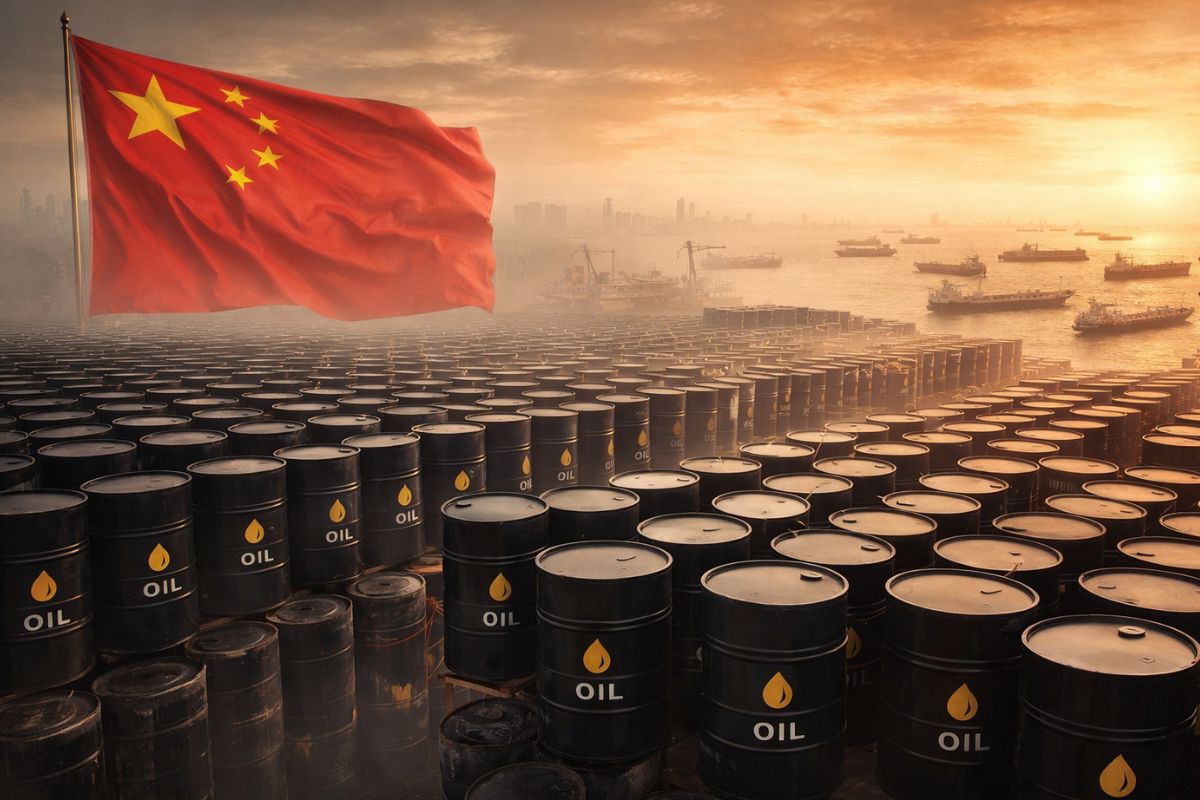
While the blockade of the Strait of Hormuz causes energy panic in the West, China turns to strategic oil reserves estimated between 900 million and 1.4 billion barrels, a solar and wind energy capacity that reached 1,200 GW ahead of schedule, and land pipelines that bypass vulnerable maritime routes.
China observes the global energy chaos with an almost insulting indifference. While the blockade of the Strait of Hormuz catapults the price of Brent oil well above $100 a barrel and Asian countries cut work hours and desperately intervene in diesel prices, Beijing remains protected. The Asian giant was not saved by providence, but by methodical planning that lasted over a decade. China spent years building what analysts call an invisible wall against the volatility of fossil fuels, combining massive strategic oil reserves with an unprecedented deployment of renewable energy.
China’s Strategic Oil Reserves are estimated between 900 million and 1.4 billion barrels, a volume sufficient to meet between 96 and 140 days of domestic demand without importing a single drop. In July 2024, China reached its goal of 1,200 GW of wind and solar capacity, six years ahead of schedule. And new energy vehicles already accounted for more than 60% of car sales in the country by the end of 2025. The result is that China has built, layer by layer, an energy shield that no Western country has been able to replicate.
The energy rice barn: how Xi Jinping turned self-sufficiency into a state obsession

The seeds of this resistance date back to 2021. During a visit to an oil field, President Xi Jinping declared that China should keep its “energy rice barn” firmly in its own hands.
-
Unemployment rises again to 5.8% at the beginning of 2026, raising alarms about the end of temporary positions and its impact on the Brazilian job market.

-
Document organization can cut invisible costs in small businesses, a simple step that prevents waste, rework, and losses in daily operations.

-
Chinese giant worth nearly R$ 4 billion that manufactures cables for electric cars, solar energy, and robotics wants to open a factory in SC.
-
Many employers do not know, but the law guarantees domestic workers a 25% increase in salary during trips, 50% for overtime, 20% for night shifts, and 17 additional benefits that can lead to labor lawsuits if not paid.


Applying this traditional metaphor, historically used to appeal to food sovereignty, to the energy sector made a state obsession clear: China would tirelessly prepare for the worst possible scenario. Dependence on foreign oil and gas was seen as the country’s greatest military and economic vulnerability.
This vision is a direct result of the “Made in China 2025” strategy, conceived a decade ago. The Chinese government understood that mass electrification was not an environmental whim, but a matter of national survival.
Today, China generates more than a quarter of its electricity from solar and wind energy, rewriting the global energy order and dividing the field between the old “petrostates” and the new “electrostates.” At the same time, Beijing has not neglected fossil fuels: the Chinese model prioritizes raw resilience over the efficiency of Western markets.
$10 billion in sanctioned oil: how China filled its strategic reserves

While global markets debated a supposed oil oversupply, China took advantage of low prices to spend $10 billion on heavily sanctioned oil from Russia, Venezuela, and Iran.
It was crude oil that China did not need immediately, but stockpiled as a strategic reserve for times of crisis. The result of this quiet accumulation is that the country now has Strategic Oil Reserves estimated between 900 million and 1.4 billion barrels.
This volume is sufficient to meet between 96 and 140 days of domestic demand in China without a single drop of imported oil needing to enter the country.
For comparison, the United States Strategic Petroleum Reserve has about 400 million barrels, covering approximately 40 days of net imports. The difference in scale between the two reserves illustrates the magnitude of Chinese planning and the comparative fragility of the West in the face of a crisis like the blockade of the Strait of Hormuz.
The shield in action: the measures China activated since the beginning of the conflict
Since the beginning of the conflict in the Gulf, China has deployed an arsenal of almost immediate containment measures. The first order from the National Development and Reform Commission was to require state refining giants, PetroChina, Sinopec, and CNOOC, to suspend gasoline and diesel exports to protect the domestic market.
At the same time, China keeps the flow of Iranian oil active through a fleet of old tankers, without tracking systems, that operate outside the U.S. financial system. Iran exports an average of 2.1 million barrels per day using this so-called “parallel fleet.”
To completely bypass the vulnerable Strait of Hormuz, China is also maximizing the use of land pipelines that connect it directly to Russia and Kazakhstan. But China’s most impenetrable shield does not involve oil: it is renewable energy.
The price of solar panels and electric cars does not rise when there is a war in the Persian Gulf. With 1,200 GW of wind and solar capacity already installed and electric vehicles dominating domestic sales, China has structurally and durably reduced its exposure to oil.
The cracks in the wall: coal, semiconductors, and dependencies that China has not yet resolved
Despite the energy fortress, China’s wall has cracks. In 2024, coal still provided 56% of the country’s primary energy, and over 300 power plants are under construction.
The immense coal supply offers Chinese policymakers a final safety net against disruptions in other energy sources, but the associated pollution is the environmental cost that China accepts to pay in the name of resilience.
The other vulnerability is technological. Although China manufactured 484 billion chips in 2024, it still does not have access to the ultraviolet lithography machines from the European company ASML. Companies like SMIC and Huali Microelectronics are already producing 7-nanometer chips using alternative techniques, but the process is more expensive and less efficient.
China also relies almost entirely on Japan for photoresist liquids essential for chip manufacturing. The Chinese five-year plan has already set a five-year deadline to break this Japanese monopoly.
The decline of petrostates and the rise of China as the world’s first electrostate
The current crisis in the Middle East has exposed a brutal geopolitical irony. While the West relives the terror of the 1973 oil inflation, the real energy war of the 21st century has already been silently won by Beijing.
In 1973, the Arab embargo replaced American V8 engines with economical Japanese cars. Today, the closure of the Strait of Hormuz is doing the same on a global scale: driving electric cars that travel six times the distance of a diesel car for the same price. Only this time the winner is not in Tokyo. It is in China.
The era of petrostates, dependent on vulnerable maritime routes and unstable markets, is coming to an end. China positions itself as the world’s first major “electrostate.”
As The Economist noted, what was seen in the West as the paranoia of a dictator now reveals itself as the pinnacle of prudence. Xi Jinping looked to the future five years ago, and today China’s “energy rice barn” is overflowing. Beijing’s energy shield is not perfectly invulnerable. But it is incomparably more robust than anything the West has built.
What do you think of China’s strategy?





Seja o primeiro a reagir!