





 Portuguese
  English
  Spanish
  5 min of reading
  0 comments


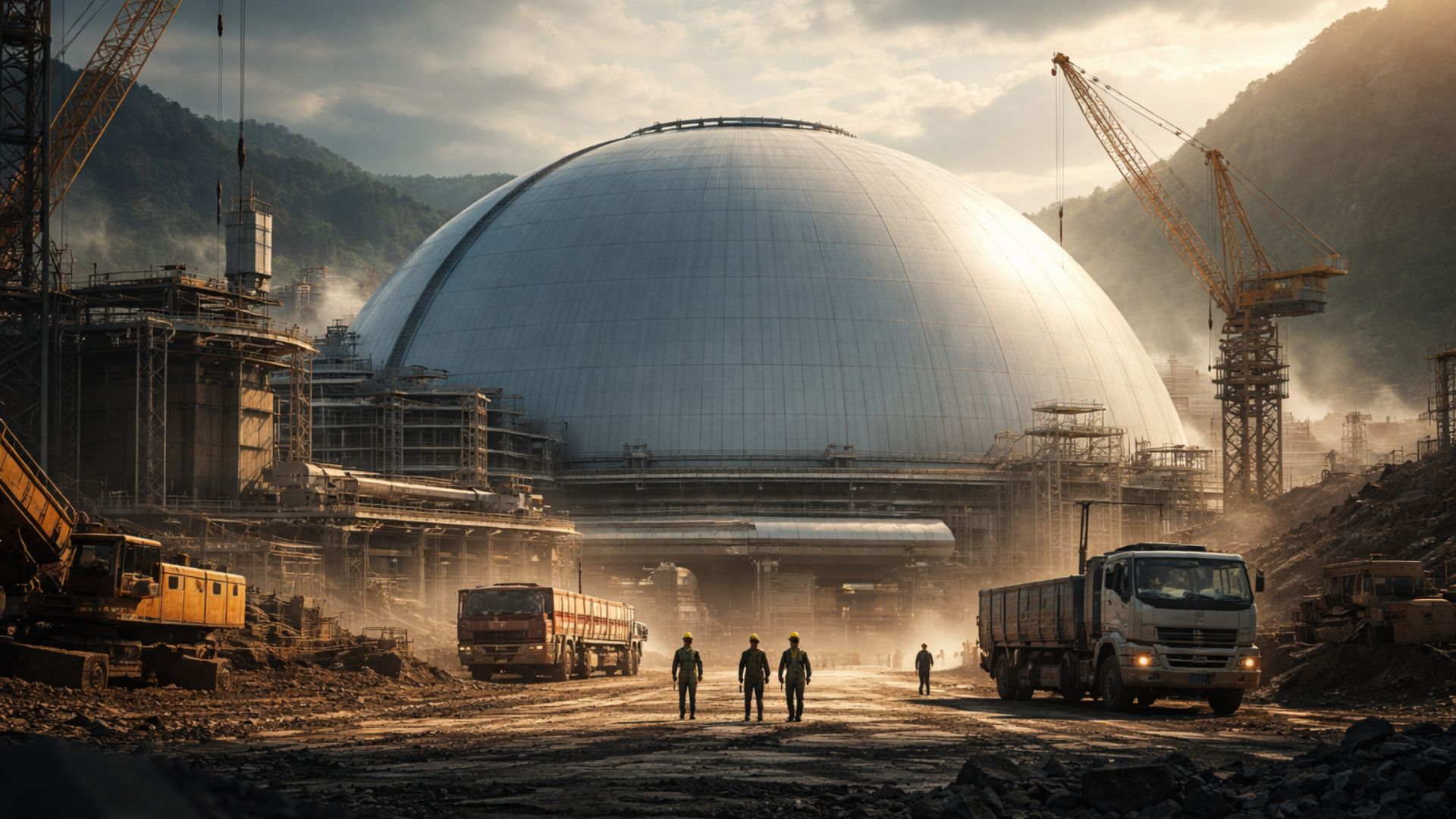
Silent expansion of nuclear bases, demolition of villages, and construction of giant structures reveal a new phase of the Chinese atomic program, with direct impact on global strategic balance and increased tensions among great powers.
An investigation by CNN reveals that China has significantly accelerated the expansion of its infrastructure related to the military nuclear program in Sichuan province, based on satellite images and official documents analyzed by the network.
In this context, the data indicates demolitions of entire villages, construction of new buildings, and modernization of a strategic network directly associated with the production of atomic weapons, reinforcing the assessment that Beijing is expanding its nuclear capacity at an unusual pace.
Nuclear expansion in Sichuan gains unprecedented scale
At the center of these transformations, Zitong County is once again drawing attention for its historical connection to the Chinese nuclear complex, now evidenced by deep structural changes observed over the past few years in the region.
-
Goodbye iron and wrinkled clothes: LG’s smart wardrobe uses TrueSteam vapor, hangers that vibrate up to 180 times per minute, and cycles of 20 to 30 minutes to remove odors and reduce wrinkles without washing.

-
In Venezuela, an area around Lake Maracaibo records the highest concentration of lightning on Earth, with about 250 strikes per km² per year and storms that light up the sky for up to 297 nights, driven by the humidity from the Caribbean and mountains that trap the air.

-
Goodbye slow and expensive internet: new laser-powered wireless technology reaches 360 Gbps and uses half the energy of Wi-Fi!

-
Yale researchers decipher the “magnetic chaos” of 600 million years and prove that changes in the Earth’s poles followed a structured and predictable pattern!


More than three years after reports of expropriations and forced removals of residents, the latest images show a completely altered landscape, where old villages have given way to reinforced facilities interconnected by a new logistical network.
At the same time, renovated roads and expanded land connections suggest integration among different military bases, indicating a broader and more coordinated operational reorganization within the nuclear complex installed in the area.
Giant structure raises suspicions about nuclear production
Among the elements that have drawn the most attention from experts is a large dome erected along the banks of the Tongjiang River, located within the so-called Site 906 and built in a relatively short time frame.
Described as resembling an elongated capsule, the structure occupies an area equivalent to about 13 tennis courts and appears protected by multiple layers of security and structural reinforcement.
Additionally, armored doors, monitoring sensors, and a robust ventilation system make up the set, leading analysts to suggest that the site may have been designed to handle or contain highly radioactive materials.
According to experts consulted by CNN, the construction does not represent an isolated project, but rather part of a broader reconfiguration of the nuclear complex in the region, with the potential to significantly increase production capacity.
According to Jeffrey Lewis from Middlebury College, the facility “is a centerpiece” in this process, while other analysts highlight that the speed and scale of the interventions suggest a relevant structural expansion.
Although the exact function of the dome has not been officially confirmed, the observed construction pattern has raised the level of international attention on the activities taking place in Zitong County.
Demolitions and logistics reinforce military expansion
Another relevant point identified in the investigation is Site 931, whose expansion has encroached on residential areas, including the village of Baitu, where residents were displaced to make way for new military facilities.
Additionally, the neighboring village of Dashan has also been completely demolished, highlighting the direct impact of the expansion on local communities and the territorial advance of strategic bases in the region.
At the same time, a transfer terminal between highway and railway has undergone extensive renovation since 2021, indicating that modernization is affecting not only productive structures but also military support and transportation logistics.
Chinese nuclear arsenal surpasses 600 warheads
As these transformations occur in Sichuan, broader estimates point to the continuous growth of the Chinese nuclear arsenal over the past few years, according to data released by the United States Department of Defense.
According to the report, China had already surpassed the mark of 600 operational nuclear warheads by mid-2024, with projections indicating continued expansion in the next decade.
In this scenario, the expectation is that the country could exceed 1,000 operational warheads by 2030, consolidating a significant advancement compared to previously observed capabilities.
Although it still lags behind the arsenals of the United States and Russia, the growth reduces the gap in terms of strategic capacity and operational complexity of Chinese nuclear forces.
Moreover, U.S. officials state that Beijing has been diversifying vectors and enhancing early warning systems, while experts highlight that the expansion also depends on a renewed industrial and scientific base.
Science City undergoes structural transformation
About 65 kilometers from the main area, the so-called Science City emerges as another essential component of this process, being considered a research hub linked to China’s nuclear program.
Analyzed images indicate that the site has undergone a large-scale structural renovation, with hundreds of buildings demolished to make way for newer and possibly more efficient facilities.
Thus, the volume and scale of the changes reinforce the perception that the ongoing process represents a comprehensive and long-term structural reorganization.
U.S. accuse nuclear tests and China responds
In the diplomatic field, tensions have also intensified following statements made in February 2026 by the U.S. Under Secretary of State for Arms Control, Thomas DiNanno.
At the time, he accused China of conducting low-yield explosive nuclear tests, which could represent a violation of international commitments related to the global testing moratorium.
In response, Chinese officials rejected the accusation and stated that Washington distorts the facts, reiterating that the country maintains a nuclear strategy based on self-defense.
Spokesperson Jiang Bin also emphasized that China follows the policy of not being the first to use nuclear weapons in any scenario.
Still, experts assess that the structural changes observed on the ground fuel concerns, with Renny Babiarz stating that the amount of ongoing transformations is clearly noticeable.
For his part, Decker Eveleth highlighted that the scope of modernization complicates more accurate estimates of China’s future nuclear production capacity.
Global impact and risk of new arms race
On the international stage, the advancement of the Chinese nuclear program increases the risk of a new arms race involving great powers, especially in light of Beijing’s strategic repositioning.
Part of the concern in Washington is linked to the possibility of China consolidating itself as a third nuclear power of equivalent weight, alongside the United States and Russia.
This scenario tends to pressure decisions related to military spending, deterrence policies, and global arms control negotiations.
Additionally, the issue is directly connected to tensions involving Taiwan, considered one of the main points of friction between Beijing and Western countries.
There is also the risk that interpretations based on incomplete data lead to disproportionate responses, increasing strategic instability.
In this sense, Jeffrey Lewis warned that countries may react not necessarily to what China is doing, but to what they believe it is doing, which can intensify perceptions of threat.
This combination of secrecy, structural expansion, and divergent interpretations helps explain why the changes observed in Sichuan have taken center stage in the debate on global nuclear security.





Seja o primeiro a reagir!