





 Portuguese
  English
  Spanish
  6 min of reading
  1 comment


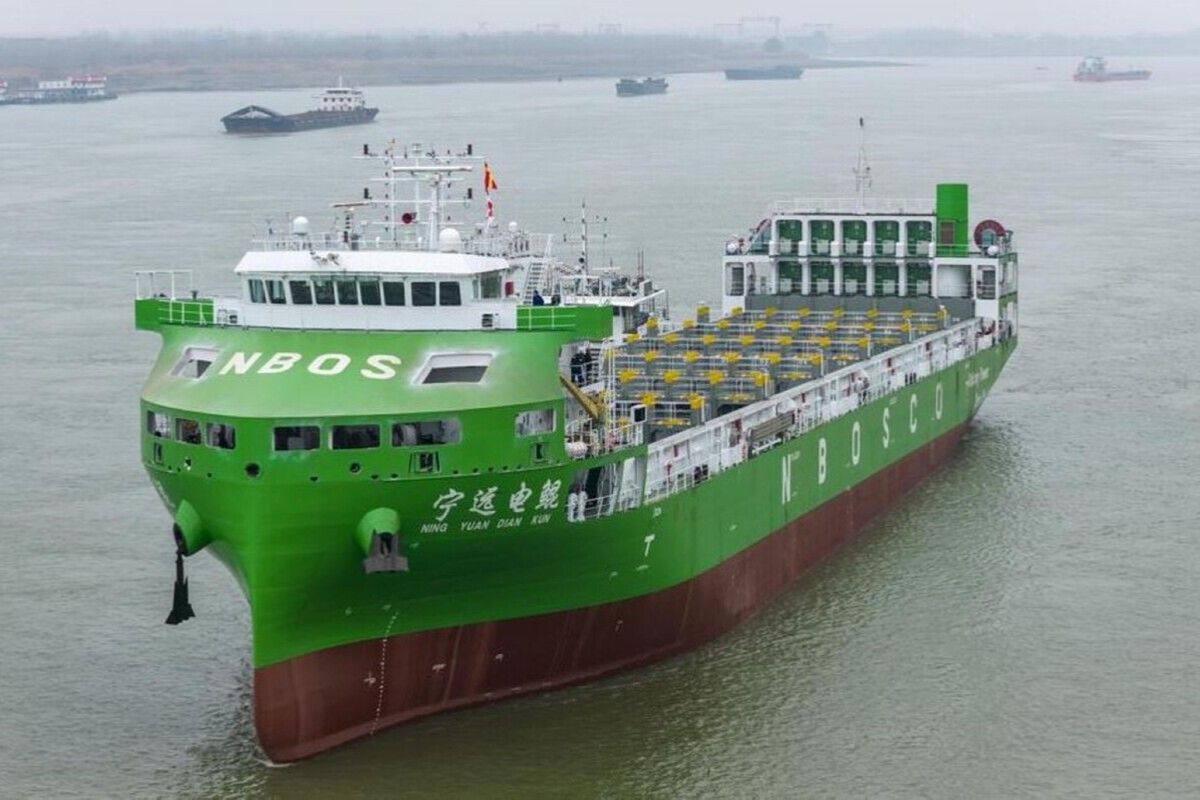


The Ning Yuan Dian Kun Container Ship Is Presented as the Largest 100 Percent Battery Electric Mega Ship Ever Built, with Capacity for Up to 19,000 kWh in Interchangeable Containers and Operation Designed for Zero Emissions on Commercial Coastal Routes and Docking Maneuvers.
In an industry where maritime transport accounts for a significant portion of global trade and is simultaneously on the list of major CO₂ emitters in logistics, China bets on this electric mega ship weighing 10,000 tons to show that it is possible to move containers with exclusively electric propulsion, combining modular batteries, permanent magnet motors, and autonomous navigation systems in a real line ship.
The vessel measures about 127.8 meters in length, 21.6 meters in breadth, and is designed to carry approximately 740 standard 20-foot containers, placing it in a relevant size range within coastal shipping and feeder routes. While completing sea trials in the Shanghai area, the Ning Yuan Dian Kun is viewed as a technological showcase that could redefine what is expected from an electric mega ship in commercial operation, far beyond demonstration prototypes.
Why the Electric Mega Ship from China Is a Milestone in Maritime Transport
Sea transport moves the majority of global cargo but traditionally relies on heavy fossil fuels, resulting in significant CO₂ emissions and local pollutants.
-
How the terraforming of Mars can transform the planet: artificial aerosols can increase the temperature by up to 35°C in 15 years, creating conditions for liquid water.

-
Scientists drilled nearly 8,000 meters into the ocean floor above the fault that caused the 2011 tsunami in Japan and discovered that a layer of clay 130 million years old was responsible for making the wave much worse than any model had predicted.
-
Thousands of years after causing the largest eruption of the Holocene, one of the world’s largest supervolcanoes is rebuilding itself beneath the sea south of Japan, receiving new magma and alarming scientists with its transformation.

-
China has activated a magnet 700,000 times more powerful than the Earth’s magnetic field that operates for over 200 consecutive hours while consuming little energy, and now the world wants to know what Beijing plans to do with this technology in 2026.

By launching a 10,000-ton electric mega ship, China breaks the perception that fully battery-powered vessels are limited to small ships or very short routes.
The Ning Yuan Dian Kun was conceived from the start as an electric container ship designed to operate on real coastal routes, with a maximum speed close to 11.5 knots and dimensions compatible with the feeder routes of a large port hub.
It is not an isolated experiment, but a ship designed to enter service, transport real cargo, and demonstrate that electrification can move beyond the realm of proof of concept.
While meeting the demand for new green technologies, the project signals that the energy transition in the maritime sector can encompass a broader spectrum of solutions, where electric motors powered by large battery banks coexist with alternative developments.
Batteries in Interchangeable Containers and High-Voltage Charging
The central differentiator of the Ning Yuan Dian Kun lies in how the electric mega ship stores and replenishes energy. Instead of fuel tanks, the vessel uses ten batteries installed within modular containers, totaling up to 19,000 kWh of capacity.
These modules power two permanent magnet electric motors, each rated at 875 kW, responsible for primary propulsion.
These batteries can be recharged in two complementary ways. When the ship is docked, the containers can be connected to a high-voltage charging infrastructure in the port, receiving energy directly from the grid.
In situations where downtime is more critical, the same containers can be replaced with already charged modules, allowing the electric mega ship to “refuel” by swapping batteries instead of waiting long hours for a full recharge.
The logic is similar to the concept that the country has been applying to trucks with swappable batteries. By transporting this idea to the sea, the project aims to reduce the main drawback of large battery banks, which is recharge time, without compromising the regularity of commercial routes.
Zero Emissions at the Port and Support from Solar Panels
One of the stated goals of the Ning Yuan Dian Kun is to operate with zero emissions during navigation and port operations, reducing air pollution and noise in urban areas near terminals.
Since there are no combustion engines for propulsion, typical exhaust emissions from heavy oil-powered ships are also eliminated.
In addition to the large battery bank, the electric mega ship incorporates photovoltaic panels on board that provide additional power during operation.
These panels do not replace the primary role of the energy containers, but help to meet some auxiliary system demands and reinforce the proposal for a vessel aligned with green technologies on different layers.
For port cities that deal with soot, gases, and noise from ships, the arrival of a vessel capable of maneuvering, docking, and loading or unloading without burning fossil fuel represents an important shift in the relationship between the port and the urban environment.
An electric mega ship that operates relatively silently and without visible smoke can become a concrete argument in favor of electrification in local environmental negotiations.
Autonomous Navigation and Digital Control Onboard
The Ning Yuan Dian Kun stands out not only as an electric mega ship but also as an intelligent vessel.
The vessel integrates a digital control platform that offers autonomous navigation functions in open waters, with real-time environmental monitoring and route decision support.
The onboard systems include visual perception in different weather conditions, the ability to automatically plan routes, and collision prevention mechanisms.
During sea trials off the coast of Shanghai, the team evaluates not only the electrical performance and hull behavior but also the reliability of these automation modules in practice.
The combination of electric propulsion and autonomous functions suggests a trend in which the intelligent use of energy also depends on algorithms.
By adjusting routes, speeds, and maneuvers based on real-time data, the electric mega ship can optimize battery consumption and simultaneously increase safety.
Coastal Routes, Ningbo-Zhoushan Port, and Green Technology Demonstration
Upon completing the testing phase, the Ning Yuan Dian Kun is expected to operate for Ningbo Ocean Shipping on feeder routes connected to Ningbo-Zhoushan Port, one of the largest maritime hubs on the planet.
In this role, the electric mega ship will make regional connections, transporting containers between coastal terminals and the main large port.
The project is part of China’s national list of green technology demonstrations, indicating the intention to make it an example for future emission-free coastal shipping vessels.
If the scheme of interchangeable batteries and fully electric propulsion proves to be efficient and reliable, it could inspire the creation of other similar ships, adapted to different cargo capacities and coastal routes.
By focusing on feeder routes, the proposal aims to balance technological ambition and operational feasibility.
Regional routes allow the electric mega ship to scale for distances where 19,000 kWh of batteries are sufficient while exposing the vessel to real port, weather, and logistical challenges.
What the Electric Mega Ship Signals for the Future of the Global Fleet
Even being just one unit, the Ning Yuan Dian Kun points to several possible pathways for the decarbonization of maritime transport.
It demonstrates that a 10,000-ton container ship can navigate with fully electric propulsion on planned coastal routes, using swappable battery containers as a solution to reduce downtime.
It also indicates that electrification can go hand-in-hand with layers of automation, in a package that combines electric mega ship with autonomous navigation systems, advanced digital control, and continuous monitoring.
This set is likely to influence investment decisions by other shipowners and ports seeking to reduce emissions while maintaining operational competitiveness.
If ships of this kind multiply along different coastlines, the immediate impact could be felt in ports, with less smoke, less noise, and reduced direct dependence on fossil fuels for regional connections.
From this basis, the discussion about how to electrify longer routes and larger vessels gains a practical example to support studies and new technological bets.
Thinking about the future of maritime transport, do you see the electric mega ship with swappable battery containers as a model that is likely to spread along the world’s coastal routes, or do you believe that alternative fuels, such as synthetic derivatives and new forms of hydrogen, will still have more space in the global fleet?








Eu acredito, se é possível fazer um protótipo, isso prova que é possível fazer mais.