





 Portuguese
  English
  Spanish
  4 min of reading
  16 comments


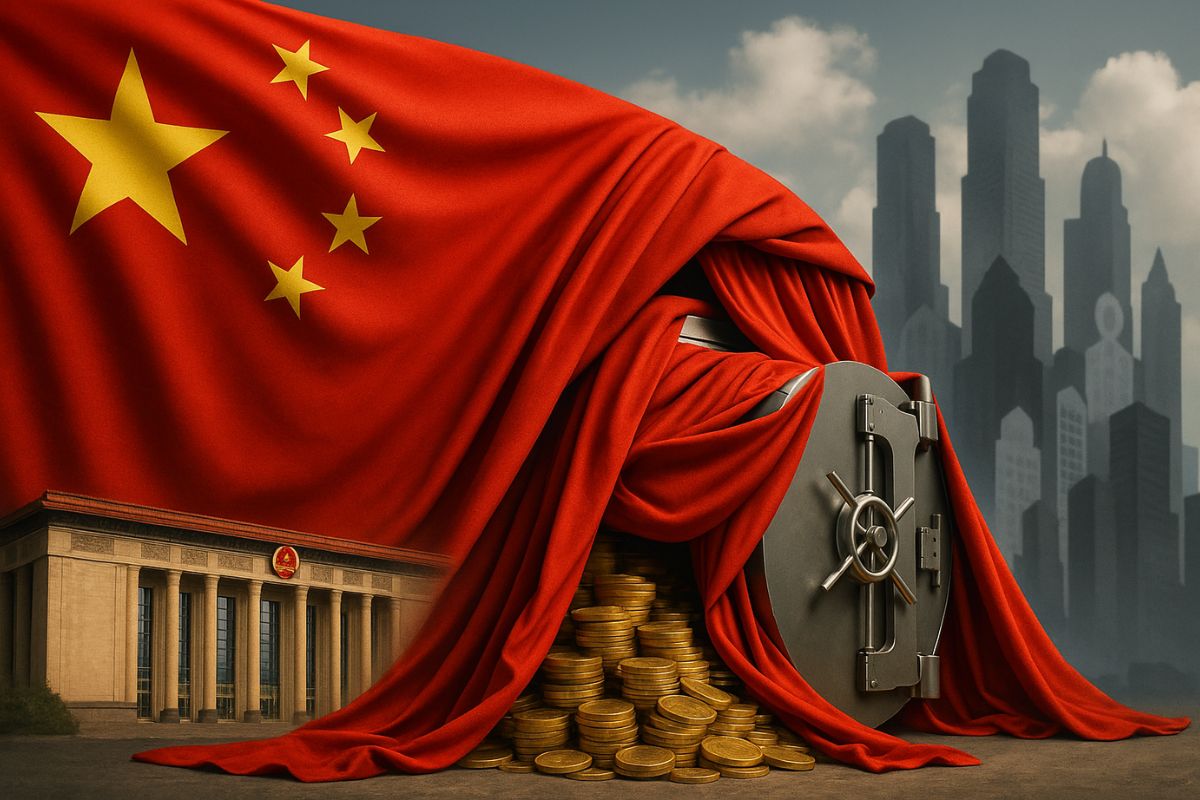


China Maintains Official Debt Indicators Well Below Reality, Using Shell Companies, Over-Indebted State-Owned Enterprises, and Inflated Accounting to Sustain the Growth Model of the Chinese Communist Party, According to Specialist Ismar Becker.
China discloses a public debt of around 84% of GDP, a figure that, at first glance, seems more comfortable than the 123% of the United States. The problem is that this Chinese percentage is based on artificial grounds, with hidden debts and an boosted GDP to please the Party. When off-budget liabilities are added, the picture radically changes and reveals a level of indebtedness much closer to highly leveraged economies.
According to specialist Ismar Becker, at the same time, the country created a system of permanent expansion through state credit, infrastructure, and construction that needs to show results with each five-year plan. When politics demands growth and the real number doesn’t come, the makeup enters. This is how the trillion-dollar hole of the CCC’s economic model is formed, which grows but doesn’t show the full bill.
Why the Official Number Doesn’t Add Up
The central point is simple. If the numerator of the debt/GDP ratio is understated and the denominator is overstated, the final percentage does not represent reality. China does both things at the same time. It hides debts and increases GDP.
-
Larger than entire cities in Brazil: BYD is building a 4.6 km² complex in Bahia with a capacity for 600,000 vehicles per year, but the discovery of 163 workers in conditions analogous to slavery has shaken the entire project.

-
With an investment of R$ 612 million, a capacity to process 1.2 million liters of milk per day, Piracanjuba inaugurates a mega cheese factory that increases national production, reduces dependence on imports, and repositions Brazil on the global dairy map.

-
Brazilian city gains industrial hub for 85 companies that is equivalent to 55 football fields.

-
Peugeot and Citroën factory in Argentina cuts production by half and opens a layoff program for more than 2,000 employees after Brazil drastically reduced purchases of Argentine vehicles.


The result is a nice-looking official indicator, but little credible for those closely following public finances.
The published figure of 84% of GDP does not consider a series of commitments made off the central budget. Local governments, state-owned enterprises, and vehicles created solely to take out loans are excluded from the main statistic.
When these layers are added, the debt/GDP ratio easily surpasses 200% and can reach around 300%, according to the estimates presented. This places China at a very different risk level than the official narrative.
How Local Financing Vehicles Work
In China, only the central government can incur direct debt. To bypass this limitation, provinces and municipalities have started creating shell companies to raise funds in the market and finance infrastructure works.
These are called local government financing vehicles, used as a turbocharged PAC that doesn’t fully appear in national accounts.
These companies borrow by offering land and real estate as collateral, often for projects with low or no return rates. The estimated volume of these liabilities reaches 12.6 trillion dollars, about 76% of China’s GDP.
Since they are not in the central budget, they do not enter the official debt, but the economic risk is the same, because the government is behind them.
State-Owned Enterprises as the Hidden Arm of the Budget
Another channel of indebtedness is the massive Chinese state sector. The country has over 391,000 state-owned enterprises and is also partially involved in more than 1 million companies. Their role is not to maximize profit, but to execute the agenda of building, expanding, and obeying.
In other words, they engage in economic policy disguised as business activity.
When these state-owned enterprises take loans to meet expansion targets, the liability stays on the company’s CNPJ, not on the Treasury’s account. Estimates point to debts exceeding 30 trillion dollars, which is about 60% more than China’s own GDP.
It is a number incompatible with the image of a lean and controlled state that the regime tries to project.
Inflated GDP and Targets Imposed by the Party
The Communist Party works with five-year plans that define how much each region needs to grow. Those who don’t meet the targets lose power, prestige, and, ultimately, can lose their freedom. This environment creates a direct incentive to inflate results, anticipate revenues, and record unfinished works as economic progress.
Independent estimates suggest that China’s GDP may be inflated by between 20% and 60%. This means that the denominator of the debt/GDP ratio is larger than the real economy can sustain.
If the real GDP is lower than what is reported and the real debt is higher than what is reported, the indicator of 84% becomes indefensible. It’s the same logic seen in creative accounting practices in other countries, but on a much larger scale.
The Bill of an Excess-Based Model
When debts of local governments, liabilities of state-owned enterprises, and statistical inflation of GDP are combined, the picture shows a China with indebtedness exceeding 300% of GDP.
This places the country among economies that depend on constant roll-over, permanent growth, and positive narrative to avoid a sharp slowdown. As long as there is cheap credit and works to showcase, the system remains intact.
The question is how long this model can be sustained without a repricing of risk. The manipulation of numbers may delay the problem, but does not eliminate the fact that there are overvalued assets, real estate used as collateral, and low-productivity projects financed by credit. At some point, the real economy needs to validate the accounting numbers.
Historical experience shows that centralized economic models resort to makeup when reality gets far from the plan.
In China, the use of ghost companies, indebted state-owned enterprises, and inflated GDP signals that the point of tension has already arrived. The difference is that the country has the scale, reserves, and political control to extend the game longer than others have managed.
Now the ball is in your court. Given these numbers and the way the regime organizes its accounts, do you believe that China can still push this adjustment for several more years or has the model already entered a phase of silent exhaustion? Comment and tell us which scenario seems more likely to you.








Faltou informar as fontes das informações.
A china até 1996 estava atrás do brasil , na linha do tempo da história da china e da humanidade a china tem aproximadamente ” 5 mil ” anos , diversas etnias, e atrasada , por todo esse tempo. Diversas dinastias até chegar em mão” comunista e atrasada . Paradoxalmente cresceu com modelo de produção capitalista e com ajuda do ocidente . fato. Enaltecer ou desmerecer essa simbiose , e perder o foco na verdade chinesa ; o bom é o capitalismo o ruim é o q não é. Nem confucio, nem Platão , só Adam Smith , a prova incontestável? O bom mesmo entre coisas ruins sobressai . ” A Mão ✋ INVISÍVEL. O ocidente com globalismo , etc….. Woke , etc….. Entenderam filósofos?
Os EUA&Cia piram com a expressão econômica chinesa, torcendo e tentando provocar um colapso semelhante ao da União Soviética. Quem viver verá: Platão ou Confúcio? Façam suas apostas rs
A China também pira em saber que os Estados Unidos é a maior potência econômica do mundo, e eles não vão conseguir alcança -los, ainda mais jogando sujo! O comunismo socialista destrói economias, a China adotou o capitalismo porque é a fórmula que dá certo, mas o comunismo sempre faliu nações, e não vai dar certo porque uma coisa não tem nada a ver com a outra