





 Portuguese
  English
  Spanish
  5 min of reading
  0 comments


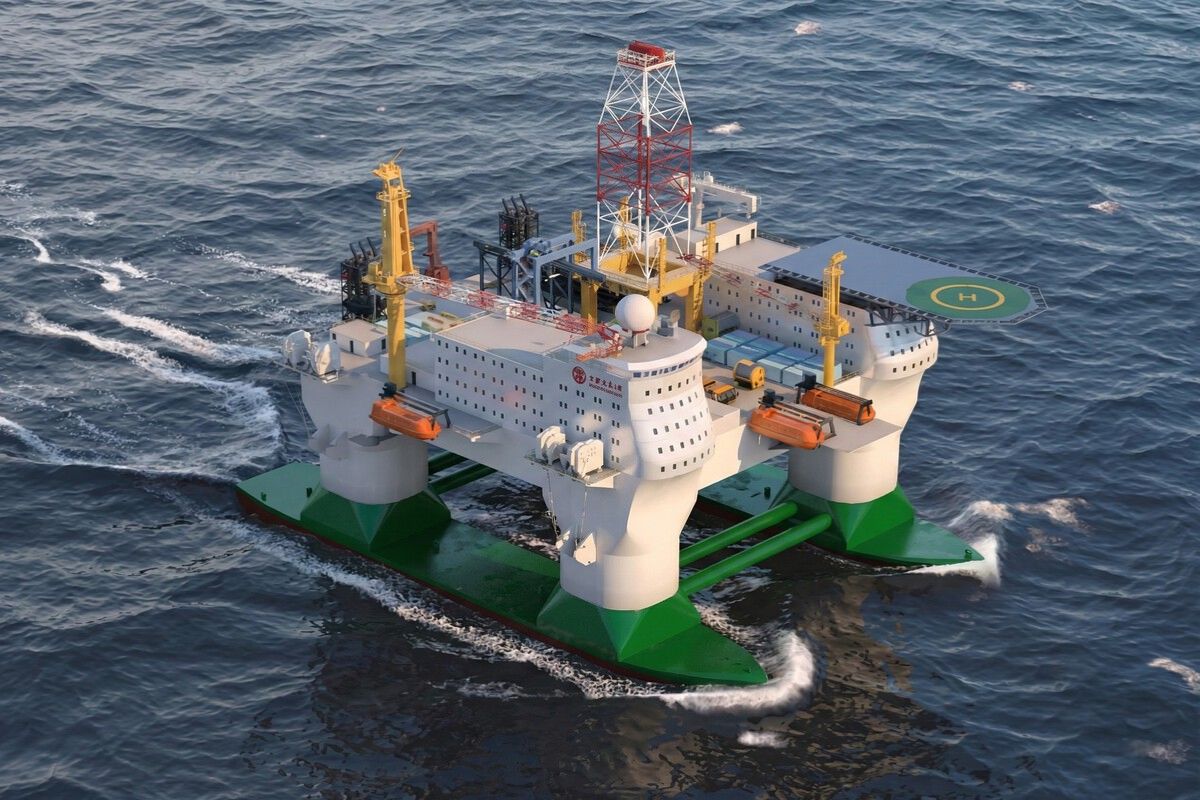
The pilotable floating island is described as a facility “for all climates,” capable of withstanding category 17 typhoons and 9-meter waves, with a double hull and a growing debate on possible dual use.
The pilotable floating island that China is preparing looks like an oil platform at first glance, but the proposal is much broader: to create a semi-submersible mega-structure for deep-sea research, designed to navigate quickly and remain for long periods in the same operational area. According to the project description, the facility can function as a scientific center, testing ground, and even a kind of maritime fortress.
What put this pilotable floating island on the radar was not just its size, but the list of capabilities attributed to the design: shelter for nearly 240 people for months, resistance to extreme sea and wind conditions, and the adoption of a metamaterial in layers, designed to dissipate the shock wave from a nuclear explosion, something that immediately raises discussions about risk and purpose.
What is the pilotable floating island and why has it become a topic
The official proposal describes the structure as a “Floating Research Facility in Deep Waters Prepared for All Climates.” In another definition cited in the material, the name appears as “Resident Floating Research Facility in Deep Waters.”
-
End of the stove: new technology from Xiaomi promises to retire the old stove with a smart pot that prepares up to 16 servings in 24 minutes and has 10 automatic levels controlled by an app.

-
If Ormuz closes, the world freezes: the 1,200 km Saudi Petroline transports oil from the Gulf to the Red Sea, operates near 7 million barrels/day, and becomes a geopolitical weapon in the crisis with the US.
-
Scientists restore seagrass meadows in the open sea.
-
Scientists find about 1 million giant live eggs hatching in an active underwater volcano, discover a natural furnace on the ocean floor, and reveal one of the most unlikely nurseries ever seen in the ocean.

In practical terms, the pilotable floating island would be a mobile base, capable of operating for long periods in open sea, without relying on frequent returns to the mainland.
The project is presented as a response to an operational gap: the need for a research ship or platform that can quickly reach the operational point and stay there for a long time, something that traditional equipment does not always combine efficiently.
Dimensions and design: a semi-submersible the size of a giant ship
The pilotable floating island is described with a double hull of 78,000 tons and dimensions that reinforce the scale of the project: 138 meters long, 85 meters wide, and a main deck 45 meters above the waterline.
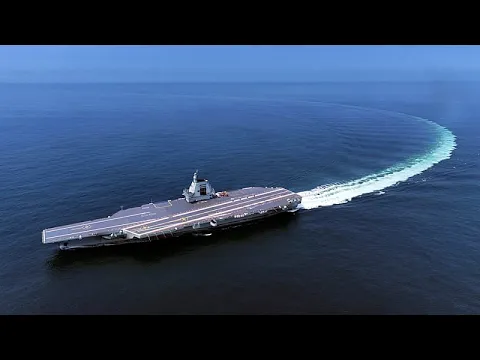
The comparison used in the base itself provides context: the aircraft carrier Fujian is cited with a displacement of 80,000 tons, very close to the number presented for the facility.

The idea resembles an oil well because the design is inspired by these structures, but with adjustments to meet typical research ship missions. The intended result is a hybrid platform, with the capacity for permanence and stability, without sacrificing mobility.
What is it for: deep-sea research, mining, and prospecting
The declared focus of the project is the exploration of deep waters and the advancement of technical activities in still little-known regions. The base mentions that the facility should serve as a testing ground for mining systems, oil and gas prospecting, and research of the still unexplored ocean floor.
In practice, the pilotable floating island would function as a permanent infrastructure at sea for months, allowing scientific and technical teams to conduct measurements, tests, and operations with fewer interruptions and greater predictability, something difficult when logistics depend on short navigation windows.
Life on board for months: autonomy and operation routines
One of the most striking points is the promise of prolonged permanence. The base claims that the pilotable floating island can shelter nearly 240 people for months, supported by backup energy systems and a structure to sustain life on board.
This changes the logic of missions in deep waters, as long and costly displacements cease to be the main bottleneck. Instead of “going back and forth,” the platform seeks to solve the problem with continuous presence, which also increases the capacity to respond quickly to sea conditions, tests, and collection opportunities.
Extreme sea: category 17 typhoons and 9-meter waves
To operate in areas where the hull could be damaged and ocean conditions are aggressive, the pilotable floating island was designed to handle extreme scenarios.
The base cites resistance to 9-meter waves and category 17 typhoons, described as the highest category for this type of cyclone.
This “for all climates” package is part of the technical argument of the project: stability, robustness, and operational continuity, even when the sea is the main enemy of the schedule.
The “detail” of the metamaterial and the claim of blast protection
The most sensitive point of the project is the shielding. Instead of conventional steel, the base describes walls in a “sandwich” shape, with multiple layers intended to dissipate the shock wave from a nuclear explosion.
The construction would use a metamaterial that, under pressure, compresses and creates a denser structure than very thick steel panels.
The text also mentions that simulations indicated that these walls would withstand more pressure than a submarine.
Here, caution is important: what exists in the base is the description of the concept and reference to simulations, not a real test in an extreme environment. Still, the mere fact that this capability appears in the project changes the political and strategic reading of the structure.
Why the debate about dual use and command center arose
The base claims that, in addition to being a research center, the facility can function as a command center and nuclear bunker, which opens the door to interpretations of dual use, that is, civilian and military.
This point is what “flips the switch” of the debate: a scientific platform with fortress-like characteristics and advanced protection is not seen merely as a floating laboratory.
Therefore, the pilotable floating island enters a gray area: the scientific justification exists, but the design and the attributed capabilities raise concerns about how it could be employed in maritime dispute scenarios.
The ocean floor as a strategic territory
The base also connects the project to a broader scenario, in which the ocean floor becomes an area of growing interest.
The text mentions reports and concerns that civilian research ships could, in theory, collect information of military interest, such as real-time data on water temperature, salinity, and terrain characteristics, in addition to installing sensors.
Within this logic, a pilotable floating island with prolonged permanence and a robust structure could become a fixed piece of presence, research, and monitoring, depending on how it is used.
Next steps and horizon of completion
According to the base, China would begin the final phase of design and construction of the platform, after years of development. Shanghai Jiao Tong University appears responsible for much of the project. A completion forecast for 2030 is also mentioned.
Until then, the discussion is likely to remain on two axes: the scientific value of a resident platform in deep waters and the perceived risk of a structure with fortress attributes and possible applications beyond research.
If a pilotable floating island promises science in deep waters but brings shielding with metamaterial and fortress discourse, do you see more scientific innovation or more signs of dual use?








Seja o primeiro a reagir!