





 Portuguese
  English
  Spanish
  5 min of reading
  2 comments


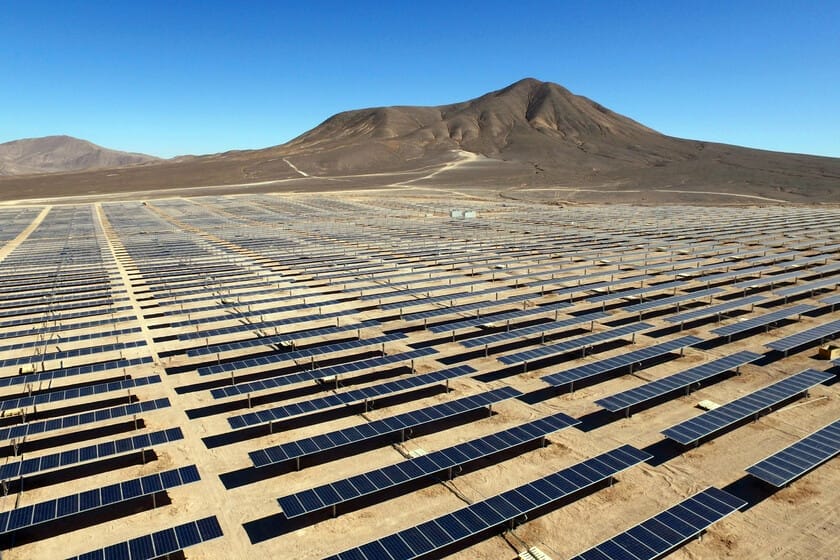

Know The Largest Solar Power Plant In The World In China, Located In Xinjiang. Discover How This Renewable Energy Source Exposes Social And Labor Problems, Including The Repression Of Uighurs.
China has repeatedly demonstrated, over the past two years, two of its major obsessions: megaconstructions and renewable energies, in which it stands out both for its generation capacity and for its weight in the supply chain. In Xinjiang, the country has just shown its strength in both. Just a few days ago, a state-owned company connected what is considered the largest solar farm in the world, a vast installation of 3.5 gigawatts that spans over 13,300 hectares and could supply energy for 2-3 million residents.
However, the farm has a less desirable effect for Beijing: drawing attention to the repression of the Uighur people in Xinjiang, denounced for years by international organizations and its repercussion in the renewable energy sector itself.
An XXL Solar Power Plant. And Not Just Any
What CGDG and the Power Construction Corp of China (PowerChina) have just activated is the largest solar farm on the planet, a facility that came online last week. The plant, with a capacity of 3.5 GW, spans 32,947 acres, equivalent to 13,333 hectares, according to data released by Reuters. To install it, technicians chose the northwest of the country, in the autonomous region of Xinjiang. To be more precise, they settled in a desert area of Urumqi, its capital.
-
Renewable energy advances over protected areas in Brazil, and a survey by the Energy Transition Observatory reveals silent impacts that challenge environmental conservation and pressure sensitive traditional territories.

-
Abandoned house for 15 years disappears in the woods, shocks owner with unrecognizable scenery and is reborn in an intense transformation after almost 90 hours of work in just 10 days.
-
Rio Grande do Sul accelerates energy transition: State invests in renewable technologies and consolidates decarbonization strategies and pathways to attract billions in new industrial investments.

-
In just three hours, a natural stone floor transforms the entrance of the house with an organic effect, immediate drainage, and a sophisticated non-slip finish that doesn’t puddle water, dries quickly, and impresses with the final result.

Energy For A Country
Its managers estimate that the installation will be able to generate about 6,090 million kilowatt-hours (kWh) per year, sufficient to power Papua New Guinea for 12 months, according to Reuters calculations. Other estimates suggest that its capacity could nearly cover the electricity demand of the entire state of Pará with energy.
Its power will further strengthen China’s position in renewable energy generation, which has already seen a significant increase in 2023. Data released in January by the National Energy Administration shows that, in 2023, the installed solar power generation capacity across the country increased by 55.2%.
Expanding The Chinese Footprint
The fact is that China already had two of the largest solar installations in the world: Ningxia Tennggeli, from Longyuan Power Group, and Qinghai Golmud Wutumeiren. Their capacity is around 3 GW. The Asian giant also has some record installations for wind or floating photovoltaic production. In fact, the Xinjiang park is part of an even larger project to install 455 GW of solar and wind energy, which includes megabases in sparsely populated areas, from where energy is sent to urban centers.
What Matters What, How Much… And Where
The new solar farm is located in a desert area of the Xinjiang Uighur Autonomous Region, which stands out on the Chinese map for solar and wind energy. For its weight. And also for the controversy that accompanies it. In the region, significant infrastructure dedicated to renewable energy has been promoted, such as Urumqi Dabancheng, and record infrastructures, but Xinjiang is also in the international spotlight for the repression that, according to various international organizations, Uighurs have suffered there.
A Controversy Affecting The Energy Sector
In 2021, Amnesty International (AI) spoke of “mass incarceration, torture, and systematic persecution” of Muslim minorities in Xinjiang, a campaign organized by the state that constitutes, in its opinion, “crimes against humanity.” The UN itself issued a report in 2022 on Xinjiang warning of “serious human rights violations” against Uighurs and other Muslim communities.
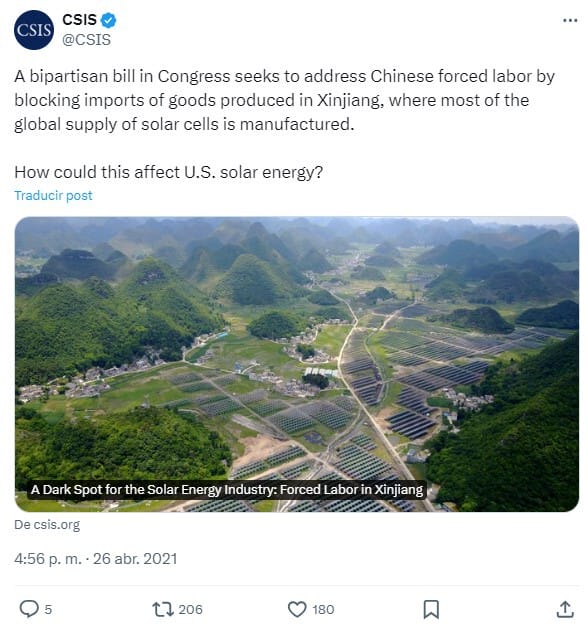
What happened in Xinjiang would directly affect the renewable energy sector. In 2021, William Alan Reinsch and Seán Arrieta-Kenna pointed out in CSIS that much of the solar panel manufacturing depends on components made precisely in Xinjiang, which brings the focus to the conditions offered to workers in that region. Their article was titled “A Dark Spot for The Solar Industry: Forced Labor in Xinjiang.”
The Origin Of Polysilicon
“Residential, commercial, and utility solar panels rely on photovoltaic (PV) cells to capture and convert sunlight into usable energy. Most photovoltaic cells are manufactured with polysilicon components, which are produced through an industrial furnace process that requires extremely high temperatures. Xinjiang, with some of the cheapest energy in China thanks to local coal abundance, has become home to four of the five largest factories in the world.”
After recalling the region’s importance in the sector, Reinsch and Arrieta-Kenna’s article highlights that, between 2010 and 2020, China’s footprint in global polysilicon production grew exponentially, from 26% to 82%, while the US lost ground at the same rate. “According to Jenny Chase of Bloomberg New Energy Finance, ‘It is likely that nearly all silicon-based solar modules (at least 95% of the market) contain some polysilicon from Xinjiang’.”
The Link To Xinjiang
Earlier that same year, The New York Times reported on a study by Horizon Advisory that suggested links between Xinjiang’s growing photovoltaic sector and “a broad state-sponsored labor program in China that includes methods that fit documented patterns of forced labor.” The study cites major companies in the sector and, according to the New York newspaper, presents “evidence” of forced labor, workers displaced with government support from Xinjiang and even the implementation of “military-style” training.
Extensive And Increasing Evidence
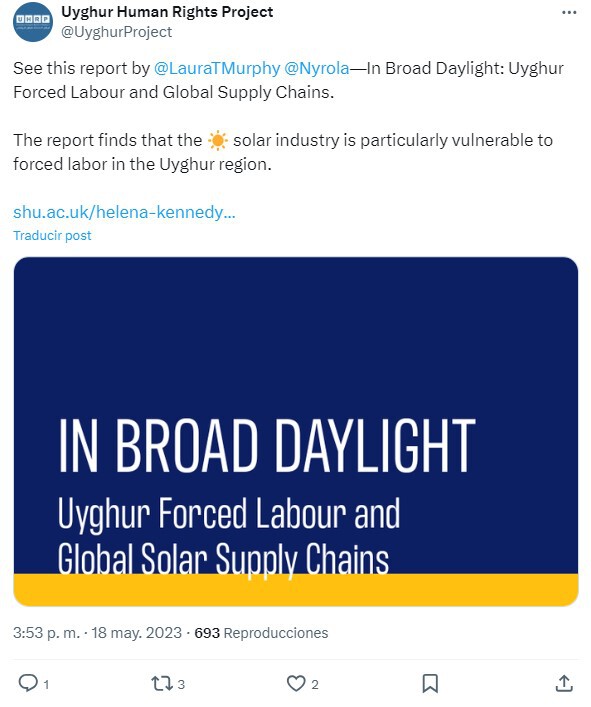
They are not the only ones. Sheffield Hallam University conducted a study that, in its view, “reveals the ways in which forced labor in the Uighur region can permeate an entire supply chain and reach international markets.” In the opinion of its researchers, the solar energy industry is “particularly vulnerable” to being linked to this practice because polysilicon manufacturers in the region account for 45% of the global supply of solar-grade material and raise alarms about employment programs that develop in “an unprecedented coercive environment” and under the “constant threat.”
The Agenda
Concerns about the impact of this type of work continue to loom over China’s renewable energy sector, as recently reported by Semafor and Sourcing Journal, which warned a few months ago that the solar energy or electric vehicle industry is “very exposed” to the risks of forced labor due to the significant weight of Xinjiang in the supply chain because of solar-grade polysilicon and lithium, nickel, and graphite used in lithium-ion batteries for vehicles. Within the sector, there are already voices, such as Skyline International, calling for greater transparency throughout the supply chain.
Image | PowerChina









O Ocidente liderado pelos EUA sempre estão publicar coisas más que acontecem na China, será que a China é a nação mais maldosa do mundo? Nós EUA e na Europa não existe essas más práticas? Boas coisas que são feitas na China eles não divulgam, porque tem medo duma derrota retumbante em termos de inovação tecnológica.
Parabéns a todos os envolvidos , do mais baixo cargo aos engenheiros responsáveis, os chineses juntamente com o brics, é o futuro do mundo moderno , países que procuram construir e desenvolver e não tirar dos–fracos e subdesenvolvidos. Que Deus abençoe essas nações.