





 Portuguese
  English
  Spanish
  4 min of reading
  0 comments


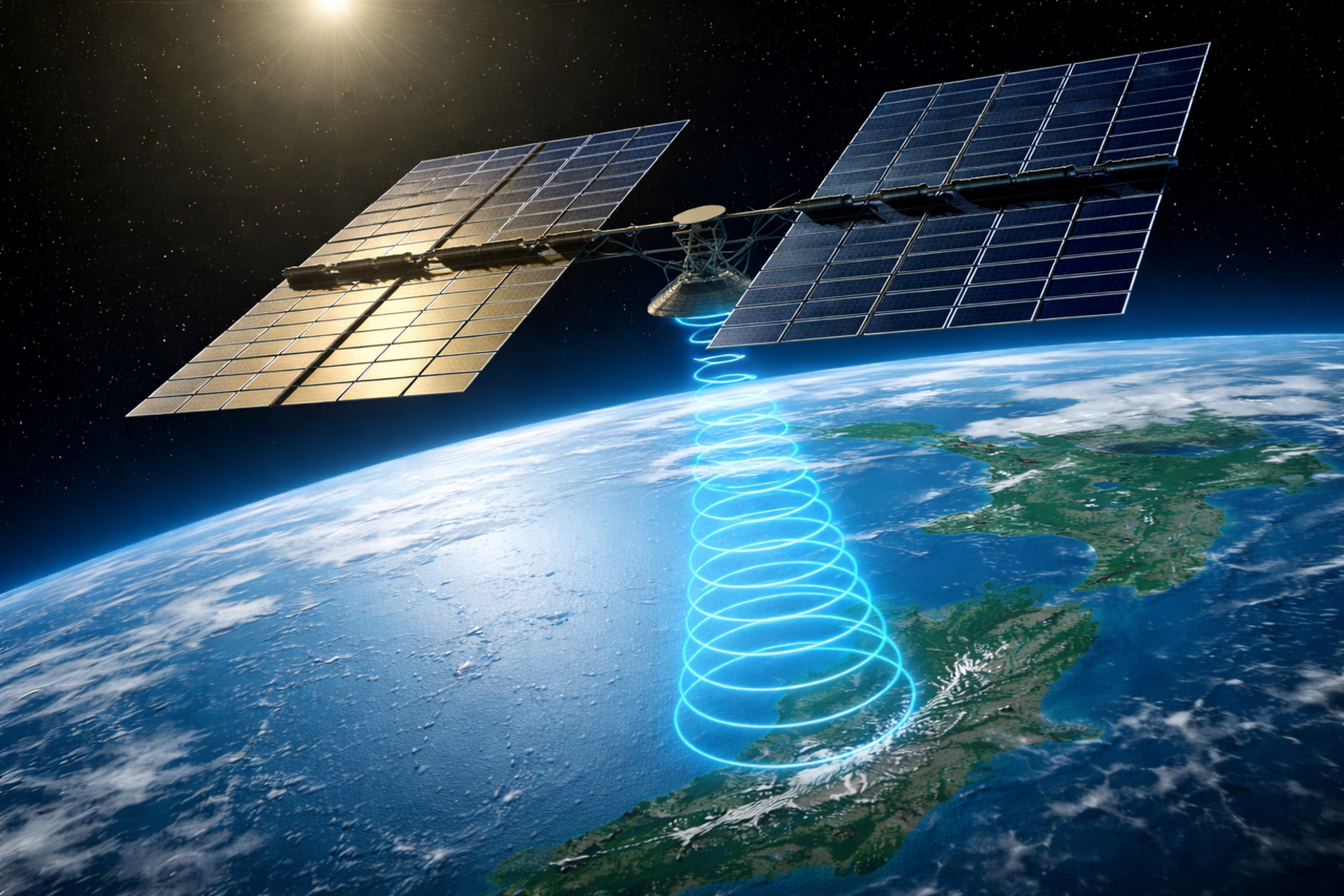
Chinese space solar energy project advances with modular architecture and raises global debate on military use, communications, navigation, and electronic warfare
China has returned to the center of the debate on space solar energy after scientists pointed out that its future orbital power plant could go beyond electricity generation and support communications, navigation, reconnaissance, interference, and remote control, increasing the strategic weight of the project.
Chinese project unites energy and strategic functions
The Chinese plans to build a space solar power plant gained new prominence after the release of a study describing additional applications for the system beyond providing clean energy.
According to Interesting Engineering, the article was authored by Duan Baoyan, a professor at Xidian University and one of the main architects of the Zhuri initiative, also known as “solar pursuit.” The text presents a restructured architecture for the project.
-
Without rain, with reservoirs under pressure, countries are accelerating desalination and placing the sea at the center of water supply, but the advancement of this infrastructure requires a lot of energy and increases the disposal of brine.

-
NASA satellite images show a circular structure 13 km in diameter in Tocantins, with raised edges and a preserved interior: it is the Serra da Cangalha, the best-preserved meteorite impact crater in Brazil, formed 220 million years ago and overlooked by almost all Brazilians.

-
They spent up to 5 hours a day underwater, and their bodies changed because of it: discover how human populations developed impressive biological adaptations to survive in the most extreme environments on Earth.

-
The tallest wind turbine in the world is rising where there was coal: 360 meters in Schipkau, Germany, it ascends with a telescopic system, captures winds above 300 m, and aims to connect to the grid by 2026.
In this version, the system can support multiple functions, such as communication, navigation, reconnaissance, interference, and remote control, in addition to its central function of transmitting energy from space to Earth.
Space solar energy thus appears as a dual-use technology. The same orbital set designed for continuous supply can also be adapted for strategic purposes related to defense.
How microwave transmission works
According to a report by Ling Xin for the South China Morning Post, the system uses extremely narrow and precisely directed microwave beams to deliver energy from orbit to receivers on the ground over long distances.
The system was designed for efficient energy transfer, but the ability to form highly controlled beams could, in theory, target communication systems, interfere with signals, or protect military communications.
The basis of this model is space solar energy, known by the acronym SBSP. The proposal is to collect sunlight in orbit, where incidence is nearly continuous and does not depend on weather or the cycle between day and night.
After collection, the energy is converted into electricity and transmitted wirelessly, usually by microwaves or lasers, to receiving stations installed on Earth.
Researchers claim that systems of this type can generate much more energy per unit area than terrestrial solar farms because orbital panels operate without atmospheric losses and cloud cover.
Modular architecture tries to reduce risks
The OMEGA project, which stands for Orbit M-shaped Exploration and Gigawatt Application, was initially proposed in the 2010s and evolved into a modular architecture with multiple smaller solar collection units.
This distributed design seeks to simplify engineering challenges, improve thermal management, and maintain system operation even when some modules fail.
The proposal indicates that space solar energy, in the Chinese case, does not rely on a single isolated mega-structure, but on several components integrated into a broad and continuous orbital infrastructure.
International dispute accelerates orbital studies
China is not alone in this race. In the United States, NASA has explored the SPS-ALPHA concept, based on large networks of modular units to capture solar energy and send it to Earth.
Researchers at the California Institute of Technology launched the Space Solar Power Demonstrator in 2023.
The project tested deployable structures, advanced photovoltaic cells, and a microwave set for wireless transmission in orbit.
In Europe, the European Space Agency is examining the concept through the SOLARIS initiative, which assesses whether orbital solar plants could provide continuous renewable energy to Earth in the coming decades.
Technical obstacles remain at the center of the debate
Despite the growing global interest, the technology still faces significant technical and economic challenges.
Among them are the construction of structures extending kilometers and the transmission of energy over tens of thousands of kilometers.
Another central obstacle is maintaining precise control of the beam during operation. These factors keep the technology experimental, despite ongoing advances in wireless transmission and orbital manufacturing.
Broader space strategy gains a new piece
The Zhuri system fits into a broader technological strategy of China, which includes concepts like the Nantianmen Project, proposals for a nuclear reactor on the Moon, and the Tianwen-2 mission.
This scenario also includes futuristic ideas, such as an electromagnetic launch platform. In this context, space solar energy emerges as part of a larger orbital network aimed at satellites and other space systems.
With information from Interesting Engineering.







Seja o primeiro a reagir!