





 Portuguese
  English
  Spanish
  3 min of reading
  0 comments


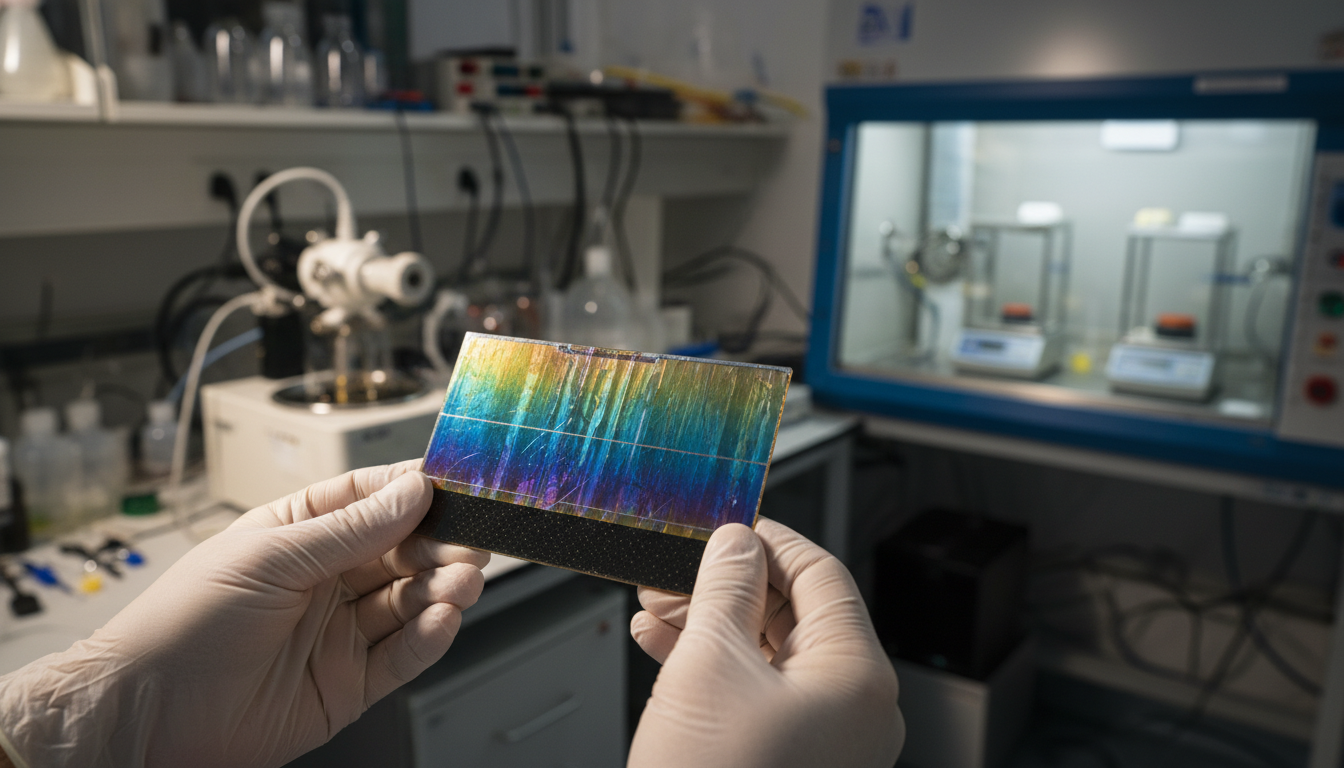
LONGi set a world record for efficiency in perovskite and crystalline silicon tandem cells certified by the NREL laboratory in the United States, while the British company Oxford PV is already selling the first commercial modules in Europe with 421 watts of power per panel and a projected manufacturing cost between $0.29 and $0.42 per watt
The Chinese manufacturer LONGi broke the world efficiency record for perovskite solar cells and crystalline silicon by achieving 34.85% energy conversion, surpassing the theoretical physical limit of pure silicon at 33.7%, known as the Shockley-Queisser limit. The result was certified by the National Renewable Energy Laboratory (NREL) in the United States and announced on April 16, 2025.
Perovskite solar cell surpasses barrier that silicon will never overcome
Traditional silicon solar panels, found on most Brazilian rooftops, operate with efficiency between 22% and 24%. This means that more than three-quarters of the sunlight that hits the panel is wasted.
The perovskite solar cell combined with silicon changes this scenario by stacking two materials that absorb different ranges of the light spectrum. In this way, the energy that one material cannot capture is utilized by the other.
-
Scientists create a “molecular sponge” that transforms dirty water and even water from the Dead Sea into potable water using only sunlight and without consuming any electrical energy.

-
For the first time in over half a century, humans have seen the Moon up close and returned to tell the tale, and the technology that brought them back makes Apollo look like a toy.

-
From 1969 to 1972, only 12 human beings set foot on the Moon, and then the world simply stopped going, until this week when NASA showed that the journey back has finally begun.

-
Prairie chicken robots simulate mating dances and sounds in Wyoming to bring the species back to habitats and prevent breeding at Jackson Hole Airport after a decline from 73 to 3.

Moreover, the theoretical limit of this tandem technology reaches 43%, far above the ceiling of conventional silicon. Therefore, laboratories and manufacturers around the world are heavily investing in the race for commercialization.
Consecutive records show accelerated advancement of perovskite
LONGi has been breaking its own records at an impressive pace. In November 2023, the company recorded 33.9% efficiency. In June 2024, it rose to 34.6%. Now, with 34.85%, it has consolidated its global leadership.
However, the Chinese company is not the only one in the competition. The race for records in tandem cells also involves manufacturers like JinkoSolar, which achieved 33.24% in similar cells.
The development was made possible thanks to a bi-layer interface passivation strategy, combining lithium fluoride (LiF) with ethylenediammonium diiodide (EDAI) molecules. This technique maximizes electron transport and hole blocking at the junction between the two materials.

Oxford PV already sells panels with the new technology in Europe
While LONGi breaks records in the lab, the British company Oxford PV has already turned the perovskite solar cell into a commercial product. The company made its first sale of tandem modules for an industrial-scale project in the United States in September 2024.
The modules are manufactured at the plant in Brandenburg an der Havel, Germany, with a capacity of 100 MW. Each panel contains 72 cells and delivers up to 20% more energy than a conventional silicon module.
As a result, the levelized cost of electricity (LCOE) is lower, even with the higher initial price. The projected manufacturing cost for tandem modules with 25% to 30% efficiency ranges between $0.29 and $0.42 per watt.
Still, Oxford PV has ambitious goals: to achieve 26% commercial efficiency by 2026 and to start mass production at the gigawatt scale in 2027.
Record module reaches 421 watts with tandem technology
In partnership with the Fraunhofer ISE, a leading German research institute in solar energy, Oxford PV developed an industrial-format module with 25% efficiency and a power output of 421 watts in an area of just 1.68 square meters.
For comparison, conventional silicon panels with a similar area deliver between 340 and 370 watts. Therefore, the difference in generation over 20 or 25 years is significant for those seeking savings on their electricity bill.

Durability challenge still concerns experts
Despite the advances in efficiency, perovskite has a Achilles’ heel: sensitivity to moisture, oxygen, and high temperatures. Thus, the degradation of the material can reduce the lifespan of the panels if the encapsulation techniques are not adequate.
Oxford PV is working to ensure modules with a lifespan of 20 years by 2028, but field tests are still ongoing. The longest publicly reported operating time is approximately 1,000 hours — while market guarantees require performance for 25 years.
On the other hand, researchers have already demonstrated that vacuum-manufactured perovskite retains 80% of performance after 1,080 hours at 75°C, indicating that stability is rapidly evolving.
Therefore, although perovskite tandem technology is already a commercial reality, consumers should follow the next few years of testing before considering an immediate switch. The promise is real, but field validation still needs to mature for perovskite panels to become as reliable as silicon panels that have been operating for decades on rooftops around the world.







Seja o primeiro a reagir!