





 Portuguese
  English
  Spanish
  5 min of reading
  0 comments


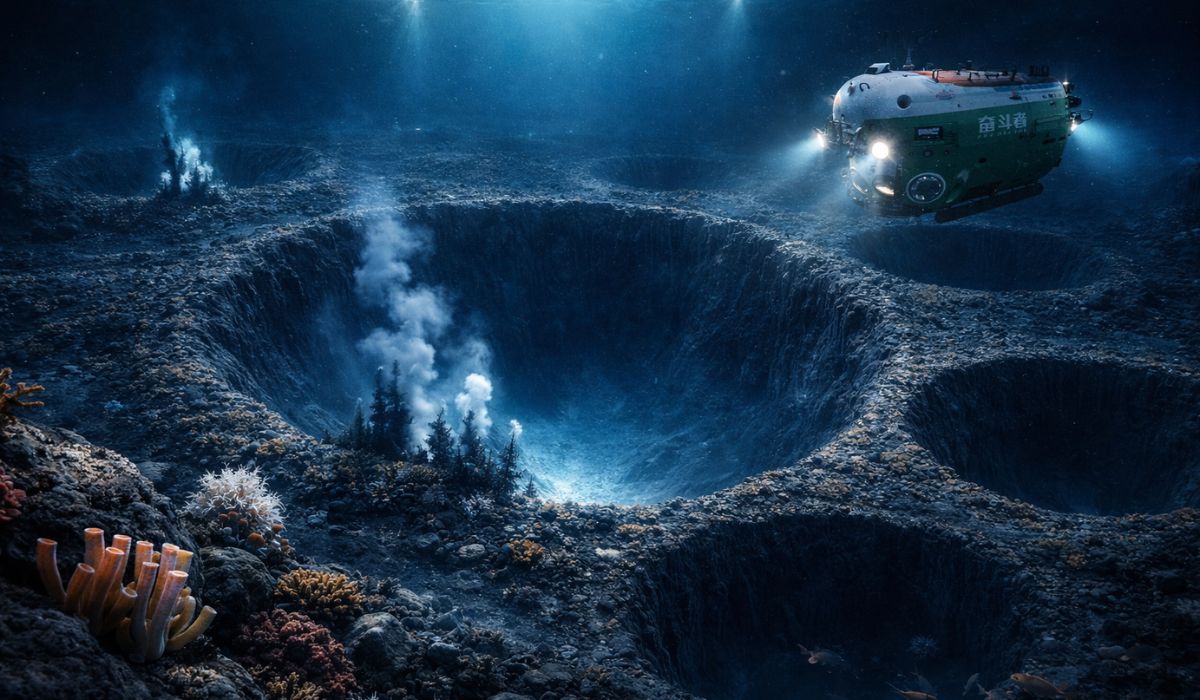
An expedition in the Pacific revealed giant formations on the seabed and rekindled scientific interest in extreme environments, natural hydrogen, and ecosystems that live far from ocean solar light.
Chinese researchers identified in the western Pacific Ocean an unknown hydrothermal system, formed by 20 craters on the seabed and associated with intense hydrogen release.
Named Kunlun, the area is located near the Mussau Trench, northeast of Papua New Guinea, and features large structures, as well as communities of animals adapted to life without sunlight.
The results were published on August 8, 2025 in the journal Science Advances.
-
A mysterious structure has been found beneath an ancient city in Egypt — and the most impressive thing is what technology has revealed hidden for 2,600 years.
-
Astronauts reveal that cities shine so brightly at night that they are visible from space as “artificial constellations,” while highways in the desert appear more than the Great Wall of China, which practically disappears when viewed from orbit.

-
A magnitude 9.2 earthquake in Alaska reshaped the coastline in minutes, sank entire cities, raised sections of the seabed by several meters, and left one of the fastest geographical transformations ever recorded on Earth.
-
The entire Brazil is expected to face above-average rainfall in the next ten days, with accumulations reminiscent of the peak of summer, raising concerns especially for those living in the Southeast, Northeast, and Northern regions of the country.


The largest of the craters is about 1,800 meters wide and 130 meters deep.
Overall, the system occupies 11.1 square kilometers.
According to the authors, the 20 structures are distributed in a clustered area, described in the study as a “swarm of pipes,” a term used to indicate a set of conduits and circular depressions concentrated in the same region.
Hydrothermal system in the Pacific in an uncommon area
The study highlights that Kunlun differs from many already documented hydrothermal systems, which usually occur near mid-ocean ridges and tectonic plate boundaries.
In this case, the field is located within the Caroline Plate, about 80 kilometers west of the Mussau Trench.

According to the researchers, this location contrasts with the more common distribution of hydrothermal systems associated with significant hydrogen generation through serpentinization.
In a statement released by the Chinese Academy of Sciences, researcher Weidong Sun stated that the system stands out for its high hydrogen flow, scale, and geological context.
Serpentinization is a process in which seawater penetrates fractures and chemically reacts with mantle rocks beneath the ocean floor.
This reaction forms minerals from the serpentine group and releases molecular hydrogen.
In previous studies, this type of environment had been investigated for its potential to support life forms based on chemical reactions, rather than sunlight.
Hydrogen flow captivates researchers
Measurements taken at the site indicated high concentrations of hydrogen in the hydrothermal fluids.
According to the article, the values recorded in situ ranged between 5.9 and 6.8 millimoles per kilogram.
Based on this data, the authors estimated a total flow of 4.8 × 10¹¹ moles per year.
According to the calculation presented in the study, this volume would correspond to about 5% to 8% of the estimated global submarine abiotic hydrogen flow.

The work notes, however, that this production is concentrated in a single system, which helps to gauge the geological relevance of the discovery according to the authors themselves.
Another point described in the article is the pattern of fluid discharge.
Instead of occurring mainly through concentrated chimneys, as in certain more well-known hydrothermal fields, the flow in Kunlun appears diffuse and distributed over a large area.
This differentiates it from the so-called black smokers, systems linked to volcanism and marked by much higher temperatures.
In the case of Kunlun, the measured fluids are cooler.
The maximum recorded value was 18.2 °C, above the temperature of the surrounding deep water, but far from the levels observed in classic magmatic hydrothermal systems.
The study also reports the presence of carbonates on a large scale within the pipes, including calcite and dolomite.
Additionally, the researchers described autogenic carbonate rocks exposed on the seabed and fractures through which the fluids escape.
For the team, this set of evidence is compatible with a geological dynamic in which hydrogen accumulates underground and is released in successive episodes of rupture.
Marine life in a lightless environment
During expeditions with the manned submersible Fendouzhe, the team observed shrimp, squat lobsters, sea anemones, small tube worms, and fish in the hydrothermal areas.
According to the article, shrimp from the Alvinocarididae group were seen near the fluid outlets with higher temperatures.
In the neighboring, cooler areas, concentrations of anemones and lobsters appeared.
The study describes these communities as typical of deep-sea ecosystems associated with hydrothermal activity.
As sunlight does not reach these depths, the biological base of the environment does not depend on photosynthesis.
In these locations, energy production occurs through chemosynthesis, a process in which microorganisms use chemical substances as an energy source.
In the case of Kunlun, the authors point out that hydrogen may play an important role in this mechanism.
In a statement from the Chinese Academy of Sciences, Sun stated that the observed species may depend on hydrogen-fed chemosynthesis.
The article itself, however, does not treat this relationship as definitive confirmation for all recorded fauna.
What the data shows, based on field observations, is the simultaneous presence of intense hydrogen emission, alkaline fluids, and organisms characteristic of deep hydrothermal environments.

Discovery expands studies on the seabed
For researchers, Kunlun opens a new front of investigation into hydrogen-rich environments in the deep ocean.
Systems of this type have been studied for their relevance to marine geology and also as references in research on the chemical conditions of ancient Earth.
In this context, the new field expands the set of natural environments available for direct observation.
The study does not claim that the discovery resolves questions about the origin of life, but indicates that it offers a new location to examine processes associated with serpentinization and natural hydrogen production.
The location of the system also has implications for understanding fluid circulation within oceanic plates.
According to the authors, the record of a field of this size far from a mid-ocean ridge suggests that this type of natural hydrogen generation may occur in less expected areas than previously thought.
The team proposes that the field formed in stages.
First, hydrogen would have accumulated below the surface.
Then, this material would have escaped in explosive events, opening large craters.
Subsequently, fractures at the edges and bottom of these structures would have served as routes for hydrogen-rich hydrothermal fluids.
As mineralization progressed, some of these fractures might have been sealed, allowing for new gas accumulation and other rupture episodes.
This interpretation was presented by the authors to explain the morphology observed in the mapping of the ocean floor.
The identification of Kunlun also reinforces the assessment, recurrent in oceanographic studies, that much of the ocean floor remains underexplored.
In this scenario, surveys with manned submersibles and high-resolution mapping systems continue to reveal structures and ecosystems not yet described in the scientific literature.




Seja o primeiro a reagir!