





 Portuguese
  English
  Spanish
  3 min of reading
  0 comments


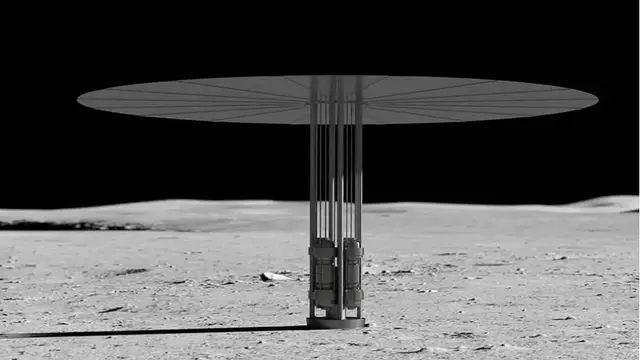
Chinese Scientists Identified Serious Flaws In NASA’s Lunar Nuclear Reactor, Questioning The Safety And Functionality Of Technology Designed To Supply Future Bases On The Moon
Nuclear engineers from China noticed flaws in the design of NASA’s lunar nuclear reactor, known as Fission Surface Power (FSP). According to specialists from the China National Nuclear Corporation (CNNC), specific adjustments could improve the system’s efficiency by 75%, as well as increase its energy production and longevity.
While they acknowledge the importance of NASA’s FSP reactor, Chinese engineers pointed out clear improvements. They claim these modifications could give China an advantage in the race to establish sustainable lunar bases.
NASA’s lunar nuclear reactor (FSP) was initially proposed during the Trump administration. The design envisions a system that operates autonomously on the lunar surface, either from a module or a rover.
-
China is testing a train that will operate at 400 km/h in daily service, which is 80 km/h faster than the French TGV, and uses carbon fiber, magnesium alloys, and more than 4,000 sensors to become the fastest commercial train on the planet.

-
Forget about having an air fryer, electric oven, and steam pot taking up space in your kitchen because a 30-liter smart oven combines all these functions, automatically selects the ideal temperature, and even turns off by itself when cooking is done.

-
Engineers rewrote all the apps from scratch and bet everything on a buttonless screen: now the creator of the iPhone says that Apple needs to make the same revolution again because of AI.

-
Researchers in the U.S. have created a flying robot that transforms into a land vehicle while still in the air. The technology, based on aerodynamic transition, converts landing into a scene worthy of Transformers and redefines mobility between sky and ground.

The original proposal emphasized the reliability of nuclear fission, allowing operation even during long lunar nights, which can last weeks. NASA set a power goal of 40 kilowatts, sufficient to power about 30 terrestrial homes for a decade.
Flaws In NASA’s FSP Design
The lunar nuclear reactor was designed to be compact and utilize cylindrical uranium fuel rods. This format requires high levels of enrichment and thick beryllium shielding to contain neutron flow.
However, one of the main challenges faced by NASA’s design is the reactor’s estimated lifespan of eight years. This is due to nuclear fuel swelling, a natural effect of prolonged exposure to radiation.
Additionally, NASA’s FSP design includes single-path control drums for reactivity adjustments. However, Chinese engineers pointed out that the system lacks double shutdown safeguards, which were recently suggested by their team. “Our goal is to compete with the FSP,” stated Zhao Shouzhi, chief reactor designer at CNNC, and his colleagues.
Advancements In The Chinese Lunar Reactor
Chinese experts revealed that their lunar reactor was inspired by the TOPAZ-II, a reactor developed by the former Soviet Union. According to an article published in the Chinese scientific journal Atomic Energy Science and Technology, the new Chinese reactor can generate 40 kilowatts of electrical power for over a decade.
Unlike NASA’s design, the Chinese model uses ring-shaped fuel rods and yttrium hydride moderators. This approach allows overcoming limitations of traditional designs.
The dual-faced annular fuel rod surrounds pellets of uranium dioxide in stainless steel cladding. This configuration enables simultaneous moderation of neutrons and heat dissipation on both internal and external surfaces.
The research team highlighted that major nuclear companies, including the American Westinghouse, already have the capability to quickly manufacture these rods.
Moreover, the use of yttrium hydride as a moderator ensures stability at extreme temperatures, reducing the risks of hydrogen leakage. This avoids issues that previously affected systems based on zirconium hydride.
Impact Of The Improvements
With these advancements, the Chinese reactor requires only a thin layer of beryllium reflectors to capture scattered neutrons. This improves the system’s energy efficiency.
The dual cooling channels allow NaK-78 liquid metal to circulate both inside and outside the fuel rods. This mechanism keeps the core temperature below 600 degrees Celsius.
The Chinese design also features three safety rods made of boron carbide and eight rotary control drums. These elements provide redundancy in the reactor’s shutdown mechanisms.
Engineers claim the system can sustain chain reactions with only 18.5 kg of uranium-235. This represents a significant saving, considering that NASA’s design requires 70 kg of the same material.
These innovations could accelerate China’s plans for lunar missions. The country seeks to establish sustainable operations on the Moon, ensuring reliable energy supply for future bases.
Meanwhile, NASA is facing budget cuts and staff reductions, impacting the pace of its lunar initiatives, including the Artemis program.
With information from Interesting Engineering.





Seja o primeiro a reagir!