





 Portuguese
  English
  Spanish
  4 min of reading
  0 comments


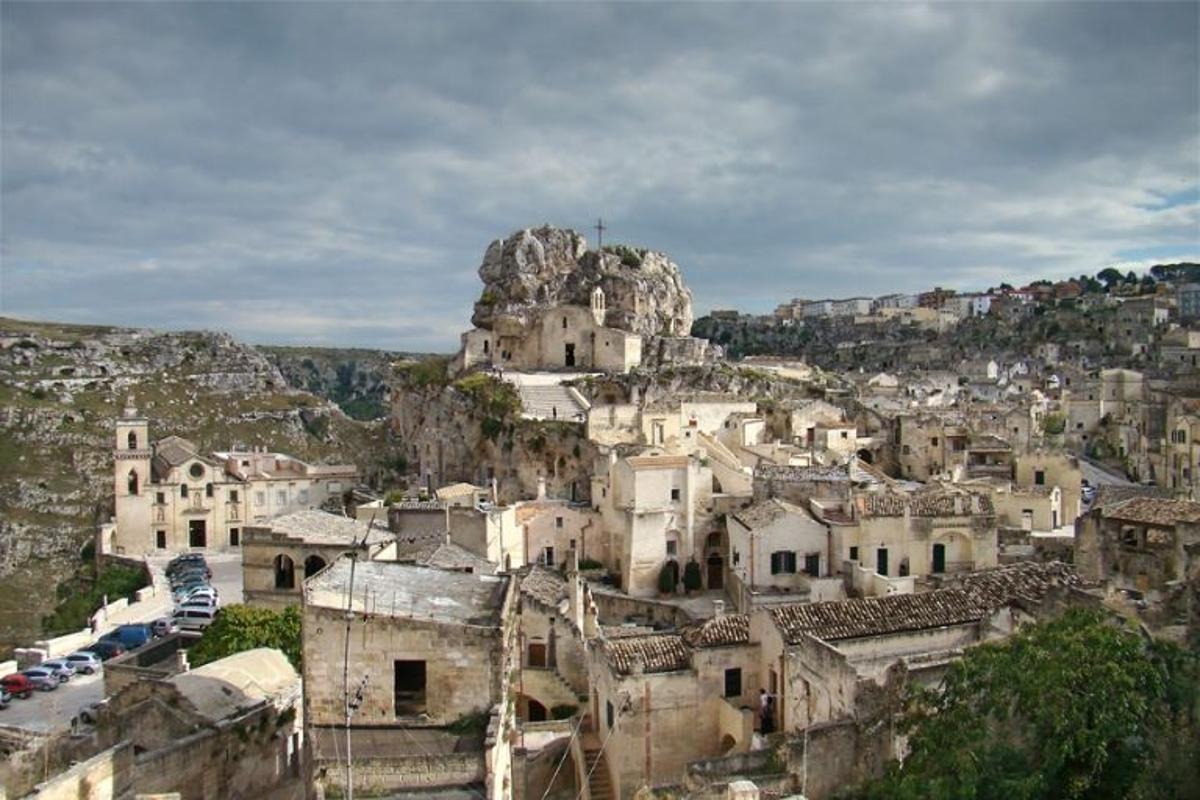
Matera Brings Together Caves Inhabited Since Prehistory, UNESCO Heritage, and An Urban Landscape Formed by Houses Carved into the Rock
A city carved directly into the limestone rocks of southern Italy continues to attract the attention of historians, archaeologists, and tourists from around the world.
Situated in the region of Basilicata, the city of Matera rises above the plateau of Murgia Materana, on the banks of the ravines formed by the Gravina River.
The unique geographical position, close to the border with the region of Puglia and about 60 kilometers from the Adriatic Sea, helped shape a continuous human occupation over millennia.
According to historical and archaeological records cited by UNESCO, the region was inhabited since the Paleolithic, consolidating Matera as one of the oldest continuously inhabited human settlements on the planet.
Over the centuries, especially from the Neolithic onward, human presence became more intense.
Later, around the 8th century BC, urban expansion surpassed ancient defensive walls built during the Roman Era, enlarging the urban core and integrating new areas into the city’s territory.
-
He started running at 66 years old, broke records at 82, and is now a subject of study for having a metabolic age comparable to that of a 20-year-old, in a case that is intriguing scientists and inspiring the world.

-
Oldest tree on the planet reappears after 130 years of searches: Wattieza, 385 million years old, was 10 meters tall and had no leaves or seeds; Gilboa fossils in New York solved the mystery in 2007.

-
A 48-square-meter house assembled in hours with 4,000 bricks made of recycled plastic that does not absorb moisture, has natural thermal insulation, and costs less than 90,000 reais in a complete kit.

-
Luciano Hang revealed that Havan’s air fleet has already accumulated more than 20,000 landings, 10,000 flight hours, and 6 million kilometers traveled, and he says that without the planes, the company would never have grown so quickly.


The Sassi of Matera Reveals One of the Oldest Urban Centers in Humanity
The historical core of the city is known as Sassi di Matera, a term meaning “stones of Matera.”
This architectural ensemble was recognized as UNESCO World Heritage in 1993, due to the cultural and historical importance of the site.
According to the international organization, the ensemble represents a rare example of a living urban ecosystem, capable of recording ways of life dating back to prehistory.
The historic area is mainly divided into three distinct sectors that organize the urban structure of the city.
Among them are Sasso Caveoso, characterized by caves excavated directly into the rocks, and Sasso Barisano, where structures adapted to the caves form entire neighborhoods.
In addition to these areas, there is the Civita, located at the highest point of the city and protected by ancient Roman walls.
Rock-Cut Architecture Creates A Unique Urban Labyrinth
The oldest dwellings were literally excavated into the limestone walls, using a rock called calcarenite, also known as tuff.
This relatively soft material allowed for the opening of shelters and livable spaces directly in the mountain.
Over the centuries, however, the city developed an extremely unique architecture.
In various sections, streets pass over the roofs of excavated houses, creating overlapping urban levels that form an unusual architectural landscape.
In addition, new constructions were built over ancient caves, which created a complex organic urban entanglement integrated into the mountainous landscape.
This construction process shaped one of the most peculiar urban scenarios in Europe.


Social Transformation Marked the 20th Century in Matera
Despite its historical significance, life in the Sassi was considered extremely precarious at the beginning of the 20th century.
Historical accounts indicate that the region faced poverty, lack of basic infrastructure, and inadequate sanitary conditions.
In light of this scenario, the Italian government initiated, during the 1950s, population transfer programs to more developed areas around the city.
These initiatives aimed to improve the living conditions of the local population.
Later, between 1970 and 1980, restoration and cultural preservation projects began to recover the historic caves.
As a result, many of these structures were transformed into restored residences, museums, and cultural spaces.
The transformation into a historical heritage, reinforced by the UNESCO recognition in 1993, boosted tourism and consolidated Matera as an important cultural hub.
Today, hotels, restaurants, and museums welcome visitors interested in experiencing this ancient setting.
Archaeological Excavations Reveal Traces of Various Civilizations
Since the early 20th century, various scientific expeditions have been investigating the archaeological layers of the city.
These surveys revealed structures and artifacts buried at approximately 13 meters deep.
Among the finds are statues and columns from the Byzantine occupation, dated to approximately 400 AD.
Additionally, archaeologists also found Greek and Roman coins, pottery fragments dating back around 3,000 years, and traces of invasions occurring until 800 AD.
These discoveries indicate that Matera was a meeting point for different peoples throughout history.
Among them were Greeks, Romans, Byzantines, Saracens, Aragonese, and Bourbons, who left cultural and architectural marks on the region.

Medieval Cathedral Dominates the Highest Point of the City
At the top of the hill of Civita stands the Catedral de Matera, one of the city’s main historical landmarks.
Initially, construction began in the 13th century.
Moreover, the temple was dedicated to the Virgin Mary of Bruna and to Saint Eustace, the local patron.
Architecturally, the building exhibits a typical Romanesque-Gothic style of southern Italy.
Although the facade is relatively simple, the interior features three naves separated by columns.
Additionally, a stone vault completes the architectural structure.
The interior also displays medieval paintings, sacred sculptures, and historical liturgical objects, preserved in a small museum.
European Cultural Capital and International Cinematic Scene
More recently, in 2019, Matera was chosen as the European Capital of Culture.
Furthermore, that year the city shared the title with Plovdiv, Bulgaria.
At the same time, the rocky landscape of the city gained prominence in international cinema.
For example, the region served as a backdrop for the film “The Passion of the Christ” (2004), directed by Mel Gibson.
According to the film’s producers, the choice was made because the stone constructions resemble the appearance of ancient Jerusalem.
Thus, in light of a history spanning millennia and gathering traces of various civilizations, Matera remains one of the most impressive examples of human adaptation to the natural environment.








Seja o primeiro a reagir!