





 Portuguese
  English
  Spanish
  4 min of reading
  0 comments


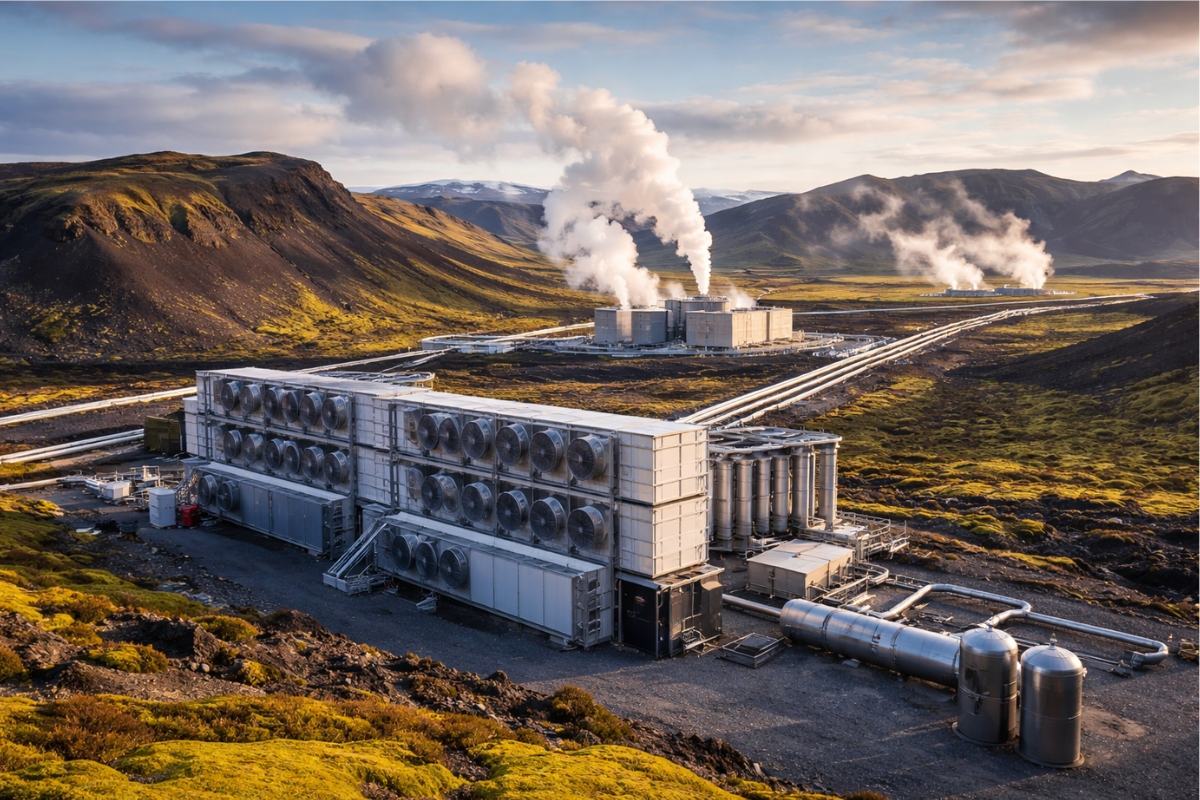
Climate Technology Company Captures CO₂ From The Air In Iceland And Converts It Into Subterranean Rock In Up To 2 Years, Using Basalt And Renewable Energy To Reduce Global Emissions
In the interior of Iceland, a technology is beginning to attract the attention of scientists, governments, and energy companies. The system captures carbon dioxide directly from the atmosphere and transforms it into solid rock underground.
The operation takes place near the Hellisheiði geothermal power plant, where an industrial facility removes CO₂ from the air and injects it into deep volcanic formations. The process permanently locks away carbon and could become a new tool in the global strategy against warming.
The project is still small in scale, but it already demonstrates that removing carbon from the atmosphere and storing it safely can be viable.
-
Scientists have finally discovered where the plastic that disappeared from the oceans went, and the answer is frightening: it fragmented into such tiny particles that they became invisible and now there are 27 million tons of nanoplastic just in the North Atlantic.

-
The Artemis II mission will take the Orion capsule back to the vicinity of the Moon with four astronauts, a private bathroom with a curtain, a system adapted for men and women, and a level of comfort that highlights how the Apollo era operated at the rawest limits of space exploration.
-
Giant structures on the seabed precisely control oil and reveal how high-tech underwater valves work.
-
China has just tested a giant drone the size of a fighter jet with a wingspan of 25 meters that carries 6 tons, flies for 12 hours, and the most frightening part: it can launch entire swarms of smaller drones directly from the air.


Technology Captures Carbon Directly From The Atmosphere
The system begins with large fans that pull in ambient air through special filters.
These filters use chemical materials capable of capturing carbon dioxide molecules present in the atmosphere. When they become saturated, they are heated to release the concentrated gas.
At that moment, CO₂ is treated as raw material for geological storage. The technology is known as direct air carbon capture, one of the most discussed solutions in the current climate debate.

CO₂ Dissolved In Water Goes To Volcanic Rocks
After being captured, carbon dioxide is dissolved in water, creating a carbon-rich solution.
This mixture is then pumped underground hundreds of meters deep. The destination is layers of basalt rock, a volcanic formation abundant in regions like Iceland.
Basalt contains minerals such as calcium, magnesium, and iron. These elements naturally react with the dissolved carbon and initiate a mineral transformation process.
Chemical Reaction Transforms Gas Into Solid Rock
When the carbon-rich solution comes into contact with basalt, a chemical reaction known as mineralization occurs.
Carbon reacts with the minerals present in the rock and forms stable carbonates. These minerals remain locked in the rock’s structure for extremely long periods.
According to data from Carbfix, an Icelandic company that develops underground carbon mineralization technology, about 95% of the injected CO₂ turns into stone in less than 2 years.
In nature, this same process can take thousands or even millions of years.

Orca Plant Captures Thousands Of Tons Per Year
One of the most well-known facilities of the project is called Orca, inaugurated in 2021.
The plant has the capacity to capture about 3,600 tons of CO₂ per year using geothermal energy to power the system.
A new facility called Mammoth, inaugurated in 2024, was designed to reach 36,000 tons annually when fully operational.
Though these numbers are still small compared to global emissions, they represent an important step in the development of the technology.
Iceland Offers Ideal Conditions For Carbon Storage
The country has geological and energy factors that facilitate this type of project.
A large part of the Icelandic territory is composed of basaltic volcanic rocks, ideal for turning carbon into solid minerals.
Furthermore, Iceland has a great availability of geothermal energy, which allows carbon capture to be operated with low additional emissions.
These conditions have made the country one of the world’s leading research centers for permanent carbon storage.
Global Potential May Help Climatic Goals
Experts say that removing carbon from the atmosphere may be necessary to limit global warming.
Human emissions exceed 36 billion tons of CO₂ per year, a volume far above the current capacity of capture technologies.
Even so, basalt formations present enormous potential. This type of rock covers much of the ocean floor and about 5% of the planet’s land areas.
This means that geological storage could offer enough capacity to hold large amounts of carbon in the future.
Experience in Iceland shows that transforming atmospheric pollution into rock is no longer just a scientific hypothesis. The technology is beginning to gain traction on the radar of the global climate strategy and is changing how governments and companies evaluate the fight against global warming.








-

-

3 pessoas reagiram a isso.