





 Portuguese
  English
  Spanish
  4 min of reading
  1 comment


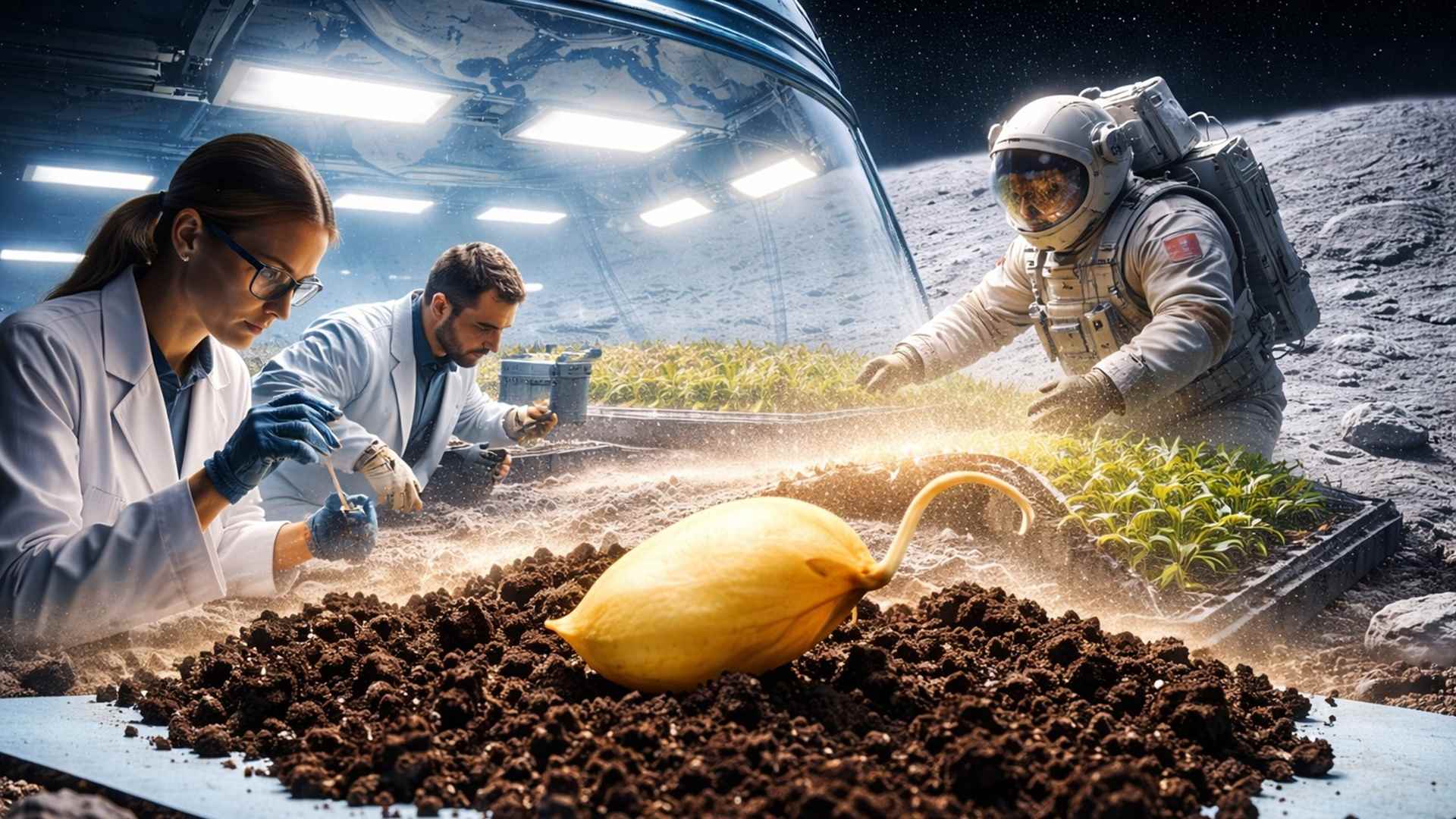


Experiment Conducted by Scientists from the University of Texas at Austin and Texas A&M University Cultivated a Crop in Simulated Lunar Regolith and Showed That Producing Food on the Moon May Be Viable for Artemis Missions Using Soil Mixtures, Vermicompost, and Fungi to Allow Plant Growth
Researchers from the University of Texas at Austin and Texas A&M University cultivated and harvested chickpeas in simulated regolith, marking an advancement in the study of food on the Moon and pointing to possibilities for food sustainability in future space missions.
The experiment was conducted using a lunar soil simulant developed to accurately reproduce the chemical and physical properties of the samples brought back by the Apollo missions. The central goal of the study is to understand whether it will be possible to produce food on the Moon during long-duration human missions.
The research was published on March 5 in the scientific journal Scientific Reports and is part of studies looking for solutions to keep astronauts fed in extraterrestrial environments. The results show that certain regolith mixtures can support plant growth with adequate biological support.
-
The Earth will plunge into a few minutes of darkness in broad daylight in August 2026, when a total solar eclipse transforms the sky into one of the most impressive astronomical phenomena in recent years.

-
How the terraforming of Mars can transform the planet: artificial aerosols can increase the temperature by up to 35°C in 15 years, creating conditions for liquid water.
-
Scientists drilled nearly 8,000 meters into the ocean floor above the fault that caused the 2011 tsunami in Japan and discovered that a layer of clay 130 million years old was responsible for making the wave much worse than any model had predicted.

-
Thousands of years after causing the largest eruption of the Holocene, one of the world’s largest supervolcanoes is rebuilding itself beneath the sea south of Japan, receiving new magma and alarming scientists with its transformation.


Experiment Tests Food Production on the Moon with Chickpeas in Simulated Regolith
The study was conducted by scientists from the University of Texas at Austin and Texas A&M University, who tested the growth of chickpeas in simulated lunar soil within controlled growth chambers. The aim was to evaluate the feasibility of food production on the Moon in hostile environments.
According to Sara Santos, a postdoctoral researcher at the Institute of Geophysics at the University of Texas, the investigation seeks to understand how regolith could be transformed into a medium capable of sustaining plants. The research also analyzes which natural mechanisms could promote this conversion.
The researchers used a lunar simulant produced by Exolith Labs. This material was developed to mimic the physical and chemical characteristics of the soil collected during the Apollo missions, allowing laboratory tests that replicate conditions similar to those found on the Moon.
Challenges of Lunar Regolith for Cultivation and Food Production on the Moon
Lunar dust, known as regolith, represents an extremely hostile environment for plants. It is a coarse material completely devoid of organic matter, an essential element for making Earth’s soils fertile.
Although regolith contains some minerals necessary for plant growth, it also presents heavy metals that can harm plant development. These metals can even contaminate the harvest if absorbed during cultivation.
To overcome this challenge, scientists mixed the simulated regolith with nutrient-rich vermicompost. This compound is produced by California red worms that recycle organic waste, including food scraps and cotton fabrics from space missions.
This mixture created a more suitable growing medium for the plants, providing essential nutrients and improving soil structure. Consequently, the researchers were able to test different proportions of lunar regolith and organic material.
Fungi Help Plants Grow in Simulated Lunar Environment
To safeguard the crop, the chickpeas were inoculated with arbuscular mycorrhizal fungi. These organisms establish a symbiotic relationship with plant roots and assist in the absorption of essential nutrients present in the soil.
In addition to improving plant nutrition, the fungi also acted as a biological filter against heavy metals present in regolith. This process reduced the toxic effects of the environment and allowed plants to survive in various experimental soil mixtures.
The results indicated that the fungi were also able to colonize the regolith simulant. According to the researchers, this ability suggests that only an initial introduction of these organisms could establish a sustainable long-term cultivation system.
Mixture with Up to 75% Lunar Soil Produced Viable Harvest
The tests demonstrated that a mixture containing up to 75% simulated lunar soil was capable of producing harvestable chickpeas. When the proportion of regolith exceeded this limit, the plants began to experience stress, and part of the harvest was lost.
Even under adverse conditions, the mycorrhizal fungi helped prolong the life of the cultivated plants. This biological interaction was crucial for allowing plants to grow in an environment that would originally be hostile to any cultivation.
Despite the initial success, the researchers state that there are still important questions to be answered. The main one is to determine whether the chickpeas grown in this environment are safe for human consumption.
Next Phase Will Assess Safety and Nutritional Value of Food on the Moon
The next stage of the NASA-funded project involves analyzing the nutritional profile of the chickpeas grown in the simulated regolith. The scientists also intend to check whether heavy metals present in the soil were absorbed by the plants.
Another unresolved question is the taste of the food produced in this environment. Although the harvest represents a scientific milestone, the researchers state that there is still no confirmation that the chickpeas are safe or suitable for consumption.
According to Jessica Atkin, a PhD student in the Department of Soil and Crop Sciences at Texas A&M University and the lead author of the study, the scientists want to understand whether the plants provide the necessary nutrients for astronauts on future missions.
She also emphasizes that, if the food is not initially safe, it will be necessary to investigate how many generations of cultivation would be needed to make it suitable for consumption. These studies may determine the role of chickpeas in off-Earth diets.
As space exploration projects advance, research like this seeks to ensure food production on the Moon for long-duration human missions. With its resilience, chickpeas could become an important crop to sustain life beyond the planet.









Que bueno eso quiere decir, que algun dia asta enel planeta marte se va poder cultivar.