





 Portuguese
  English
  Spanish
  4 min of reading
  1 comment


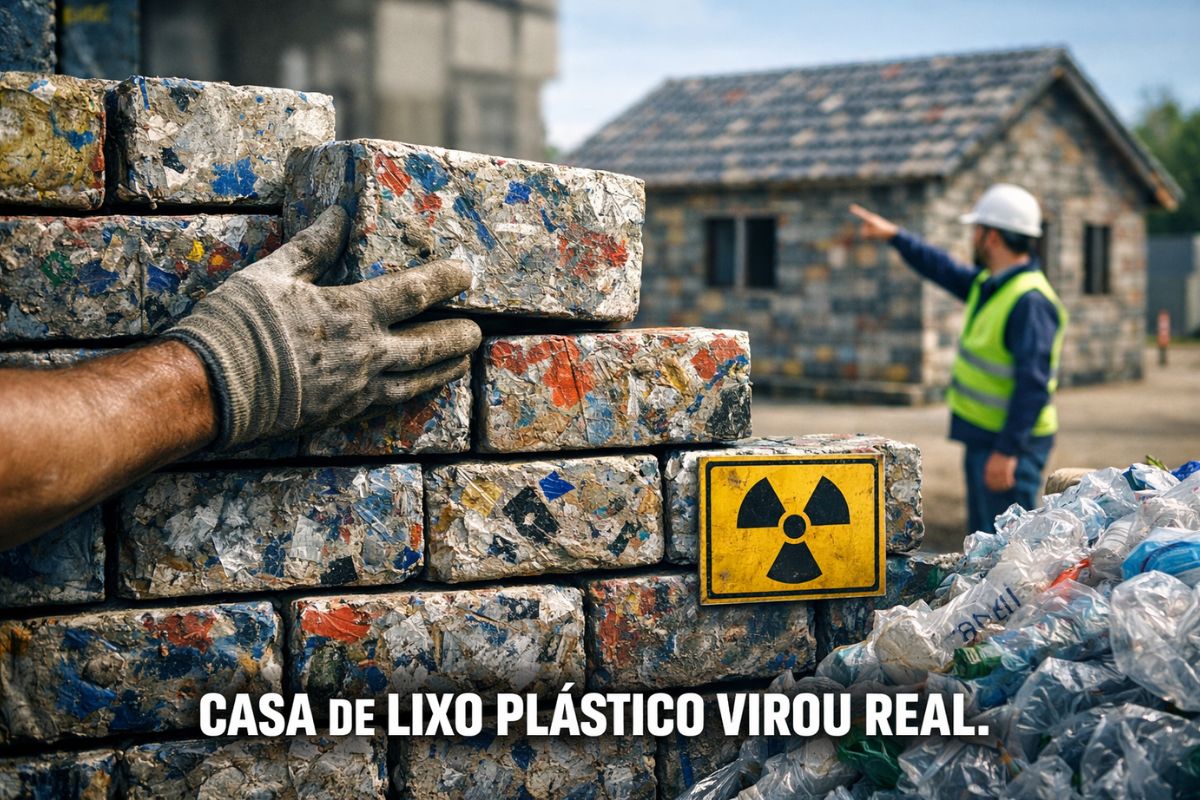


New House Prototype In The Philippines Uses Tiles And Bricks Made From Discarded Plastic Reinforced By Radiation Technology Without Radioactivity And Emerges As A Concrete Alternative To Reduce Pollution From Waste, Cut Environmental Impact Of Construction And Expand Options For Affordable Housing For Vulnerable Families In The World.
A team of scientists in the Philippines recently presented a house built with tiles and bricks made from discarded plastic, reinforced by radiation technology that increases the material’s strength without making it radioactive. The structure demonstrates in practice how low-value waste can become walls, floors, and roofs of a complete dwelling.
The new prototype was unveiled at the end of November, during the inaugural visit of the Director General of the Atomic Energy Agency, Rafael Mariano Grossi, to the Philippines, in an official demonstration by the Department of Science and Technology and the Philippine Institute of Nuclear Research. The idea is to use the model as a showcase of a solution that simultaneously addresses plastic pollution and the lack of housing.
Discarded Plastic Turns Into Tile, Brick, And Floor Of House
According to the Department of Science and Technology, the building is the first residential structure in the country built with plastic components resistant to radiation.
-
The most famous volcano in the world could paralyze one of the largest metropolises on the planet: Japan accelerates emergency plans for the eruption of Mount Fuji, which could bury Tokyo in ash for over two consecutive weeks.

-
The United States has a serious problem with its F-35s: China is already producing fighters at a pace that exceeds American capacity and could manufacture up to 300 aircraft per year before the end of the decade, shifting the global military balance.

-
Remains with battle wounds of over 100 soldiers from the Roman Empire are found beneath a football field in Vienna, leaving everyone surprised.
-
Elon Musk notes Brazil and lowers the price of his internet, Starlink, promising to connect all corners of the country with affordable plans, 10,000 satellites, and 1 million active users in the national territory!

The Philippine Institute of Nuclear Research converted low-value plastic waste, such as common disposable packaging from local markets, into tiles, bricks, and other construction elements.
These waste materials, which would normally end up in landfills or waterways, are processed to become durable structural materials, capable of composing the walls, floors, and roof of the house.
The proposal is to show that what is seen as trash can be reused on a large scale in the construction sector, one of the largest consumers of natural resources in the world.
How Radiation Reinforces Plastic Without Making It Radioactive
The heart of the innovation is the process called Post-Radiation Reactive Extrusion, which applies beams of electrons or gamma radiation to plastics already prepared for recycling.
The radiation modifies the molecular bonds of the material, creating stronger and more stable internal connections, which increases the mechanical resistance of the produced parts.
According to Carlo Arcilla, director of the institute, radiation allows for modification of plastic bonds, resulting in stronger connections, without making the final material radioactive.
In practice, the treated plastic achieves superior performance, but remains safe for use in residential environments, maintaining the safety standards required for a house.
Realistic Solution For Pollution And Housing Shortage
The scientists emphasize that plastic pollution already affects ecosystems around the globe. Single-use plastics often end up in landfills or rivers, breaking down into microplastics that contaminate soil, water, and food chains.
At the same time, the supply of affordable housing remains insufficient in many cities, especially in developing countries.
Traditional construction materials, such as cement and conventional bricks, come with a high environmental cost in their production.
By transforming plastic waste into durable and cheaper construction input, the project aims to alleviate both the pressure on the environment and the financial burden of building a house, opening up space for more sustainable social housing programs.
Science, Business, And Mindset Change
For the Secretary of Science and Technology, Renato Solidum Jr., the housing model shows how nuclear applications and radiation technology can be used as an innovative and realistic solution to reprocess plastic waste.
He also advocates for a mindset change regarding waste: when people see plastic as money, they will have fewer reasons to dispose of it indiscriminately.
The Philippines joined eight other countries in the international initiative Nuclear Technology For Plastic Pollution Control, which uses nuclear science to monitor and recycle waste, transforming it into high-value materials.
By adopting this house prototype as a showcase, the country signals that it wants to unite science, technology, innovation, and business to tackle the issues of waste and inadequate housing head-on.
From Laboratory To Real Life
Besides the symbolic impact, researchers argue that solutions like this can be integrated into public policies and private housing projects, especially in regions with a high volume of waste and housing deficits.
Each house built with repurposed plastic represents less waste in the environment and more families with roofs and dignity.
The public can also participate in the global effort by reducing reliance on disposable plastic at home, adopting reusable products and options with less packaging.
And you, would you live in a house made of treated recycled plastic if it meant less pollution and more affordable housing in your city?




Ha mais de 20 anos ja temos a tecnologia nacional patenteada em funcionamento em diversos paises que permite usar todos os plasticos e outros materiais destinadsd ao aterro para trabsformar em inumeros produtos entre eles casas.
Hoje tranformamos 100% dos residuos urbanos plasticos e organicos sem selecao lavagem ou triagem, alem de residuos industriais, agricolas e hospitalares, em energia eletrica, combustiveis como diesel sintetico, madeira bio sintetica para uso em constricao, industria etc…sem deixar qualquer residuo ao fim do processo.