





 Portuguese
  English
  Spanish
  4 min of reading
  0 comments


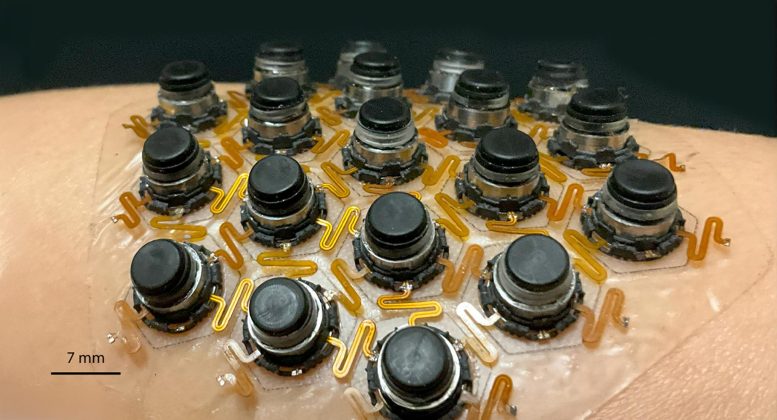
The Wearable Device Revolutionizes The Experience In Virtual Reality, Allowing Users To Feel Textures, Impacts And Other Physical Sensations In Digital Environments
A new wearable device developed by engineers at Northwestern University promises to revolutionize how touch can be simulated through technology. The thin and flexible equipment adheres to the skin and provides a range of sensations such as vibrations, pressure, and twisting.
In addition to enhancing experiences in gaming and virtual reality, researchers see applications in the healthcare field, such as assisting people with visual impairments or users of prosthetics.
The study on the wearable device was recently published in the journal Nature. It represents an advancement in wearable technology developed by John A. Rogers, a bioelectronics expert at Northwestern.
-
MetSul issues alert for 72 hours of severe weather in the South of Brazil with an extratropical cyclone, a line of instability, and a cold front that will hit Rio Grande do Sul from Monday to Wednesday with strong winds and heavy rain.

-
Scientists have built a prototype of a quantum battery that actually works, charges faster as it gets larger, stores and releases energy using quantum physics instead of chemical reactions, and can be wirelessly charged by laser.
-
New technology allows payment with the palm of the hand and may replace cards and cell phones in Brazil; The system is in development and uses the unique patterns of the veins in the hand to make the payment.
-
Scientist who “predicted” the pandemic issues new warning, says the world may be entering a phase of disintegration and urges us to prepare for what is to come.

“Our new miniaturized actuators for the skin are much more capable than the simple ‘buzzers’ we used as demonstration vehicles in our original 2019 paper,” said Rogers.
The work builds on research from 2019, also published in Nature, which introduced the “epidermal VR”. This technology communicates touch through a series of miniature vibrating actuators distributed across the skin, with wireless control.
New Generation Of Actuators
According to Rogers, the new miniaturized actuators are more advanced than those used previously. They allow for controlled forces to be applied at different frequencies and can provide constant force without the need for continuous power.
“Specifically, these small devices can deliver controlled forces across a frequency range, providing constant force without continuous power application. An additional version allows the same actuators to provide a gentle twisting motion on the skin’s surface to complement the ability to provide vertical force, adding realism to the sensations”, he stated.
Additionally, the new model introduces a gentle twisting motion on the skin’s surface, complementing the vertical force and making the sensation more realistic.
The development of the device involved collaboration with several researchers. Among them were Yonggang Huang from Northwestern, Hanqing Jiang from Westlake University in China, and Zhaoqian Xie from Dalian University of Technology.
Jiang’s team was responsible for constructing the small structures that enable the twisting motion.
Structure And Operation
The wearable device consists of a hexagonal matrix of 19 small magnetic actuators encapsulated in a flexible silicone mesh material. Each actuator can generate different types of tactile stimuli.
Communication occurs via Bluetooth technology, receiving data from a smartphone to convert environmental information into sensory feedback.
Despite being powered by a small battery, the device’s “bistable” design optimizes energy consumption. It can maintain two stable positions without requiring constant power. When the actuators push down, they store energy in the skin and the internal structure of the device.
When pushing up, they release the stored energy, using only a small amount of charge for activation. This efficient system allows for a longer operating time without the need for frequent recharging.
Matthew Flavin, the first author of the paper, highlighted the importance of this mechanism. He explained that the technology harnesses the natural elasticity of the skin to store energy. Thus, the device can provide sensory feedback without relying on a constant power source.
“Instead of fighting against the skin, the idea was ultimately to use the energy stored in the skin mechanically as elastic energy and recover it during the operation of the device,” said Matthew Flavin. “Just like stretching a rubber band, compressing elastic skin stores energy. We can then reapply that energy while providing sensory feedback, and that was ultimately the basis of how we created this truly energy-efficient system.“
Flavin, who was a postdoctoral researcher in Rogers’ lab, is now an assistant professor of electrical and computer engineering at the Georgia Institute of Technology.
Testing And Applications Of The Wearable Device
The researchers conducted tests with healthy individuals blindfolded to assess the device’s ability to replace visual stimuli with mechanical stimuli. Participants had to avoid obstacles, adjust their foot position to avoid tripping, and modify their posture to improve balance.
In one of the tests, a volunteer had to cross a path with obstacles. As they approached the objects, the device provided feedback in the form of light pulses at the upper right corner of the sensor.
As the proximity increased, the stimulation became more intense and moved toward the center of the device.
Even with a short period of adaptation, participants were able to modify their movements in real-time. This demonstrates that the device can replace visual information with mechanical information, allowing users to perceive the environment in a new way.
According to Flavin, the equipment can play a similar role to a white cane, providing additional information that is not captured by conventional devices.
Wearable Technology: A New Form Of Perception
The study showed that the system can provide a primary version of “vision” through haptic patterns transmitted to the skin. The device uses data collected by 3D imaging sensors (LiDAR) available on smartphones, transforming them into tactile stimuli.
This could represent an alternative for people with visual impairments, helping them to interpret the surrounding environment without relying on sight.
According to Rogers, this type of sensory substitution enables a functional and meaningful perception of space, offering a new possibility for enhancing the mobility and autonomy of individuals with visual difficulties.
The advancement in wearable technology demonstrates the potential for integration between electronic devices and human biology, broadening the boundaries of interaction between machines and people.
With information from SciTech Daily.







Seja o primeiro a reagir!