





 Portuguese
  English
  Spanish
  5 min of reading
  0 comments


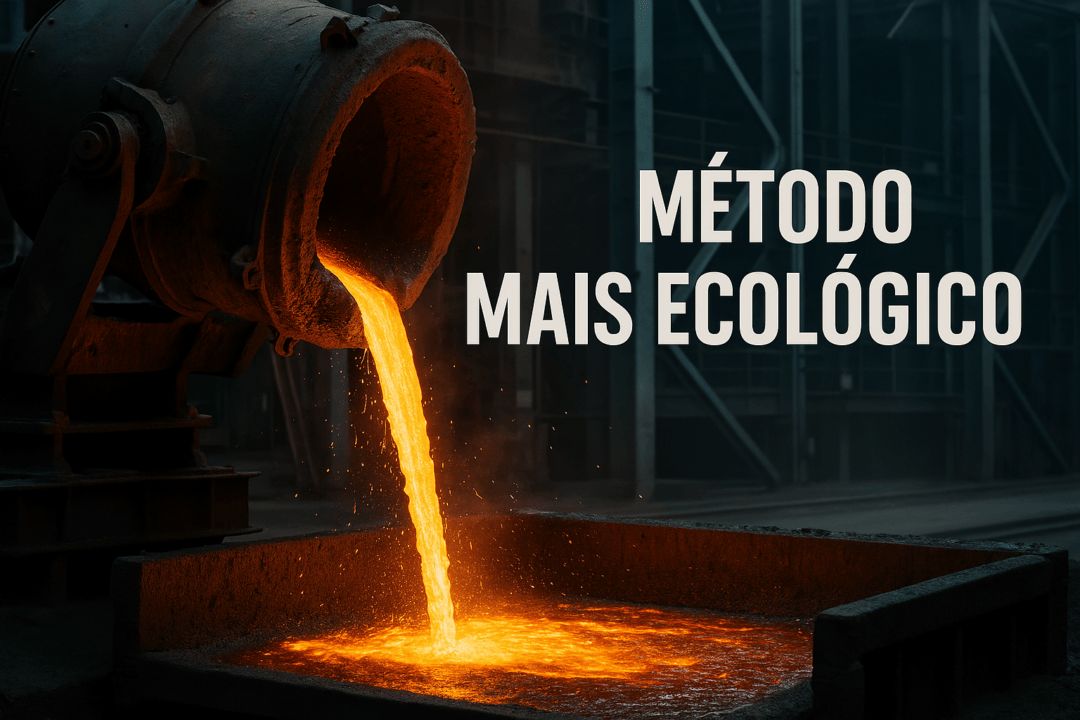
The Steel Industry Is One of the Largest Carbon Emission Sources on the Planet, but a New Scientific Advancement Could Change This Scenario. Researchers Have Developed a More Ecological Method for Iron Production That Promises to Drastically Reduce Emissions and Make the Process More Sustainable. The Innovation Represents an Important Step Toward the Decarbonization of the Industrial Chain.
The steel industry is among the top contributors to carbon emissions worldwide. But a new study conducted by chemists at the University of Oregon could change this scenario. They have developed a more ecological method to produce metallic iron, essential for steel manufacturing, with the potential to reduce the environmental damage caused by this activity.
An Alternative to Traditional Blast Furnaces
Today, steel production heavily relies on the burning of fossil fuels. The transformation of iron ore into metallic iron is one of the most polluting steps in the process.
This mainly occurs in blast furnaces, which emit large amounts of carbon dioxide into the atmosphere.
-
Something is happening around the Earth: Inside the huge explosion of fireballs in 2026

-
A hot air bubble coming from Argentina expands over Brazil, causing thermometers to exceed 38 degrees with a thermal sensation of 40 degrees in late March, affecting 6 states at once.

-
The radish leaf that almost everyone throws away has more polyphenols, flavonoids, and fiber than the consumed root, and a 2025 study showed that the leaf contains compounds that protect the intestine, combat inflammation, and may inhibit the growth of cancer cells.

-
A planet that seemed to defy the laws of physics has intrigued scientists for decades, until the James Webb revealed what is really affecting Saturn’s rotation.


The team led by chemist Paul Kempler proposes a different approach. They have created an electrochemical process that transforms iron oxides into metallic iron, using saltwater as part of the reaction. This innovation was detailed in a study published in the journal ACS Energy Letters.
In addition to reducing emissions, the new method also generates chlorine as a byproduct — a compound with commercial value.
The Importance of Starting Materials
At the beginning of the research, Kempler’s lab used iron oxides purchased from chemical suppliers. These materials were pure and performed well in laboratory tests.
However, they did not accurately represent the ores found in nature, which are more varied in composition and structure.
As a result, a fundamental question arose: would it be possible to achieve good results with materials extracted directly from the earth, without purification?
The answer came through experiments led by Ana Konovalova, a postdoctoral researcher, and Andrew Goldman, a graduate student.
They began testing different types of iron oxides, closer to those that would be used in a practical application.
Nanoparticles and Faster Reactions
In the tests, the researchers identified that some types of iron oxide were much more efficient than others. But why?
To answer this question, they created iron oxide nanoparticles and applied thermal treatments to part of them.
This resulted in two distinct types: porous particles and dense particles. The structure of the particles was maintained, but their internal characteristics changed.
The porous nanoparticles had a much larger surface area. This caused the chemical reactions to occur more quickly. With the dense particles, the reaction speed dropped significantly.
“With the really porous particles, we were able to produce iron very quickly in a small area“, explained Goldman. “The dense particles simply cannot achieve the same speed.“
Impact on Industrial Scale
This difference in reaction speed may seem like just a laboratory detail, but it has significant implications in practice. For the method to be viable on an industrial scale, the electrodes used in the reactions need to be efficient.
Building an electrochemical plant is expensive.
The cost increases according to the size of the electrode area. Therefore, the faster an electrode produces iron, the greater the chance of the process becoming competitive.
The study showed that the porous structure of the starting materials makes all the difference in this regard. A larger surface area allows for a faster iron generation. This makes the initial investment easier to recover and reduces the final cost of the product.
According to Kempler, the goal is not to rely exclusively on nanoparticles created in the lab. The important thing is to find porous materials that are abundant, cheap, and, above all, less harmful to the environment.
Partnerships for Practical Application
With promising results in hand, the team is now working to take the technology beyond the laboratory. They are collaborating with researchers from Oregon State University, particularly in the civil engineering field.
The idea is to better understand how the produced iron behaves in real applications, such as construction and infrastructure.
Another important partnership is with a company that manufactures electrodes. This collaboration aims to address the technical and logistical challenges involved in large-scale production.
These steps are crucial for the new method to compete with the traditional processes used today.
A Cleaner Path for Industry
Kempler believes that the research points to a more sustainable future in the industry. The idea is simple: keep steel and iron production, but with less environmental impact.
“We have not solved all the problems, of course, but I think it’s an example that serves as a starting point for a different way of thinking about how solutions should be. We can continue to have industry, technology, and medicine, and we can do this in a clean way — and that is amazing.“
According to him, it is possible to keep the industry, technology, and medicine functioning efficiently — while also protecting the environment. This possibility, for the scientists involved, is exciting.
The Challenge of Global Emissions
Nearly 2 billion tons of steel were produced worldwide in 2024. This number highlights the size of the demand for metallic iron. Replacing the traditional method with cleaner alternatives, like the one developed by Kempler’s team, could make a significant difference in global carbon emissions.
By using saltwater and cheap iron oxides, the new process appears promising from both an environmental and economic perspective.
Focus on Economy and Environment
In the end, the study’s message is clear: it is possible to find technological solutions for environmental problems without giving up industrial production. The key is to better understand the materials used, optimize processes, and seek strategic collaborations.
Kempler summarizes the project’s goal with a straightforward phrase: “We will not be satisfied if we invent something more harmful than the current main method of iron production.”
The research continues. But the advancements achieved so far indicate that there is a realistic — and cleaner — path for the future of iron and steel.







Seja o primeiro a reagir!