





 Portuguese
  English
  Spanish
  4 min of reading
  0 comments


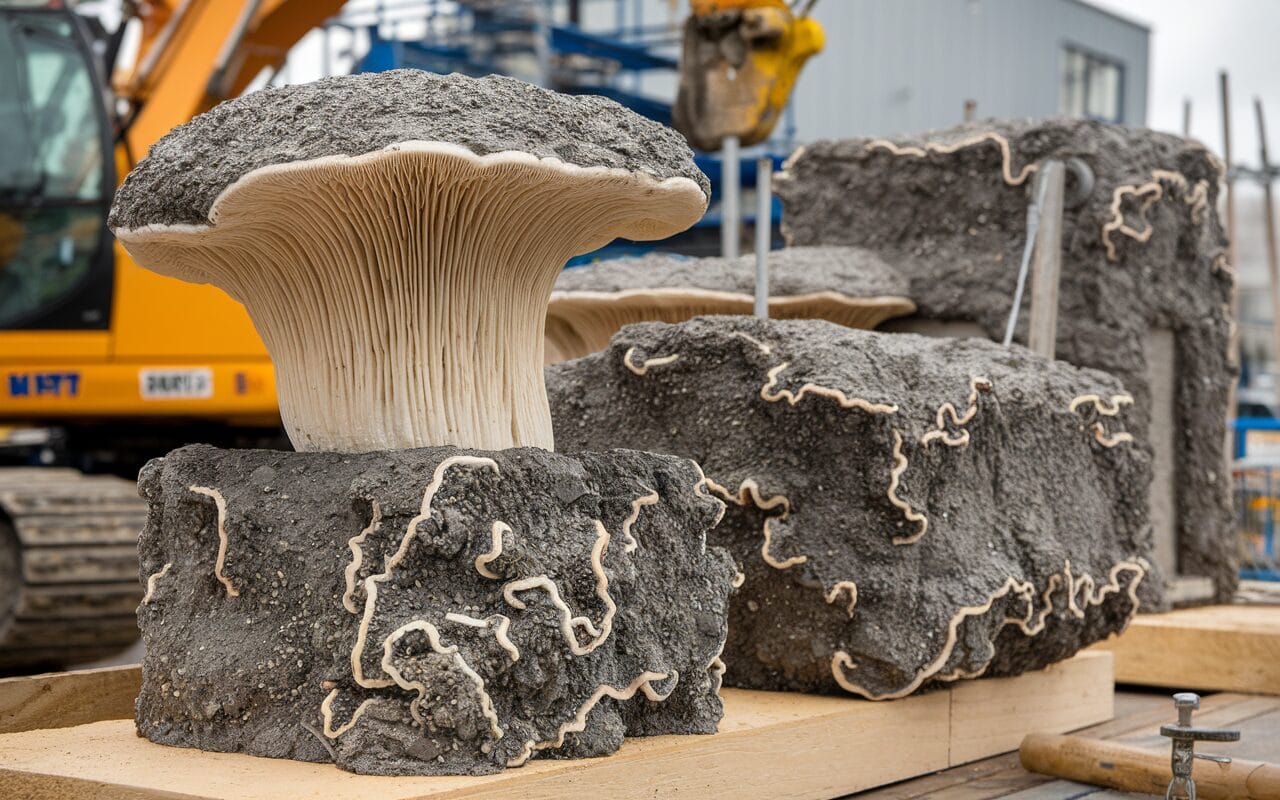
Researchers Develop Sustainable Alternative to Concrete That Could Transform the Future of Construction with Less Environmental Impact.
The search for alternatives to traditional concrete has gained momentum in the construction industry. One of the main reasons is the environmental impact of cement production, responsible for about 8% of global carbon dioxide (CO₂) emissions. A large portion of this material is used in the manufacturing of concrete, a fundamental input in building construction, roads, and infrastructure. Now, a new scientific approach could help change this scenario: the use of fungi in living materials to store and structure constructions.
Fungi and Bacteria as a Basis for a New Material
A group of scientists from Montana State University in the United States is developing a construction material based on the combination of fungi and bacteria with mineral components. The goal is to create a material that is as strong as concrete but with less environmental impact.


The proposal involves the use of mycelium — the structure similar to the roots of a fungus — to form the base of the material. The fungus chosen for the tests was Neurospora crassa, known for its rapid growth and for presenting characteristics suitable for interactions with minerals.
-
The lack of welders, electricians, and operators becomes a structural threat in 2025, with the construction industry and manufacturing already suffering from delays, cost pressures, and labor shortages in Brazil.
-
Brazil and Paraguay are just 46 meters away from a historic union on the bioceanic bridge that promises to revolutionize trade between the Atlantic and the Pacific.

-
With 55 km over the sea, a cost of US$ 20 billion, and enough steel to build 60 Eiffel Towers, China’s largest project has connected Hong Kong, Zhuhai, and Macau in a colossal bridge that defies the logic of engineering.

-
A trick with joint compound transforms a Styrofoam ceiling into a plaster-like ceiling: leveled panels, wires and mesh at the joints, sand, paint, and change the environment while spending little today.

In addition to the fungus, the material also incorporates the bacteria Sporosarcina pasteurii, previously used in experiments to patch holes in roads and even to build structures with lunar soil. This bacterium has the ability to form mineral crystals through a process called Microbial Induced Carbonate Precipitation (MICP), capable of turning sand or soil into solid blocks, similar to cement.
Science Tests Strength, Durability, and Self-Repair
One of the main challenges faced by the so-called Engineered Living Materials (ELMs) is their durability in adverse conditions. Many of these materials lose their properties after just a few days or weeks. The study conducted by Professor Chelsea Heveran and her team demonstrated that the fungi used remained alive and active for at least four weeks, a significant advancement in the field.
Another innovative aspect of the project lies in the internal architecture of the material. Thanks to the use of N. crassa mycelium, scientists were able to shape the interior of the structure to resemble cortical bone — a reference for strength and lightness in nature. This configuration offers greater rigidity and stability to the material.
The union of fungi and bacteria results in a compound with self-repairing potential. In other words, the material would be able to regenerate damaged parts over time, a promising feature to extend the lifespan of constructions and reduce maintenance costs.
Applications and Future of Construction with Living Materials
The development of this new material is still in the experimental phase, but the results suggest that it could, in the future, become a viable complement to concrete. For this to happen, scientists will need to overcome some obstacles, such as production costs, storage viability, and manufacturing scalability.
Despite these challenges, the research paves the way for a more ecological approach in construction. By using living microorganisms and avoiding intensive cement use, it is possible to significantly reduce greenhouse gas emissions and create more sustainable alternatives for small, medium, and large-scale projects.
The team at Montana State University now plans to further extend the lifespan of microorganisms within the material and develop ways to produce the compound on a large scale. The intention is to enable its practical application on construction sites and, eventually, integrate it into routine construction practices.
Fungi and Concrete: Allies for a New Construction Model
The use of fungi in construction is not a new idea, but advances in scientific research and biotechnology have expanded practical application possibilities. In the case of the material developed by the American team, the innovation lies in combining materials science, biological engineering, and microbiology to create a product that mimics and, in some aspects, surpasses the performance of traditional concrete.
If the project is successful, the construction industry could benefit from a new category of structural materials based on fungi. The impact would be significant not only for the environment but also for innovation in engineering, paving the way for new construction techniques and architectural solutions.
The partial or total replacement of concrete with living materials, such as the one being tested, still depends on regulations, safety testing, and approval in technical standards. However, the early results show that science is getting closer to transforming what seemed like science fiction into practical reality — and with the potential to change the course of sustainable construction.
Source: New Atlas









Seja o primeiro a reagir!