





 Portuguese
  English
  Spanish
  4 min of reading
  0 comments


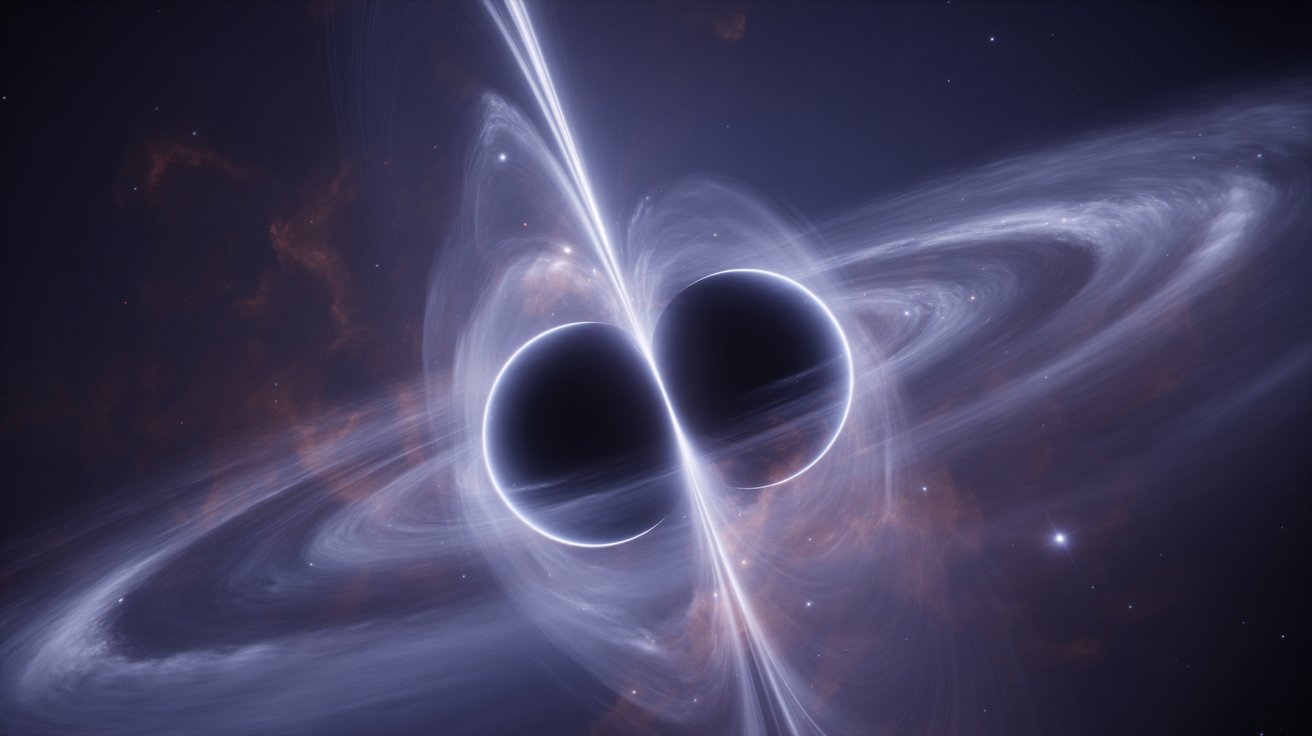
Scientists from the LIGO, Virgo, and KAGRA collaborations announced last Sunday (13) the discovery of the largest fusion of massive black holes ever recorded, in a cosmic event that occurred 10 billion light-years from Earth, resulting in the formation of a black hole with 225 times the mass of the Sun.
The phenomenon was identified as GW231123 and occurred on November 23, 2023. The collision involved two black holes with estimated masses of 103 and 137 times that of the Sun, which merged into a single, even more massive and fast object. The detection was made through gravitational waves, captured by the sophisticated sensors of the Laser Interferometer Gravitational-Wave Observatory (LIGO) in the United States.
The gravitational waves are tiny distortions in the fabric of spacetime, caused by extremely high-energy events such as the merger of black holes. Despite their violent origin, these ripples arrive at Earth almost imperceptibly, requiring extremely sensitive equipment to detect them.
According to physicist Mark Hannam from Cardiff University, the signals measured in the event lasted only one-tenth of a second but were enough to confirm that it was a colossal merger. “The ripples are tiny, but the event that generated them was one of the most violent in the observable universe,” said the expert.
-
Expedition 501: Scientists drill into the ocean floor and discover a giant reserve of fresh water hidden beneath the sea, extracting nearly 50,000 liters and revealing an invisible system that could reshape the map of water scarcity.

-
Archaeologists find an intact tomb over 2,500 years old, with more than 100 preserved objects, weapons, jewelry, and human remains never touched.

-
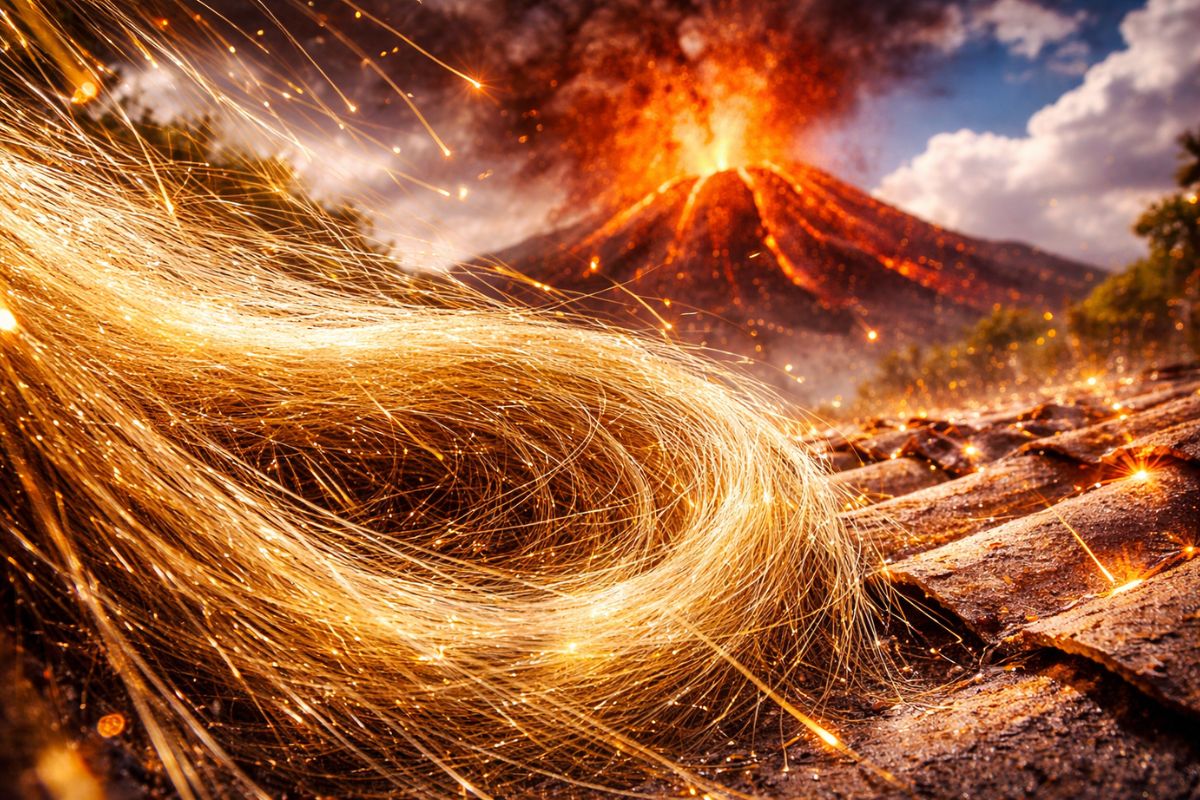
Volcanic lava transforms into threads as fine as human hair that travel over 30 kilometers by wind and fall like cutting rain on roofs and backyards in Hawaii and Iceland.
-
NASA issues a warning for the feared Godzilla El Niño that could change the planet’s climate in 2026 with extreme warming of the Pacific capable of causing devastating droughts in some regions and historic floods in others simultaneously.


How the Merger of the Black Holes Occurred
The two black holes were in mutual orbit for billions of years, accelerating their rotation until they collided at an impressive speed, about 400,000 times faster than the rotation of the Earth. The union of these bodies resulted in a structure with a mass of 225 suns, surpassing the previous record of 140 solar masses, recorded in 2021.
This result represents a real puzzle for astrophysics. According to the theory of stellar evolution, objects of this magnitude should not arise spontaneously. One possible explanation, according to Hannam, is that these giant black holes are the result of multiple previous mergers, which would explain both the unusual mass and the accelerated rotation.
Einstein’s general relativity imposes theoretical limits on the rotation of black holes, and the data from GW231123 indicates that this event was very close to that limit, making it a challenge even for the most advanced models of theoretical physics.
The Importance of This Discovery for Science
The GW231123 merger marks a significant advance in the study of massive black hole formation and challenges current models used to predict these phenomena. “It is the most massive binary black hole securely detected via gravitational waves,” said researcher Charlie Hoy from the University of Portsmouth.
In addition to the extraordinary mass and speed, the event highlights limitations in current modeling methods. Scientists now face the challenge of revising their theoretical tools to include the possibility of such extreme and rotational objects.
This type of observation also contributes to understanding the role of successive mergers in the creation of intermediate-mass black holes, a class still poorly understood in modern astrophysics.
The Technology Behind the Detection
Since the first direct detection of gravitational waves in 2015, LIGO – in collaboration with the Virgo observatory in Italy and KAGRA in Japan – has recorded more than 300 cosmic mergers. The detectors use lasers and interferometry systems to capture microscopic variations in spacetime.
Sophie Bini, a researcher on the team, emphasized that GW231123 “pushed the sensors and analysis methods to the limit of what is possible today”, underscoring the need to develop new instruments in the coming years.
The detection of this type of event depends on international synchronization and cutting-edge technology, being considered one of the greatest feats of 21st-century observational astronomy.
What Scientists Expect Now?
With the promise of even more sensitive detectors under construction, such as the Einstein Telescope and LISA, scientists estimate that it will be possible to identify all mergers of black holes in the visible universe in the next 10 to 15 years.
Meanwhile, the data from GW231123 is already being shared with the global scientific community, paving the way for deeper analyses and alternative hypotheses that may explain its origin and characteristics.
According to Gregorio Carullo from the University of Birmingham, “the merger of black holes is still the most likely explanation, but more complex scenarios may reveal unprecedented answers.” The expectation is that new studies will reveal still unknown details about the limits of the observable universe.
The information was disclosed by the international collaboration LIGO-Virgo-KAGRA, according to official publications and reports from the R7 portal.








-

-

-

3 pessoas reagiram a isso.