





 English
  Francês
  Alemão
  Italiano
  Japonês
  Norueguês
  Portuguese
  Spanish
  3 min of reading


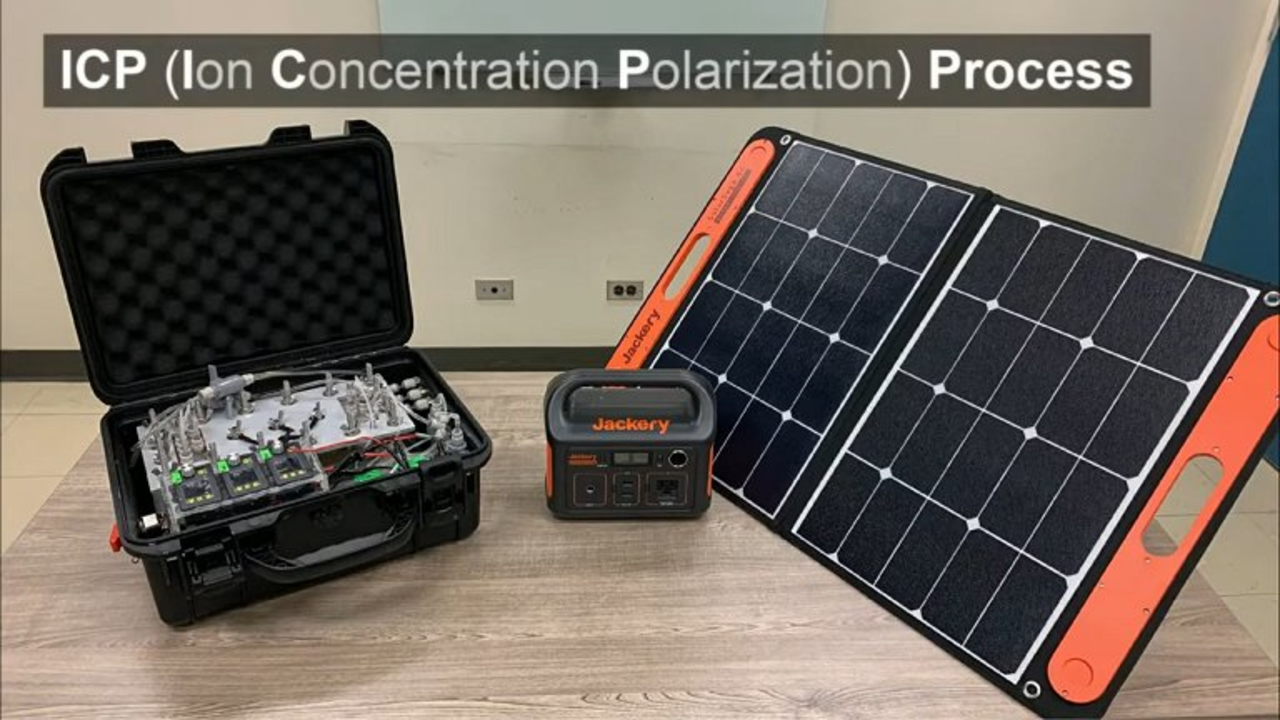
Scientists Junghyo Yoon, Hyukjin J. Kwon, SungKu Kang, Eric Brack, and Jongyoon Han recently published in the journal Environmental Science & Technology the development of an incredible water desalination device that can be carried in a suitcase and desalinates liquid directly into a cup, even with quality superior to the standards required by the World Health Organization. To offer total Independence, the prototype is completely functional off the electrical grid, featuring a battery and a mini solar panel, which can be stored along with the rest of the desalination device. This could become a high-impact social solution, usable in a myriad of situations where the need for drinking water is critical.
Learn more about this desalination device, why it is relevant, and how it could become a fundamental tool for various emergency situations or for environments where drinking water is rarer than seawater, such as on ships.
Portable Desalination Device Without Filters: A Shocking Innovation.
This portable desalination device’s main differentiator is the way the water is desalinated.
-
Historic bankruptcy of Centauro shocks the market, and the century-old company puts more than 500,000 products, machines, and complete infrastructure up for online auction.

-
Renewable energy advances over protected areas in Brazil, and a survey by the Energy Transition Observatory reveals silent impacts that challenge environmental conservation and pressure sensitive traditional territories.

-
Rio Grande do Sul accelerates energy transition: State invests in renewable technologies and consolidates decarbonization strategies and pathways to attract billions in new industrial investments.

-
With 160,000 m² of collectors, an area larger than 20 football fields, Silkeborg, in Denmark, hosts a solar thermal plant that heats 19,500 homes and could become the largest solar heating plant in the world.


The vast majority of other portable desalination devices work with limited life filters. In other words, there is a limit to the usage of the portable desalination device, depending on the number of available filters.
The portable desalination device being presented uses a desalination process entirely powered by an electric current, which completely eliminates the need for filters and allows it to operate almost indefinitely, relying only on the charge of its battery and requiring far less frequent maintenance of parts than filter replacement.
This makes this machinery highly useful, for example, on isolated islands, assisting refugees from wars or ecological disasters, ships, and other environments where brackish water is more common than drinking water.
So far, its major limitation is that the seawater used must be clean. Since it does not use filters, it cannot eliminate certain impurities from the water.
Instead of working with water passed through filters under pressure, this desalination device operates with two electrified blades of different polarities receiving a flow of water. Thus, one of the blades is positively charged, attracting only salt and other impurities, such as bacteria and similar, leaving the other blade, with a negative polarity, to attract only clean, pure water.
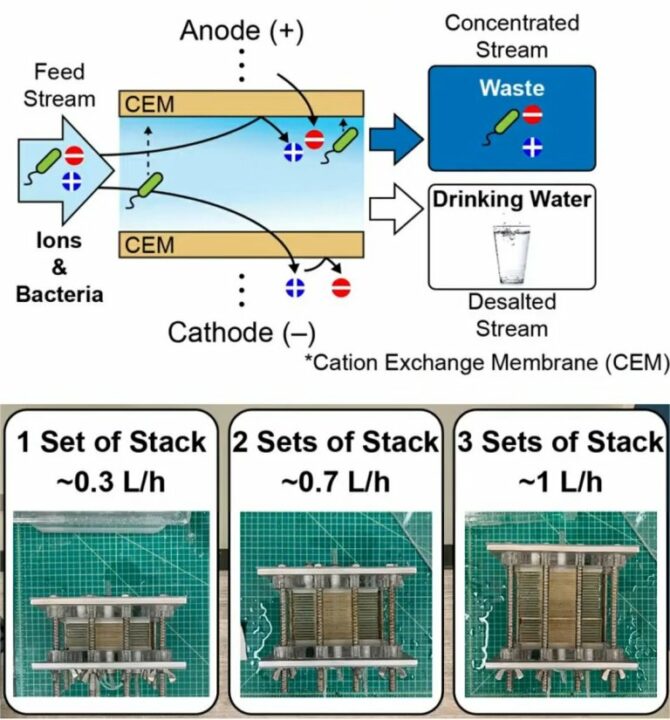
This initial process does not eliminate all impurities, making a second process, called electrodialysis, necessary. After this second phase of filtration, the portable desalination device removes the remaining salt and impurities that were not eliminated in the first stage of water treatment.
“This is truly the culmination of a journey that my group and I have been on for 10 years. We worked for years on the physics behind the individual desalination processes, but putting all these advancements into a box, building a system, and demonstrating it in the ocean, it was a very meaningful and rewarding experience for me,” said Professor Jongyoon Han from MIT.
Small and Efficient
One of the biggest challenges the team faced in creating this portable desalination device was precisely the fact that the technologies needed to be miniaturized so the result would be a machine that could be easily carried to hard-to-reach places.
All desalination processes are performed by small, efficient, and durable components, still working with a low-power water pump, which reduces energy consumption during operation, making this process one of the most economical for autonomous water desalination.
Testing in Real Situations
Despite already being extremely optimistic results, the desalination device is still not approved, as it now needs to undergo the more rigorous process of using real seawater in its desalination processes.
This is because clean seawater samples were used for these initial tests, which may not reflect the reality of all environments where it will be needed.
means that the upcoming rounds of tests for the desalination device will be much more demanding, with water samples from real environments where it should be necessary.










Seja o primeiro a reagir!