





 Portuguese
  English
  Spanish
  6 min of reading
  8 comments


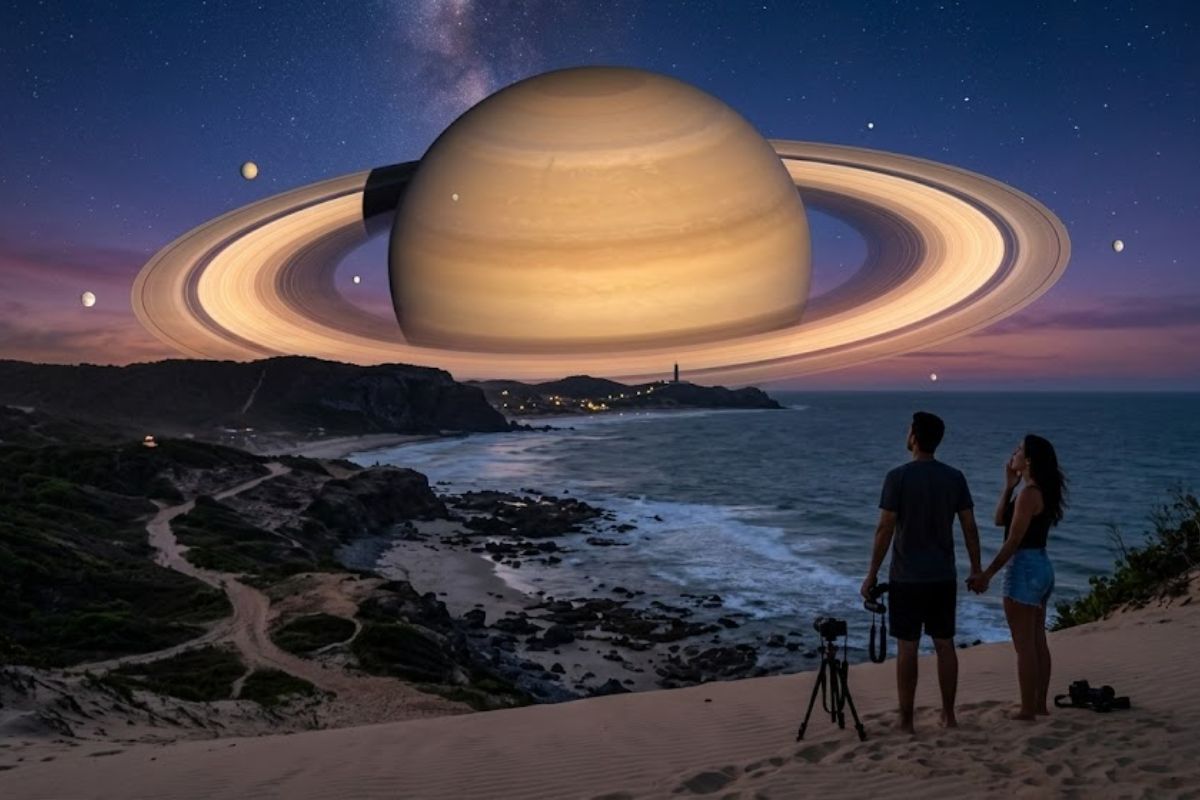


Based on Analyses Revisited by Hubble and Gaia, Researchers Show That the Fusion Between Milky Way and Andromeda Has Lost Urgency, While the Real Clock Runs Within the Solar System: Earth May Leave the Habitable Zone in About 1 to 1.75 Billion Years Before the Final Collapse.
The Earth may have a shorter timeline than popular imagination tends to accept. While cosmic news often focuses on the possibility of a collision between the Milky Way and Andromeda, scientists and space agencies have once again drawn attention to a problem much closer to our real fate: the gradual heating of the Sun could push the planet out of the habitable zone in about 1 to 1.75 billion years.
This shifts the axis of concern. The grand galactic fusion remains possible but has lost the appearance of immediate inevitability after a review with data from Hubble and Gaia. The crisis of habitability on Earth does not depend on visual spectacle or collisions between galaxies. It arises from the very evolution of the Sun and progresses long before the Sun reaches the red giant phase and decides whether or not to engulf the inner worlds.
The Shorter Clock Is Not Among Galaxies

For years, the collision between the Milky Way and Andromeda was treated as an almost certain outcome in about 4.5 billion years.
-
Something is happening around the Earth: Inside the huge explosion of fireballs in 2026

-
A hot air bubble coming from Argentina expands over Brazil, causing thermometers to exceed 38 degrees with a thermal sensation of 40 degrees in late March, affecting 6 states at once.

-
The radish leaf that almost everyone throws away has more polyphenols, flavonoids, and fiber than the consumed root, and a 2025 study showed that the leaf contains compounds that protect the intestine, combat inflammation, and may inhibit the growth of cancer cells.

-
A planet that seemed to defy the laws of physics has intrigued scientists for decades, until the James Webb revealed what is really affecting Saturn’s rotation.

The most recent review, however, repositions this scenario. With over a decade of data from Hubble combined with Gaia’s observations, researchers found only about 50% chance of fusion in the next 10 billion years, dismantling the sense of inevitability that dominated the previous narrative.
This repositioning is important because it removes weight from a threat that seemed fixed and, at the same time, reinforces another much more consistent one.
If the galactic collision now appears as an open question, solar heating continues as an expected process of stellar evolution.
The consequence is direct: Earth may lose conditions to support life long before any dramatic encounter between galaxies.
The change in perspective becomes even clearer when looking at the scales. In about half of the simulations, the Milky Way and Andromeda pass each other, move away, and only later, perhaps, return for a distant fusion.
In many other scenarios, they don’t even get close enough for dynamic friction to work efficiently. The galactic future, therefore, has become more nebulous.
Meanwhile, the situation on Earth did not gain this relief. The very foundational material highlights that solar heating should make the planet uninhabitable in approximately 1 billion years.
When this estimate is broadened to the range of about 1 to 1.75 billion years, the diagnosis remains the same: the first major timeline that is really tight is not in the collision with Andromeda, but in the gradual deterioration of the terrestrial environment.
Hubble, Gaia, and the Downgrading of an Old Certainty

The review of the galactic scenario came from a study led by Till Sawala, from the University of Helsinki, with contributions from teams at the University of Durham, the University of Toulouse, and the University of Western Australia.
The group reassessed the collision forecast using the most recent observational data and conducted 100,000 Monte Carlo simulations that extend 10 billion years into the future.
The researchers worked with 22 different variables, precisely to incorporate margins of error and uncertainties that previously did not receive the same weight.
The result was not a new certainty, but a new caution. Instead of asserting the merge as a closed fate, the study began to treat the encounter between the two galaxies as an event with divided probability and dependent on interactions more complex than previously assumed.
In this context, the presence of the Large Magellanic Cloud gained relevance. According to the study, this satellite galaxy pulls the Milky Way out of the orbital plane and reduces the likelihood of a head-on encounter with Andromeda.
At the same time, M33, a satellite of Andromeda, exerts force in the opposite direction, pulling the Milky Way a bit closer to its neighbor. It is the kind of unstable balance that prevents simplistic answers.
Still, there remains a small chance, around 2%, of a head-on collision in just 4 to 5 billion years. The decisive detail is that, even in this more aggressive scenario, the problem of Earth continues to arise first.
If the Sun has already made the planet uninhabitable due to heating long before that, the grand galactic dance ceases to be the main urgency of our world.
Why Earth May Leave the Habitable Zone Before the Final Phase of the Sun
The central point is in normal stellar evolution. The Sun is still approximately halfway through its life, but this does not mean eternal stability for Earth.
As the star ages, its luminosity increases, gradually changing the thermal conditions of the Solar System.
This growth in energy received by the planet is what puts the permanence of Earth within the habitable range at risk long before the terminal phase.
This process does not depend on the Sun becoming a red giant tomorrow or any external event. The crisis starts before engulfment, before extreme expansion, and before the final spectacle.
It is a progressive loss of climatic and energetic balance, sufficient to transform Earth into an inhospitable environment even if the planet remains physically intact for a long time.
The foundational material is clear in stating that solar heating will make Earth uninhabitable in approximately 1 billion years.
The proposed theme broadens this range to about 1 to 1.75 billion years, but the logic does not change: the critical timeline for habitability ends long before the definitive collapse of the Sun. The red giant phase, in turn, would still be at least 5 billion years away.
When that final stage arrives, the solar diameter may grow more than a hundred times and begin to engulf any unlucky planet in nearby orbits. The question of whether or not to engulf Earth belongs to that later stage.
The most immediate problem, on a cosmic scale, is another: the planet may cease to be habitable long before being destroyed.
The Real Drama Is Less About the Impact and More About the Deterioration
There is something counterintuitive about this. The collective imagination tends to fixate on violent imagery, such as colliding galaxies or stars devouring planets, because these scenarios offer a visible end.
In the case of Earth, however, the most consistent risk is not the sudden impact, but the long-term deterioration of the conditions that sustain liquid water, thermal balance, and environmental stability.
This makes the discussion less cinematic and more serious. It is not necessary for the Sun to touch Earth for complex life to lose its future here.
It is enough for the flow of energy to push the planet beyond the limit where oceans, atmosphere, and temperature can sustain what we currently call habitability.
The review of the collision between Milky Way and Andromeda helps to clarify this difference. While previously the galactic fusion seemed the great clock of the end, now it appears as an event surrounded by uncertainty and even possible delay.
Earth, in contrast, remains tied to a shorter and less spectacular timer, but much more robust from a physical standpoint.
That is why the new picture shifts the center of the debate. The big question ceases to be whether a collision between galaxies will erase us and becomes when Earth will cease to offer real conditions to continue being the habitable planet we know.
The scientific weight of this shift in focus is enormous because it reorganizes priorities even in how the cosmic future tends to be told.
The review conducted with Hubble and Gaia does not eliminate the possibility of an encounter between the Milky Way and Andromeda, but reduces its appearance as an inevitable sentence.
At the same time, it reinforces by contrast that Earth carries a shorter and harsher deadline: something between about 1 and 1.75 billion years to leave the habitable zone, long before the Sun reaches the stage where the image of the red giant dominates the conversation.
In the end, the most uncomfortable scenario is not one galaxy colliding with another, but that of a planet that may become unviable long before the final act of its own stellar system. If you had to point out the most disturbing point of this story, what would it be: the chance that the galactic collision might not even happen, or the fact that Earth may lose habitability long before any visually grand catastrophe?






Estarei esperando acontecer
E o aquecimento global? Ele não poderia agravar esse cenário? Já que a Terra está retendo mais calor doque há um tempo atrás.
Mas independentemente disso só tenho uma certeza: FUDEU!!
Não está não, tanto que ficou provado que as geleiras aumentaram e muito
Fud3u…