





 Portuguese
  English
  Spanish
  4 min of reading
  0 comments


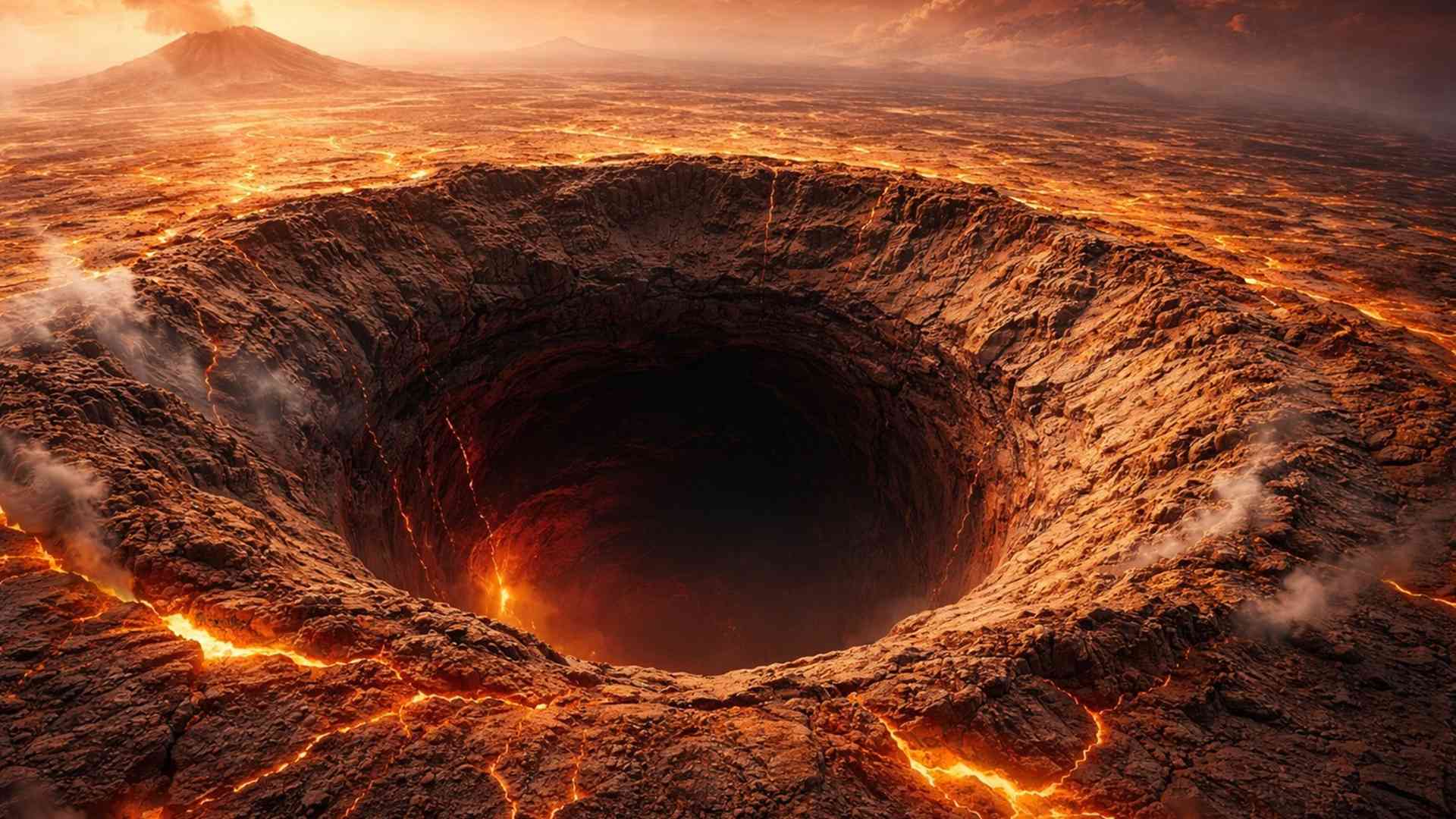
A Crater Detected on the Slope of the Volcano Nyx Mons, with About 362 Kilometers in Diameter on Venus, May Reveal the Presence of a Subterranean Cave Formed by Lava Tubes, Identified from Radar Data Collected by the Magellan Probe During the Mapping of 98% of the Planet’s Surface
A crater detected on a volcano on Venus may indicate the presence of a subterranean cave formed by lava tubes. The possible cavity was identified by scientists analyzing radar data collected by the Magellan probe.
Crater on Volcano on Venus Raises Hypothesis of Subterranean Cavity
The crater identified by researchers appears associated with a phenomenon known as volcanic skylight. This type of opening occurs when part of the ceiling of a lava tube collapses, revealing a subterranean cavity visible from the surface.
The discovery was described in a study published in the journal Nature Communications. The scientists point out that this crater may represent the first concrete evidence of the existence of subterranean lava tubes on Venus, something that until now was considered just a hypothesis.
-
In a flooded well, archaeologists found a 1,700-year-old Roman egg that still contains clear and yolk intact inside the very thin shell.

-
Something is happening around the Earth: Inside the huge explosion of fireballs in 2026

-
A hot air bubble coming from Argentina expands over Brazil, causing thermometers to exceed 38 degrees with a thermal sensation of 40 degrees in late March, affecting 6 states at once.

-
The radish leaf that almost everyone throws away has more polyphenols, flavonoids, and fiber than the consumed root, and a 2025 study showed that the leaf contains compounds that protect the intestine, combat inflammation, and may inhibit the growth of cancer cells.


The structure was identified thanks to the detailed analysis of radar data and images captured by the Magellan probe. NASA’s mission orbited Venus in the early 1990s and mapped most of the planet through radar observations.
Location of the Crater on the Volcano Nyx Mons
The possible cave associated with the crater is located on the western slope of Nyx Mons. This shield volcano has a diameter of approximately 362 kilometers and is considered one of the large volcanic formations identified on the Venusian surface.
Volcanoes of this type form from the gradual accumulation of highly fluid lava. This process occurs over decades and produces structures similar to those observed in large volcanoes in Hawaii, on Earth.
During eruptions, lava flows can create natural tunnels. The outer layer of the lava solidifies while the magma continues to move inside, forming a subterranean conduit that may become a cave after the activity ends.
How Scientists Identified the Opening Associated with the Crater
The researchers detected the cavity by analyzing an unusual signature in the Magellan radar data. The pattern was found at a specific point identified as “Well A,” located in the area of the Nyx Mons volcano.
This radar signature suggests the presence of an opening that may lead to a deeper cavity below the surface. The signal behavior indicates characteristics compatible with a skylight formed by the collapse of the ceiling of a lava tube.
This type of structure allows subterranean cavities to be identified from orbital observations. The hole resulting from the collapse functions as a natural window that reveals the empty space below the surface.
Possible Implications of the Crater for Space Exploration
If the existence of this subterranean cavity is confirmed, structures of this type may be of great importance for space exploration. In extreme environments like Venus, lava tubes may offer natural protection against adverse conditions.
These caves could protect equipment or missions from extreme temperatures, intense radiation, and impacts from micrometeorites. For this reason, similar formations are studied as potential natural shelters on other celestial bodies.
On the Moon and Mars, comparable volcanic cavities have already been identified. Researchers believe that these spaces could serve as protected locations for future human or robotic missions.
Missions That Revealed the Geology of Venus
The first probes to successfully reach Venus were those of the Venera series from the Soviet Union. These missions transmitted data about the atmosphere and surface of the planet, and some even sent images directly from the Venusian surface, as was the case with Venera 9 in 1975.
Despite these initial missions, the detailed understanding of the planet’s surface advanced mainly with the Magellan mission. Between 1989 and 1992, the probe mapped about 98% of the surface of Venus using radar capable of penetrating the dense clouds that surround the planet.
The data revealed that the Venusian surface is dominated by volcanoes, extensive plains formed by magma flows, and some impact craters. Subsequent observations also identified geological changes that suggest recent volcanic activity.
New Missions May Deepen the Study of Craters and Volcanoes
Studies based on data from Magellan have indicated changes in the surface caused by recent lava in some volcanoes. This evidence suggests that Venus may still be geologically active at present.
Observations have also indicated that volcanoes like Sif Mons may have erupted recently. These signs reinforce scientific interest in investigating the planet with more advanced instruments.
For this reason, NASA and other space agencies are preparing new missions to Venus. The planned projects for the 2030s are expected to use equipment capable of penetrating the atmosphere and analyzing the composition and geology of the planet more accurately.







-

-

2 pessoas reagiram a isso.