





 Portuguese
  English
  Spanish
  5 min of reading
  0 comments


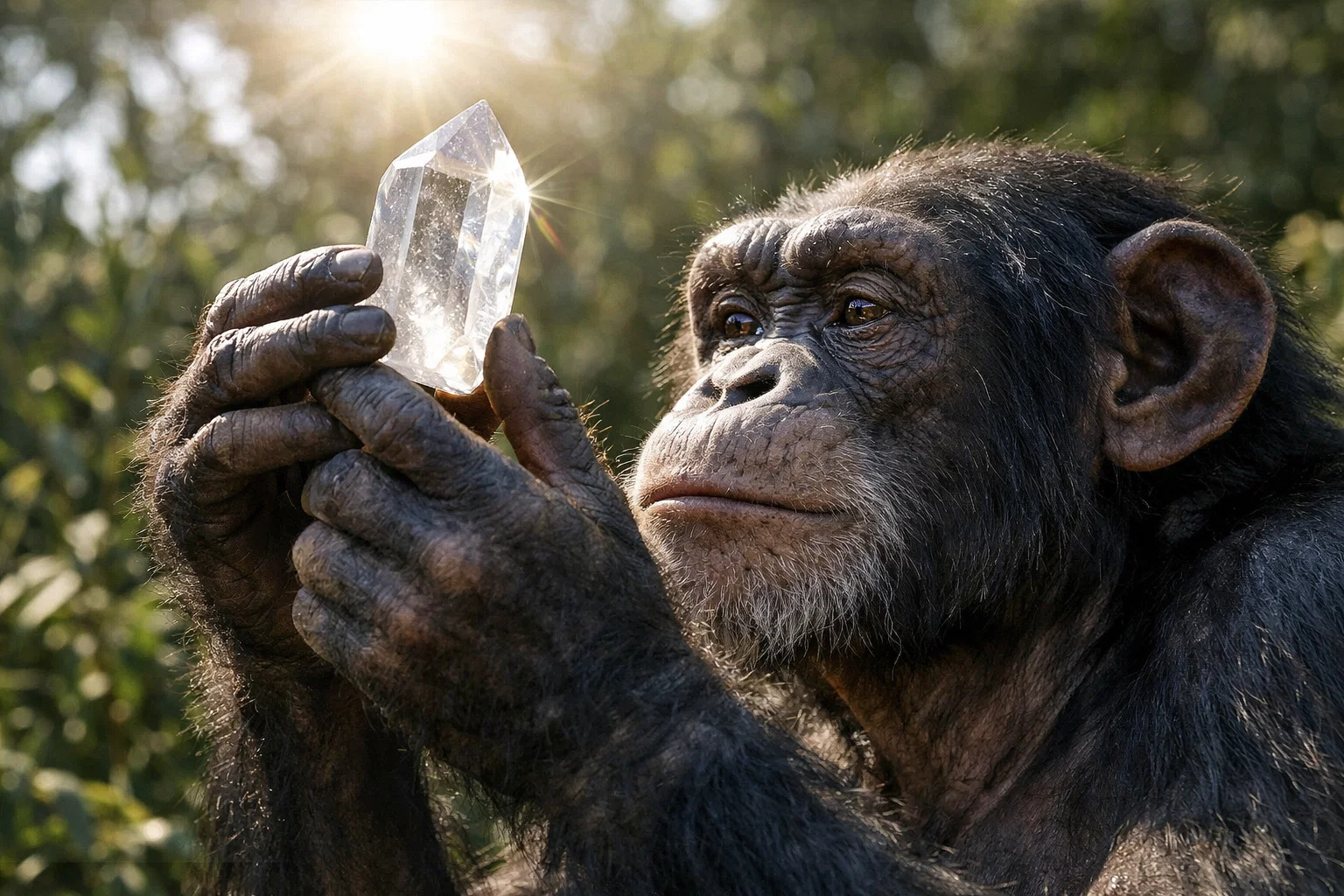
Scientific Experiment With Quartz Crystals And Chimpanzees Reveals Surprising Behavior That May Help Explain Why Humans Have Collected Shiny Stones For About 780 Thousand Years
For thousands of years, crystals have held an almost universal fascination for humans. Since the ancient civilizations of China, Egypt, Rome, and Central America, these shiny stones have been used for both aesthetic purposes and in religious and spiritual practices. However, a new scientific study indicates that this enchantment may have much deeper roots in evolution than previously thought.
The information was published by the magazine “Superinteressante,” which presented the results of a research study published in the scientific journal Frontiers in Psychology. The study investigated the reaction of chimpanzees when coming into contact with quartz crystals, seeking to understand whether the human fascination for these objects may have evolutionary origins shared with our primate relatives.
Experiment With Chimpanzees Reveals Intense Curiosity About Quartz Crystals
To investigate the origin of this curious behavior, researchers conducted experiments with chimpanzees in Spain, offering the animals quartz crystals to observe their reactions. The idea was to find out if our closest evolutionary relatives would show any special interest in these shiny stones.
-
Residents of Australia woke up to a sky completely red like blood before the arrival of Cyclone Narelle, which hit the coast with winds of 250 km/h, tearing off roofs and lifting iron dust in a scene they described as apocalyptic.

-
New 100% clean fuel produced in Brazil could retire diesel.

-
Plastered walls become a trend and end up being the perfect choice for finishing; the secret of the 2 coats that prevent waste in painting.

-
With 333 meters and equivalent to a 20-story building: China launches a supertanker that transports 2 million barrels, has 540,000 m² of area, and saves $5 million per year.


Right at the beginning of the experiment, the results drew attention. The chimpanzees began to hold, examine, rotate, and observe the crystals with great attention, demonstrating a curiosity very similar to that observed in humans when confronted with unusual or visually attractive objects.
The study revealed that the animals’ interest was not just momentary. In fact, some chimpanzees even refused to return the crystals to the researchers, even after the experiment ended.
The tests were conducted at the Rainfer Primate Rescue Center, located near Madrid, where scientists had to negotiate for hours with the animals to recover the objects.
This unusual situation was described by the researchers themselves as a kind of “scientific hostage crisis”, since the chimpanzees simply did not want to part with the shiny stones.


The Monolith: Experiment Inspired By A Classic Work Of Science Fiction
The study was divided into two main experiments. The first was curiously nicknamed “The Monolith”, a direct reference to the famous opening scene of the film 2001: A Space Odyssey (1968), in which a mysterious object appears before prehistoric hominids.
In this test, scientists placed two objects on pedestals inside the enclosures: one clear quartz crystal and one common stone of the same size.
Initially, both objects sparked the chimpanzees’ interest. However, after a few attempts, the animals quickly began to show a clear preference for the crystal.
A 50-year-old chimpanzee named Yvan even grabbed the crystal and carried it with him for long periods, even while climbing structures in the enclosure or eating lettuce leaves.
Shortly thereafter, the animal took the crystal to the group’s dormitory, where the object remained for several days. In another enclosure, a chimpanzee named Sandy also picked up a crystal and simply refused to return it.
Only after long negotiations were the researchers able to recover the objects. For this, they had to offer rewards highly valued by the animals: banana and yogurt.
This behavior suggests that the chimpanzees began to consider the crystal as an item of value, something that goes beyond simple curiosity.
Crystals Have Already Sparked Human Interest For 780 Thousand Years
The research also aligns with very ancient archaeological evidence. Records indicate that hominids have been collecting crystals for about 780 thousand years.
Interestingly, these objects showed no signs of practical use. The stones were not turned into tools, nor used in the making of jewelry.
This detail has puzzled researchers for decades. After all, why would our ancestors keep crystals that apparently had no utilitarian function?
One possible answer may lie precisely in the visual characteristics of these minerals. Crystals exhibit transparency, shine, and geometric flat surfaces, something rare in nature.
According to researchers, these visual properties may spark curiosity and attention in both humans and other primates.
Second Experiment Confirms Fascination With Shiny Stones
In the second experiment, scientists decided to test another hypothesis. They scattered several small common stones and small quartz crystals in the chimpanzees’ environment.
The goal was to observe whether the animals would be able to identify and select the crystals among the other materials.
The result was surprising: the chimpanzees quickly located the crystals in a matter of seconds.
After finding them, the animals began to examine the shiny stones with great interest. In several recordings, the chimpanzees held the crystals up to the sunlight to better observe the transparent surfaces.
In an unusual behavior, the chimpanzee Sandy even hid small stones inside her mouth, something rare for this type of primate.
Fascination With Shiny Objects May Have Deep Evolutionary Roots
According to Juan Manuel García-Ruiz, a Spanish crystallographer who led the study, the results suggest that the attraction to crystals may have a very ancient evolutionary origin.
He stated that the transparency and unusual shape of the crystals seem to be the main elements that spark the curiosity of primates.
“We were positively surprised by how strong and apparently natural the attraction of chimpanzees to the crystals turned out to be. This suggests that sensitivity to such objects may have deep evolutionary roots,” said the researcher.
However, not all experts interpret the results in the same way. Archaeologist Michael Haslam, in an interview with the New York Times, pointed out that it is still early to claim that the behavior observed in chimpanzees directly explains human interest in crystals.
According to him, although the fascination is evident, the exact motivation behind this behavior still remains a scientific mystery.
Source: Superinteressante








Seja o primeiro a reagir!