





 Portuguese
  English
  Spanish
  9 min of reading
  0 comments


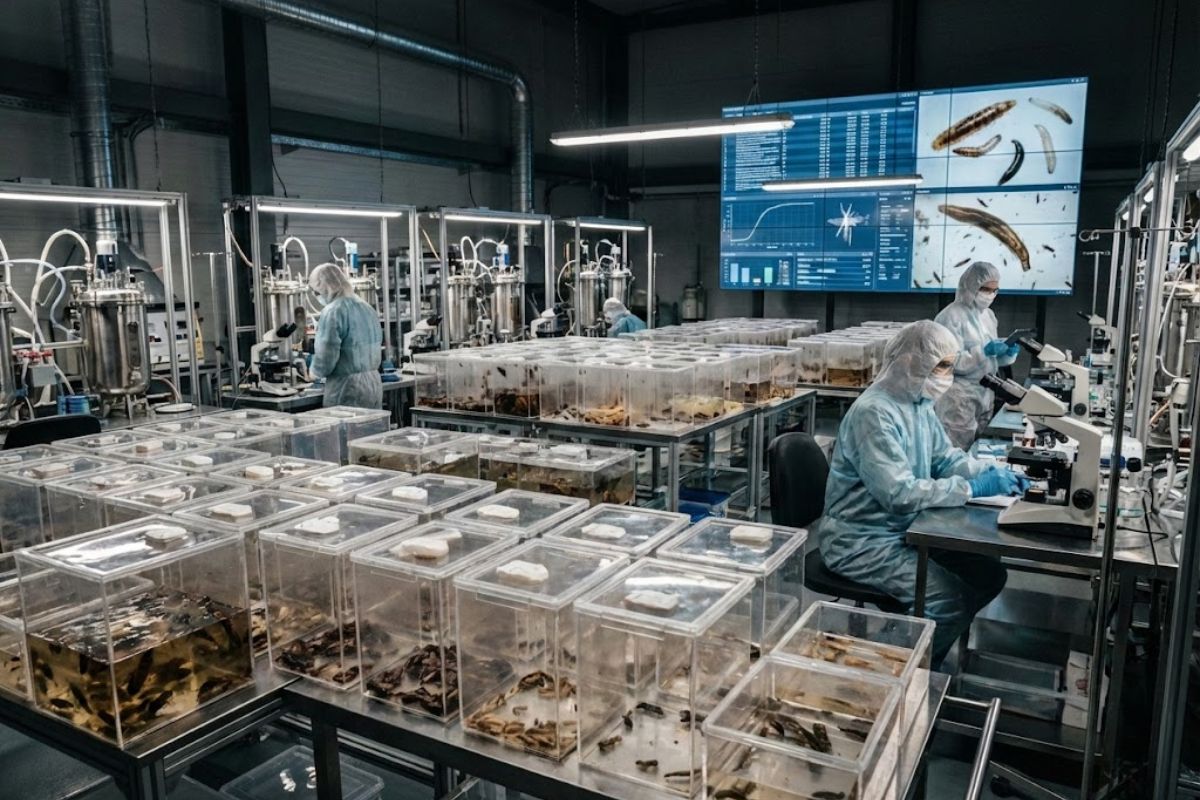
Parasites In Laboratories Are Growing On An Industrial Scale With Cockroaches, Larvae, Leeches, And Mosquitoes, Promising Health, Protein, And Waste Recycling, But Raising Real Fear Of Escape, Invasion, And Biological Risk.
Parasites in laboratories have stopped being an image from a movie to become routine in facilities where no one enters without authorization. In controlled rooms, humans create creatures that suck blood, lay eggs, live in the dark, and multiply in numbers that seem unreal.
What is frightening is the logic behind the project. Parasites in laboratories perform tasks that no machine can maintain without pause, battery, or recharging, and that is why they have begun to be used to save lives, fight diseases, and recycle organic waste on a large scale.
Cockroach Farm That Functions As A Waste Plant

Parasites in laboratories start with the most hated animal by many: the cockroach. In Shandong, China, the system is described as hard to imagine because a standard farm has about 60 rooms, and each room houses almost 20 million cockroaches, a volume comparable to an entire population.
-
China showcases robot dogs that act in groups like a coordinated pack, make decisions together, and could change the way modern wars operate.
-
The coldest seawater ever recorded in Earth’s history was hidden under extreme ice 717 million years ago and reached an impressive -15°C.

-
China has launched the world’s first floating artificial island, a scientific structure designed to face open seas, test equipment weighing hundreds of tons, and reach depths of 10,000 meters.

-
China accelerates global science and may surpass the United States in 2 years with increased public investment, continuous growth, and direct impact on the global technological competition.


The set operates 24 hours a day, with a temperature around 20, high humidity, and receiving almost 50 tons of restaurant food scraps, potato skins, wilted vegetables, and discarded bread daily.
In constant darkness, reproduction explodes. Each female can produce between 400 and 600 offspring throughout her life.
At this rate, a farm with 1 billion cockroaches can grow an additional 20 to 30 million individuals in just one week if control fails.
Biological resistance also helps explain why the model works: they can live up to a week without a head, withstand water loss 12 times greater than humans, resist radiation levels 15 times higher, and remain alive in low oxygen environments.
The goal is not curiosity. Dried cockroaches are sold for about 20 for every half kg, and the chain includes cheap protein snacks, feed for chickens, fish, and lizards, as well as raw material for cosmetics and traditional medicines.
Among the mentioned products is cockroach syrup used by millions of people to treat gastric ulcers and inflammations.
To maintain scale, the operation is automated. Artificial intelligence monitors temperature, humidity, feeding, reproduction rates, and even the sounds of the swarm to detect diseases or escape risk. And still, there was a failure.
In 2013, a farm in Jansu Province was vandalized, and over 1 million cockroaches escaped.
Residents described a black river moving along rural roads, climbing walls, and invading crevices, and the district mobilized four disinfection teams, isolated the area, and sprayed insecticides for three consecutive days to contain the problem.
The escalation of fear is simple: if 1 million was already chaos, what would happen with a unit that produces billions?
Larvae And The Transformation Of Food Into Protein For Humans

When the idea of parasites in laboratories seems to have reached its limit, the second axis emerges: larvae for human consumption.
Since 2021, the European Union has officially legalized Mealworms as food, and the industry is advancing in vertical factories that operate 24 hours a day with robots feeding and harvesting, while temperature, humidity, and lighting are calculated second by second.
In France, located in Amiens, the factory of Ÿnsect is described as the largest larvae city on the planet, with the capacity to produce 230,000 tons of larvae per year, in stacked systems of 15 floors.

The destination, according to reports, goes beyond animal feed: a significant portion becomes burgers, bread, pizza, pasta, and snacks for humans. The justification is comparative: to produce 1 kg of beef would require about 15,000 liters of water, in addition to land and associated emissions, while 1 kg of larvae protein would require 1 liter of water and about 2 square meters of space for millions of individuals. In 20 to 30 days, they could grow up to 15 times.
The cycle is presented as direct: eggs become larvae, larvae gain weight, are dried and ground, turned into powder, and then pressed into products, while the leftovers become fertilizer.
The feed also relies on waste: bread scraps, soybean meal, fruit peels, discarded vegetables, beer grains, and agricultural waste.
The nutritional argument appears as an additional engine, citing Mealworm flour with 60% protein, more omega 3 than fish, more vitamin B12 than beef, two to three times more iron than spinach, and the presence of chitin linked to the immune system.
The mentioned regulatory opening includes the European Union, United States, and Canada, with FDA approval for use in alternative meats, and the narrative ends with a question that exposes the cultural shock: would you eat worm pizza and worm burgers if that became common in the supermarket?
Farmed Rats And The Idea Of Urban Protein
The sequence leads to another point of tension: rats deliberately raised, including where rodents have already caused damage.
A disaster in Australia, in New South Wales and Queensland, with losses of about 1.5 billion Australian dollars and massive use of poison, contrasts with rat farms in countries like Cambodia, Laos, Myanmar, the Philippines, Indonesia, Ghana, China, and Vietnam, where the meat is cited as common and in some places as a delicacy.
The focus returns to reproductive efficiency. A female can have five to six litters per year, with 2 to 10 offspring each.
In 12 months, a couple can generate hundreds of individuals, while for cattle, the reference is one calf per year.
The described farm model is small, with 400 to 500 rats, operating with little space and even in urban areas.
The feed echoes the other examples: feed, grains, and vegetable scraps. The time to reach sale weight appears as short: females in 2.5 to 3 months, males in 3.5 to 4 months, with sale between 500 and 700 grams when the meat would have better quality.
The narrative reaches the sensitive point: the rat as a candidate for protein if beef and chicken become extremely expensive.
Leeches And Larvae Entering Modern Medicine
The most counterintuitive part of parasites in laboratories appears when the parasite becomes a medical tool.
Leeches are described as being raised for use in microsurgery, such as finger reattachment, breast reconstruction, and very small vessel grafts.
More than 600 species are noted, and it is recalled that in the 19th century, France reportedly used about 40 million per year, causing a crisis in Europe.
Anatomy explains the fear and utility: three triangular jaws with 60 to 100 microscopic teeth, a bite that leaves a triangle mark.
Then come the mechanisms that sustain the practice: they release a natural anesthetic, making the bite almost painless, and produce hirudin, cited as the most potent natural anticoagulant recognized by the FDA, with the observation that it has not yet been completely reproduced in the laboratory.
In hospitals, they are transported in gel, and when biting, they allow blood to continue flowing for up to 10 hours, preventing clots and saving grafts.
The breeding model describes scale and control: a standard farm houses about 100,000 leeches, raised in dark rooms with temperature controlled by life stage. Young ones receive sheep blood only once every six months, then go through fasting, selection, and maturation rooms.
In the final stage, sterilization with UV light and restricted access. In captivity, some can live up to 6 years, while in the wild, they could reach 20 years. After use, they are sacrificed in alcohol to prevent the risk of infection.
The same reasoning appears with medicinal larvae used to eat dead tissue, in a technique called Maggot Therapy, recognized as a Class Bios medical device.
Raised in sterile environments, they would not attack healthy tissue and would be used in cases where antibiotics no longer work, with an especially relevant effect in diabetic and elderly patients. Here, parasites in laboratories cease to be a threat and become a clinical tool.
Mass-Produced Mosquitoes To Block Viruses
The point that provokes the most disgust is explicit: creating mosquitoes. In Medellín, Colombia, a two-story building that appears ordinary would house millions of mosquitoes in hot rooms with dim light. On plastic strips, there would be about 10,000 eggs fed with a mixture of fish flour, sugar, and blood.
The stated goal is not to attack humans, but rather to carry Wolbachia, a bacteria described as harmless to people but capable of blocking viruses such as dengue, zika, and Chikungunya inside the mosquito’s body.
When released, they reproduce with wild mosquitoes and spread the bacteria. The reported results include drops of 77% in dengue cases and 86% in hospitalizations in Yogyakarta, Indonesia, described as a biological strike.
The scale is again alarming: Colombia would release tens of millions of mosquitoes per year. In China, located in Guangzhou, Guangzhou Wolbaki Biotech Co., Ltd, previously considered the largest mosquito factory in the world, would produce about 20 million mosquitoes weekly, with reports of opened boxes and a dark cloud of mosquitoes, as well as the use of drones for aerial release.
In smaller experiments, some scientists use their own blood because mosquitoes do not accept artificial blood or anesthetized animals with the same efficiency, requiring humans in the dark. After years, some report less allergic reaction, describing the sensation as light and continuous pinches.
Isopods, Enzymes, And The Promise Of Biofuel
The list of parasites in laboratories expands with lesser-known creatures: isopods. The story begins in 1799 when sailors noticed organisms rotting ship hulls and called them sea termites.
The turning point occurs when biologists study the intestines of isopods and identify an enzyme capable of breaking down cellulose, a structure present in wood, straw, and difficult-to-decompose organic waste.
The proposed idea is to use these enzymes to turn waste into biofuel: complex sugars would turn into simple sugars, fermentation would produce ethanol, and the city could process waste in a biological plant.
There is also the giant isopod, cited as living about 2,700 meters deep in extreme darkness and cold, with an appearance compared to a giant armadillo with a cockroach. Some would exceed 40 cm and weigh almost 2 kg.
Breeding in captivity is considered practically impossible because it would require extreme pressure, low temperature, total darkness, and perfectly clean water, as if the farm had to exist at the bottom of the sea.
Earthworms And The Industry That Tries To Disarm The Organic Waste Bomb
The closing expands the focus to the parasite that many people tolerate more: earthworms. Billions raised in systems operating 24 hours a day, consuming about 30,000 tons of organic waste per day.
The justification is a global crisis: the UN estimates that 1/3 of the food produced in the world, about 1.3 billion tons per year, is wasted.
Urban waste is said to be 70% organic and, when buried, generates methane, presented as 28 times more potent than CO2. The conclusion is direct: each bag of buried organic waste turns into a climate bomb.
In this scenario, earthworms are positioned as a solution because they can consume 60% of their own weight in waste per day, decomposing 10 times faster than in nature.
The produced humus, described as rich in enzymes, live microorganisms, and minerals, would make plants grow 30 to 40% faster without chemical fertilizers.
India appears with farms in Maharashtra raising 2 to 3 billion earthworms and processing 20,000 to 30,000 tons of waste per year, while the largest in Tamil Nadu would have 17 billion and operate with automatic nebulization, humidity sensors, and machines that separate by growth stage.
In China, a company in Yunan would raise worms in 200 concrete silos, each with 300 million individuals, processing 1,000 tons of waste per day. In New South Wales, Australia, a facility with 8 billion would treat waste and even animal carcasses, reducing methane emissions by up to 95%.
The soil recovery effect: areas destroyed by chemical fertilizers for 20 years could be restored in 1 to 2 years with earthworm farming because they burrow into the soil, activate microorganisms, and form a new layer of humus.
Behind this, there is a market: humus sold at 250 per ton, a sector expected to generate $4.5 billion in 2023 and 15 billion in 2030, with the hypothesis that in 20 years earthworm farms could be as essential as electricity, water, and the internet.
Why This Divides Scientists Between Fascination And Panic
When looking at cockroaches, larvae, rats, leeches, mosquitoes, isopods, and earthworms, the common line is uncomfortable: parasites in laboratories exist because they do what industrial technology still does not replicate with the same efficiency.
They carry enzymes, biological cycles, and evolutionary resistance that sustain continuous solutions, without battery and without pause, in a world pressed by climate, health, and resource crises.
At the same time, fear is not theoretical. The 2013 episode with over 1 million cockroaches wandering shows how a small accident, close to total scale, can become real panic. And when it comes to releasing tens of millions of mosquitoes, social discomfort grows even when the goal is to block viruses.
After all this, what predominates in you: fear or admiration when thinking about parasites in laboratories?







-

-

-

5 pessoas reagiram a isso.