





 Portuguese
  English
  Spanish
  8 min of reading
  5 comments


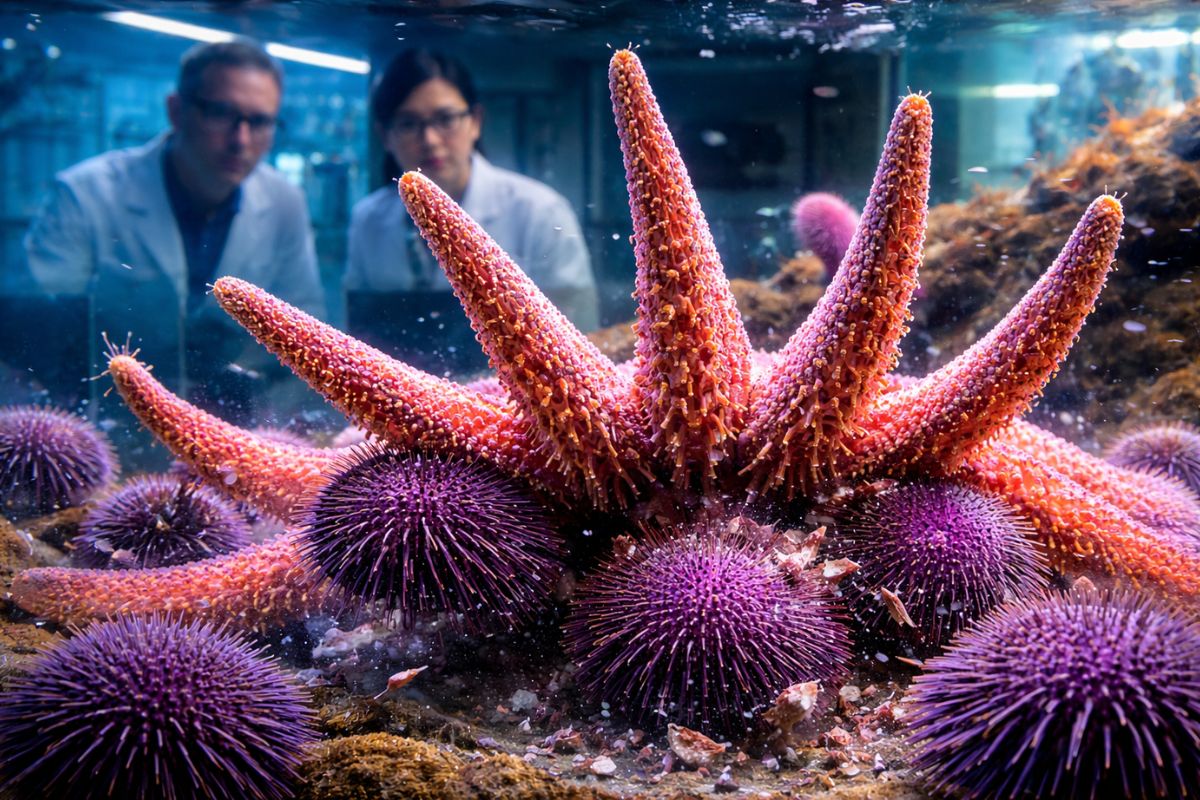


The Sunflower Star Is Being Bred In Aquariums And Laboratories To Control Purple Sea Urchins That Devastated Kelp In California After The 2013 Mortality. With US$ 18 Million From NOAA And Partner Support, The Program Combines Breeding, Genetics, Cryopreservation, Searching For Survivors And Planned Reintroduction Along The Coast.
The sunflower star has become the main scientific bet to reverse the collapse of California’s kelp forests, after the abrupt decline of this predator paved the way for an explosion of purple sea urchins and the accelerated destruction of large areas of kelp.
By recreating juveniles in the laboratory, researchers are trying to return to the coastal ocean a predator capable of eating dozens of urchins per day, restoring ecological balance and recovering an ecosystem that once supported a kelp-related fishery and has suffered economic losses of hundreds of millions of dollars.
The Predator That Keeps Eating And Why It Matters

The sunflower star is not an abstract symbol of conservation. It is a biological machine for population control. In a feeding test, a juvenile about the size of a hamburger bun consumed 44 small purple sea urchins, the size of a pea, in the span of a day and still seemed to be hungry.
-
In a flooded well, archaeologists found a 1,700-year-old Roman egg that still contains clear and yolk intact inside the very thin shell.

-
Something is happening around the Earth: Inside the huge explosion of fireballs in 2026

-
A hot air bubble coming from Argentina expands over Brazil, causing thermometers to exceed 38 degrees with a thermal sensation of 40 degrees in late March, affecting 6 states at once.

-
The radish leaf that almost everyone throws away has more polyphenols, flavonoids, and fiber than the consumed root, and a 2025 study showed that the leaf contains compounds that protect the intestine, combat inflammation, and may inhibit the growth of cancer cells.


The feeding method is fast and efficient. The sunflower star sucks the urchins, makes their bodies swell, and about three hours later, expels perfectly clean skeletons. This repeated sequence shows why the species has the potential to reduce large densities of urchins in a short time, especially in areas where urchins have multiplied unchecked.
What Destroyed The Kelp Forests Of California

The collapse began when a debilitating disease hit the sunflower star in 2013 and wiped out nearly the entire population in California. Without this predator, the purple sea urchins, which were already native, grew explosively in number.
With the urchin population out of control, kelp began to be consumed on a large scale.
Underwater forests that were considered among the most productive and biodiverse ecosystems on the planet have practically disappeared from much of the California coast over the next decade, altering the seafloor structure, reducing habitat, and collapsing system productivity.
The ecological crisis also hit the coastal economy. The kelp-related fishery collapsed, accumulating economic losses of hundreds of millions of dollars, turning the disappearance of kelp into both an environmental and productive problem.
The US$ 18 Million Investment And The Recovery Task Force

The recovery has gained momentum with an investment of US$ 18 million from NOAA Fisheries’ Habitat Conservation Office.
The strategy brings together institutions to accelerate research and juvenile production, aiming to restore kelp forests and rebalance the coastal marine ecosystem.
The collaboration includes The Nature Conservancy and a network of partners working on the recovery of the sunflower star in its historical range from California to Alaska.
The initiative prioritizes key species and centers on the star as a focal point for being one of the main predators of the ecosystem.
With the funding, aquariums expanded laboratory space, purchased equipment, and hired more staff, increasing capacity for breeding and research, focusing on reproduction, feeding, behavior, genetics, and reintroduction strategies.
Who Is Breeding The Sunflower Star And What Each Group Does

The effort brings together the Sunflower Star Laboratory, the Aquarium of the Pacific, and the California Academy of Sciences, among other partners.
The work involves breeding juvenile stars in captivity and conducting research on behavior and genetics, with the ultimate goal of restoring wild populations.
The logic is to produce enough individuals, with genetic diversity and solid health protocols, so that reintroduction is viable and the species can regain its ecological function. At the same time, the work creates a knowledge base about the life cycle, including growth, feeding, reproduction, and stress response.
The Path Opened By Washington And Proof That The Complete Cycle Is Possible
Remaining populations of wild stars persist from Washington to Alaska, and this has helped to reconstruct the species in the laboratory.
In 2019, the Seastar Laboratory at Friday Harbor Laboratories in Washington reproduced adults captured in the wild and successfully raised their offspring.
This breakthrough was crucial because it allowed the development of methods to breed the sunflower star throughout its entire life cycle. This knowledge paved the way for other laboratories to begin cultivating their own stars, adapting techniques and scaling production.
The California Milestone On Valentine’s Day 2024
In California, a milestone occurred on Valentine’s Day 2024. The Birch Aquarium in San Diego achieved the first successful birth of sunflower star larvae from adults in its own collection, the first success of its kind in the state.
These larvae were sent to partners for breeding in different facilities, increasing the chance of survival and accelerating collective learning. The funding related to the initiative began in October 2024, creating recent momentum for expansion of structure and staff.
The Problem Of Cannibal Larvae And The Solution With Controlled Agitation
Breeding faced a critical hurdle early on: larvae tend to eat each other. Preventing them from killing each other was the first major operational challenge in California.
The most efficient solution was simple and practical. Biologists at the Steinhart Aquarium discovered that keeping larvae in constant motion, agitated in a container with a cheap electric stirrer, increased survival.
Hundreds of free-floating larvae managed to survive and settle, moving on to the next phase. Afterward, the individuals were isolated to reduce contact and the risk of cannibalism.
The Most Lethal Growth Period And Diets To Keep Juveniles Alive
Once settled, the stars enter a critical stage known as “the challenge,” when many juveniles die during growth. Overcoming this stage is crucial to reach a sufficient number of individuals for any future reintroduction plans.
To improve survival, biologists tested diets with sand dollar larvae, juvenile red and purple sea urchins, ground mussels, and other species.
The goal was to find dietary combinations that would keep juveniles satisfied and less prone to attacking neighbors, reducing aggressiveness and losses. Hundreds of stars survived in the three laboratories involved.
Genetics, Database And The Search For Diversity To Withstand The Future
The recovery relies not only on quantity but also on genetic diversity. Scientists are mapping the DNA of each sunflower star under human care and a selected group of wild stars.
The goal is to build a genetically diverse group capable of facing threats like diseases and ocean warming. To this end, a database is being created with all sequenced specimens.
This database will serve as a selection tool to strategically pair breeding partners, planning crosses that reinforce diversity.
If significant genetic gaps arise, the strategy may include incorporating more wild stars into the program, expanding lineages, and avoiding a genetic bottleneck in captivity.
Cryopreservation: Larvae And Sperm Stored For The Future
Cryopreservation has opened an unprecedented front for the program. Researchers have learned to freeze sperm and larvae of the sunflower star and thaw them without causing damage.
As a result, hundreds of thousands of larvae and millions of sperm have been stored in a refrigerated environment, preserving genetic lineages for future aquaculture and eventual reintroduction.
This technique allows using sperm from multiple males with the same breeding female, creating multiple crosses and increasing genetic diversity within the program.
The Cause Of The Disease And The Test That Changed Transfers Between Facilities
The recovery gained momentum with the identification of the bacterium Vibrio pectenicida as the cause of the debilitating disease that killed millions of sea stars.
The creation of a test to detect infected individuals changed the logistics of the program.
Now it is possible to transfer stars between facilities more safely, reducing the risk of spreading disease in captivity and allowing for increased exchange of individuals and lineages.
The California Department of Fish and Wildlife uses the test to check if stars from other states can be imported safely.
Alaska License And Preventive Isolation Of Adults And Larvae
A license allowed bringing five adults and about 100,000 larvae from the Alaska Sea Life Center.
These individuals are being kept isolated from California stars while undergoing evaluation to determine if they are good candidates for future spawning.
This isolation protocol combines sanitary precaution and genetic strategy. It prevents contamination, allows monitoring health conditions, and simultaneously preserves the possibility of adding new genetic lineages to the program.
The Return Of Wild Stars In California And The New Hope
The field search has also brought signs of survival. In 2024, a commercial diver working on kelp restoration funded by NOAA in the Greater Farallones National Marine Sanctuary found a solitary sunflower star.
Later, scientific divers from Sonoma State University found a small population in the same location.
This raised hopes for natural recovery and created the chance to add new genetic lineages to aquaculture programs.
The Greater Farallones Association plans to launch a broader search for wild stars in 2026.
Meanwhile, there is a direct alert for curious divers: do not touch the stars, just log locations on iNaturalist, creating a database of observations without physical interference.
Environmental DNA In The Sea And The Experiment With 12 Stars In Cages

To find more individuals without relying solely on underwater searches, the program is testing environmental DNA, or eDNA.
The idea is simple: organisms leave traces of DNA in the water, so detecting DNA can indicate nearby presence.
In a pioneering experiment for a marine invertebrate of this type, 12 baby sunflower stars were placed in cages in the ocean.
Free divers operated in a coordinated manner at specific times to collect water samples and analyze detection limits.
If the technique is validated, it may allow researchers and local divers to find stars more efficiently, reducing costs and increasing coverage.
Reintroduction: Site Selection, Resistance, And A Five Year Or Longer Timeline
Despite the acceleration of discoveries, the release of laboratory-raised juveniles still requires testing and planning.
Experiments are planned to determine if there are disease-resistant lineages and to enhance survival capacity.
There is also inspiration from coral reef research, where corals can become more resistant to warming and diseases when combined with beneficial bacteria and algae, something that could be explored for the sunflower star.
The next challenge is to choose the best sites along the California coast for reintroduction. The expectation is that it may take five years or more until the transplant begins.
Meanwhile, new information continues to emerge month after month, with the partner network gathering tools, resources, and knowledge to tackle the main barriers.
What Is At Stake: Kelp, Biodiversity, And Coastal Economy
Recovering the sunflower star means restoring a key piece of a cascading system. A predator controlling urchins opens space for kelp to return.
Kelp returning means habitat for various species, productivity, balance, and potential economic recovery.
The program combines laboratory and real ocean. It involves breeding, cannibalism management, specific diets, genetics, cryopreservation, disease diagnosis, controlled import, field searches, community monitoring, eDNA, and long-term reintroduction planning.
Each step pushes the central idea: to place the sunflower star back where it has always been crucial, in the role of guardian of underwater forests.
Do you think the return of the sunflower star can really take down the urchin invasion and make kelp forests return across much of California?







Por que tem esses **** que vem sempre dar risada desse tipo de noticias?
Na minha opnião eu não gostei eu sei q minha opnião não vale de nada mais fazer oq né
Meu paraná meu tricolo!