





 Portuguese
  English
  Spanish
  4 min of reading
  1 comment




A Team of Scientists Found an Anomalous Concentration of Beryllium-10 on the Ocean Floor, a Rare Radioactive Element That Could Change Everything We Know About Earth’s Geological Timeline – and Even Indicate an Unknown Cosmic Event!
Scientists discovered something simply unbelievable on the ocean floor. A research team found a radioactive element over 10 million years old, which may be the key to understanding events that shaped the planet. This unexpected finding not only challenges some geological theories but also raises an intriguing question: Did a cosmic event influence Earth in the past?
The Unexpected Discovery in the Depths of the Ocean
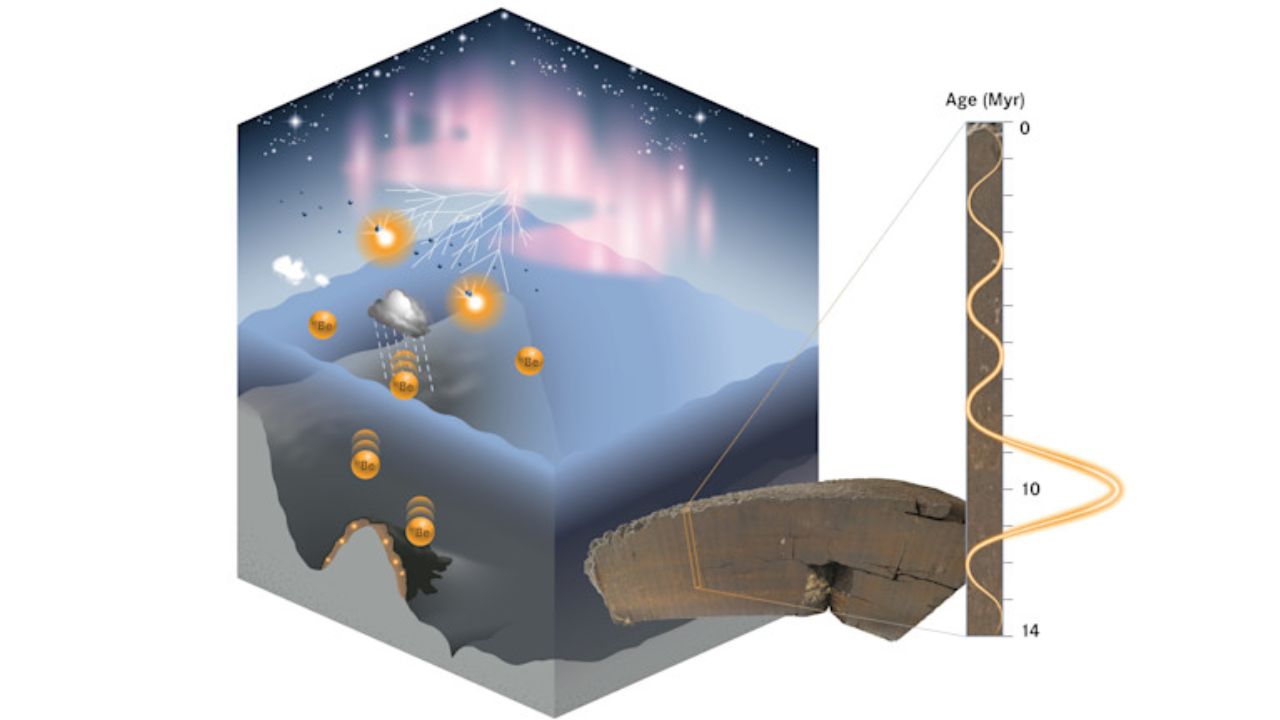
It all began when researchers from the Helmholtz-Zentrum Dresden-Rossendorf (HZDR), together with the TUD Dresden University of Technology and the Australian National University (ANU), were analyzing mineral crusts from the bottom of the Pacific Ocean.
These formations are like Earth’s diaries – over millions of years, they accumulate elements from seawater, recording environmental changes that have occurred on the planet. And that’s when the surprise came: scientists detected an absurd amount of beryllium-10, a radioactive isotope that is typically found at much lower levels.
-
In a flooded well, archaeologists found a 1,700-year-old Roman egg that still contains clear and yolk intact inside the very thin shell.

-
Something is happening around the Earth: Inside the huge explosion of fireballs in 2026

-
A hot air bubble coming from Argentina expands over Brazil, causing thermometers to exceed 38 degrees with a thermal sensation of 40 degrees in late March, affecting 6 states at once.

-
The radish leaf that almost everyone throws away has more polyphenols, flavonoids, and fiber than the consumed root, and a 2025 study showed that the leaf contains compounds that protect the intestine, combat inflammation, and may inhibit the growth of cancer cells.


The Question Is: Where Did All This Beryllium-10 Come From and Why Is It Accumulated There?

For those unfamiliar, beryllium-10 is an isotope produced when cosmic rays hit Earth’s atmosphere. It is widely used by scientists to measure geological events because its half-life is about 1.4 million years, allowing them to trace changes from up to 10 million years ago.
But the levels now found are almost double what was expected. This means that at some point in history, something extremely unusual happened.
Initially, researchers thought it could be a measurement error or some contamination in the samples. But after collecting sediments from other ocean areas, the pattern remained the same. In other words, this excess of beryllium-10 is not a local anomaly – it is something global.
So What? What Could Have Caused This Bizarre Increase?
One of the theories put forward by scientists relates to drastic changes in ocean currents around 10 million years ago.
The ocean currents act as a transportation system, distributing heat, nutrients, and even chemical elements around the planet. If there were any significant alterations in these flows in the past, it is possible that large amounts of beryllium-10 were displaced and accumulated in specific areas of the ocean.
“This could have completely messed up the distribution of the isotope across the planet, causing it to concentrate in certain regions,” explained Dr. Dominik Koll, one of the leading scientists in the research.
This theory makes a lot of sense. But if that isn’t it, something even more impressive could have occurred…
Could a Supernova Be the Key to the Mystery?
This is where things get even more interesting. Another hypothesis raised by the team suggests that the excess of beryllium-10 may have been caused by a cosmic event, possibly a supernova explosion that occurred relatively close to Earth.
Supernovas are violent explosions of stars, and one of the consequences of this phenomenon is the release of huge amounts of cosmic rays. If a supernova occurred close enough to our solar system, it may have bombarded Earth’s atmosphere with an extra dose of radiation, drastically increasing beryllium-10 production.
If this hypothesis is correct, it means that cosmic events had a much larger impact on Earth’s history than we imagined. But to be sure, scientists need more samples and analyses to confirm whether the same pattern appears in other geological records around the world.
The Importance of This Discovery for Scientists
Whatever the explanation – changes in ocean currents or a supernova explosion – the discovery of this excess beryllium-10 has enormous potential to revolutionize the way we study the planet’s history.
One of the biggest challenges for scientists is synchronizing different geological records, such as ice layers, rock formations, and marine sediments. If this beryllium-10 proves to be a global phenomenon, it could become a universal geological marker, helping to date past events with much greater accuracy.
“If we confirm this anomaly in different locations around the planet, we will have a new geological time marker – something that does not yet exist for such long periods,” Koll highlighted.
In other words, this discovery could be a key piece to rewrite Earth’s timeline.





❤️Here you can take off the girl’s clothes and see her naked) Check it out ➤ Ja.cat/gosea