





 Portuguese
  English
  Spanish
  3 min of reading
  0 comments


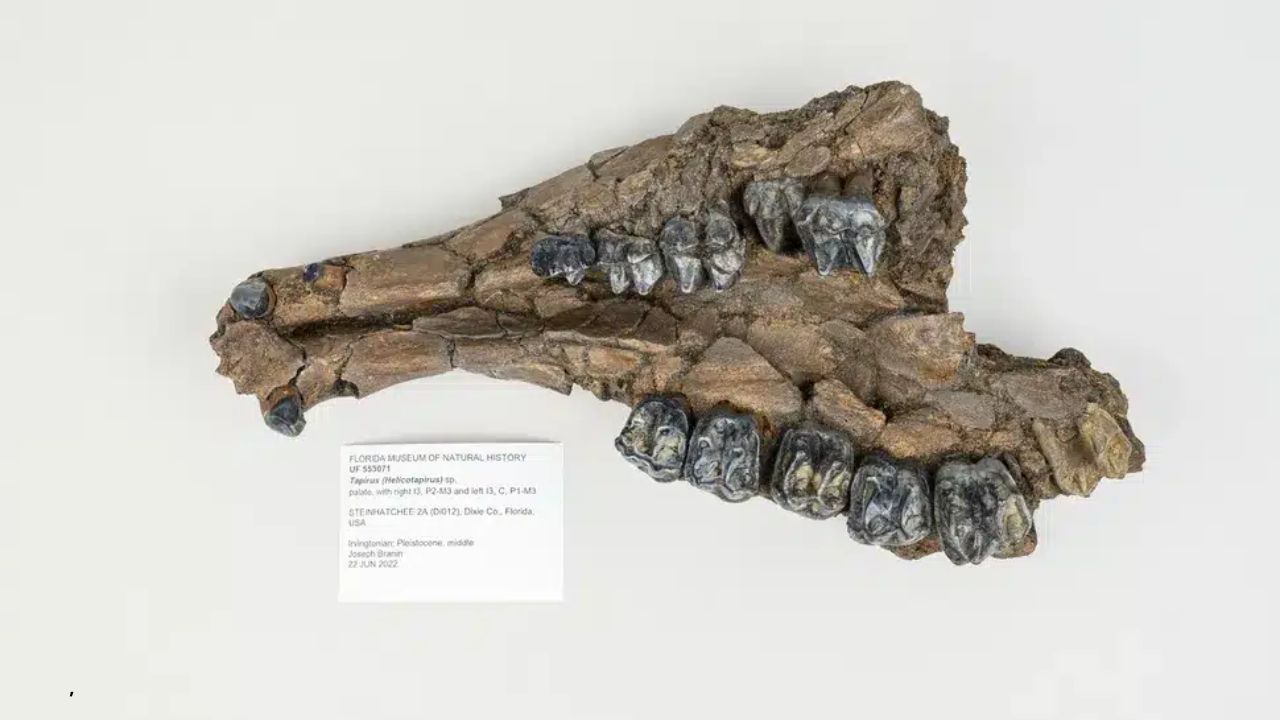
What Was Supposed to Be Just Another Routine Exploration of the Steinhatchee River in Florida Ended Up Revealing a Surprising Finding. Divers Investigating the Riverbed Came Across Fossilized Remains of Creatures That Lived Hundreds of Thousands of Years Ago. They Initially Appeared to Be Just Isolated Bones, But Upon Further Analysis, the Researchers Realized They Were Facing an Impressive Fossil Discovery.
The expedition quickly caught the attention of scientists and paleontologists, who rapidly organized a thorough study of the site of the fossil discovery. What they found could revolutionize the knowledge of Glacial Era fauna in the region.
A Glacial Era Cemetery Hidden Beneath the Water
The underwater sinkhole revealed a true cemetery of creatures that inhabited North America during the Glacial Era. Scientists recovered over 500 incredibly well-preserved fossils, belonging to extinct species such as giant armadillos, ancient horses, and colossal ground sloths.
Among the most intriguing finds is a skull of a tapir that exhibits characteristics never before seen, which may indicate a new species. The site functioned as a natural trap, where animals may have fallen and remained preserved for millennia.
-
In a flooded well, archaeologists found a 1,700-year-old Roman egg that still contains clear and yolk intact inside the very thin shell.

-
Something is happening around the Earth: Inside the huge explosion of fireballs in 2026

-
A hot air bubble coming from Argentina expands over Brazil, causing thermometers to exceed 38 degrees with a thermal sensation of 40 degrees in late March, affecting 6 states at once.

-
The radish leaf that almost everyone throws away has more polyphenols, flavonoids, and fiber than the consumed root, and a 2025 study showed that the leaf contains compounds that protect the intestine, combat inflammation, and may inhibit the growth of cancer cells.


The significance of this fossil discovery goes beyond the quantity of remains found. They provide valuable clues about how species evolved and how the ecosystem of the region changed over half a million years.
A Scientific Goldmine with the Fossil Discovery
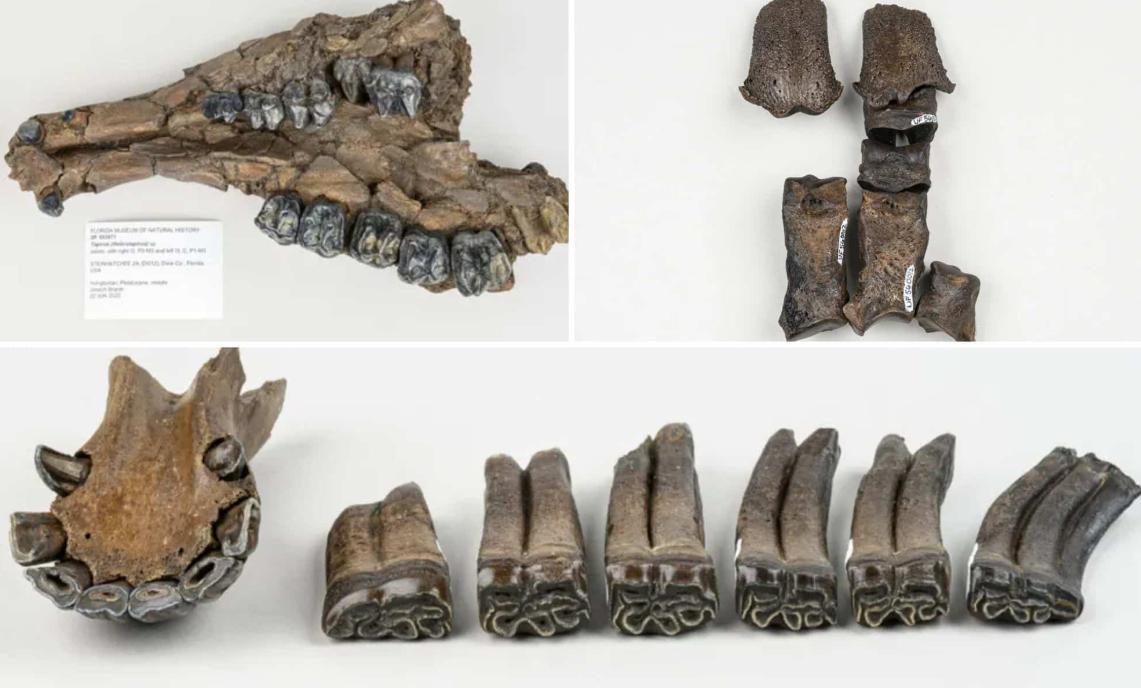
The abundance of fossils found led researchers from the Florida Museum of Natural History to organize a large-scale excavation. Among the recovered fossils is the Holmesina, an ancient relative of the giant armadillo, which helps to understand a curious phenomenon of evolution.
Scientists observed in the fossil discovery that this species underwent significant growth over time. The Holmesina floridanus, which weighed about 70 kg, gave rise to the Holmesina septentrionalis, which reached an impressive 215 kg. This transition, documented for the first time through the fossils found, indicates that the size of the animals increased before their bone structures fully adapted to the change.
“This gave us more clues about the fact that the anatomy kind of lagged behind the size increase. So they got bigger before the shape of the bones changed,” explained researcher Rachel Narducci.
A Mysterious Tapir and the Possibility of a New Species
Among the most exciting finds is a tapir skull with peculiar features. This animal, a distant relative of horses and rhinoceroses, exhibits traits that do not match those of known tapirs. This raised the hypothesis that scientists may have found a new species.
However, before making any definitive statements, researchers will need more fragments of the skeleton to analyze in detail. Richard Hulbert, the lead author of the study, warns that the observed difference may simply be a genetic variation within a known species.
“It could be a new species. Or it could just be an unusual individual within the population,” said Hulbert.







-

-

7 pessoas reagiram a isso.