





 Portuguese
  English
  Spanish
  4 min of reading
  0 comments


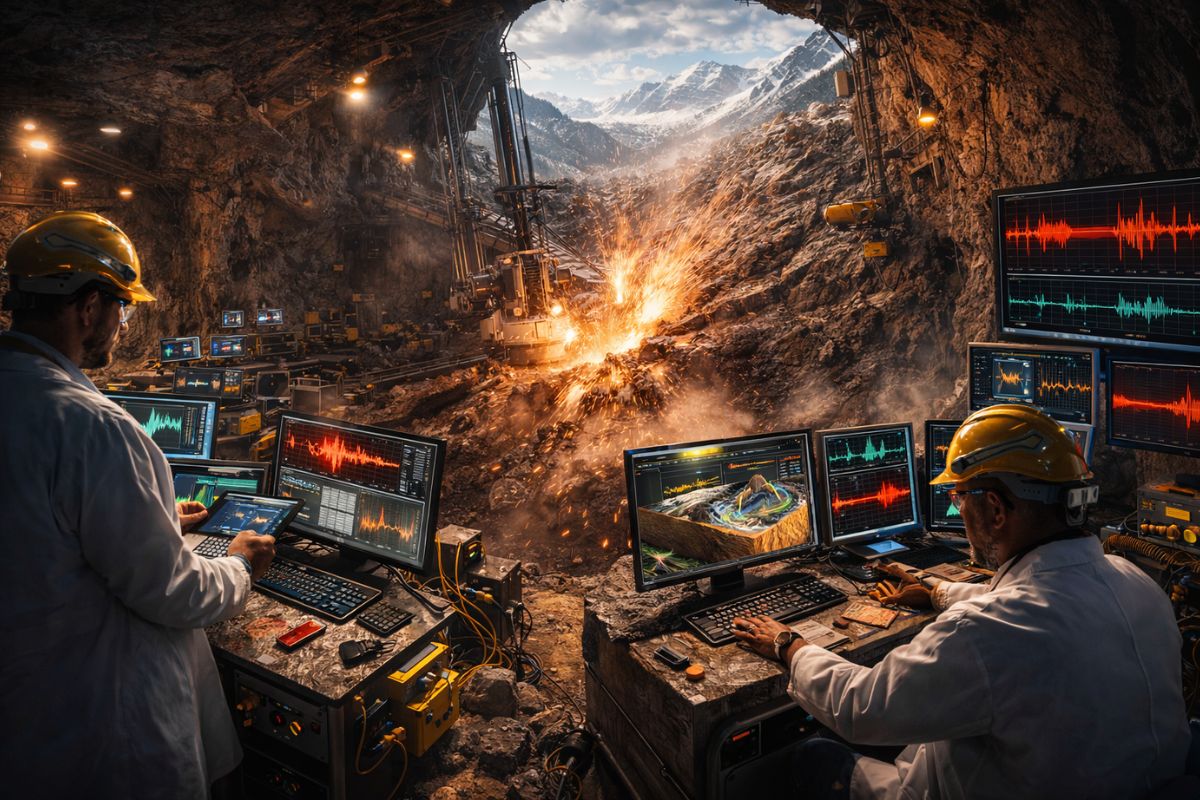
In The Bedretto Underground Laboratory, The FEAR Project Induces Small Earthquakes And Monitors Every Signal To Discover What Triggers Ruptures And How To Reduce Risks In Hydraulic Injection Activities
Studying earthquakes always encounters the same obstacle: they do not give warning when they will happen. Geological faults can go decades, sometimes centuries, without a strong event, making it almost impossible to be in the right place at the right time with enough instruments to record every detail. To circumvent this problem, researchers decided to create earthquakes in a controlled but still natural environment, directly on a real fault.
This is what happens at the Bedretto Underground Laboratory of Geosciences and Geoenergy in the Swiss Alps. The initiative, led by an international team with participation from ETH Zurich, uses hydraulic injection to induce small earthquakes in a highly instrumented section of a natural fault, aiming to observe how a tremor begins, how it propagates, and how it ends.
Why Is It So Difficult To Study Earthquakes In Nature
Even with modern seismic networks, the study of strong earthquakes faces a basic limitation: it is not possible to accurately predict the time and location of a rupture. And without sensors close to the point where the fault is moving, many important details are lost.
-
Something is happening around the Earth: Inside the huge explosion of fireballs in 2026

-
A hot air bubble coming from Argentina expands over Brazil, causing thermometers to exceed 38 degrees with a thermal sensation of 40 degrees in late March, affecting 6 states at once.

-
The radish leaf that almost everyone throws away has more polyphenols, flavonoids, and fiber than the consumed root, and a 2025 study showed that the leaf contains compounds that protect the intestine, combat inflammation, and may inhibit the growth of cancer cells.

-
A planet that seemed to defy the laws of physics has intrigued scientists for decades, until the James Webb revealed what is really affecting Saturn’s rotation.


Researchers explain that, in the natural environment, you can spend a lifetime without being exactly where an important event occurs. Therefore, the strategy of inducing small earthquakes allows instruments to be brought closer to the phenomenon and collect data that would rarely be obtained under normal conditions.
What Is The FEAR Project In The Bedretto Underground Laboratory
At BedrettoLab, about 1,500 meters below the Swiss Alps, the FEAR project operates, which stands for Fault Activation and Earthquake Rupture. The goal is to induce non-destructive earthquakes along a section of a natural fault equipped with a dense network of sensors.
The idea is to fill an important gap: it is not a traditional rock mechanics laboratory, but it also does not depend on waiting for a major event in nature. It is an intermediate scenario, a real environment, but monitored and with experimental conditions.
How Researchers Induce Earthquakes And Why This Relates To Hydraulic Injection
The central technique of FEAR is hydraulic injection, a process similar to those that can generate induced earthquakes in activities such as hydraulic fracturing, mining, and geothermal energy projects in superheated rocks.
The difference is that, in FEAR, this happens with heavy instrumentation and planning to measure each fault response.
The ultimate goal is to understand what triggers earthquakes and, if possible, apply this knowledge to reduce risks in contexts where hydraulic injection is used outside the laboratory, in real operations.
What The FEAR-1 Experiment Has Already Recorded
According to the project’s report, an experiment called FEAR-1, conducted at the end of 2024, conducted a series of 14 injections and induced approximately 9,000 seismic events, located both inside and outside the fault structure.
These earthquakes are so small that, in practice, they can only be perceived by instruments very close, just a few meters away. For this, there are sensors cemented in boreholes around the natural fault, capable of recording signals that would be imperceptible on the surface.
Safety And The Next Step With Magnitude 1 Earthquakes
Even inducing small earthquakes, safety is a priority, because no one wants the experiment to cause real damage. Therefore, the system includes safety measures to deal with any unexpected activity, with continuous monitoring of the signals.
The team also plans to increase the magnitude of the earthquakes to about 1. It is a low value in terms of impact but sufficient to collect information about the physics of the events, based on the logic that the physics of the process is the same, mainly changing the scale from microevent to large tremor.
What These Discoveries Could Change Outside The Laboratory
If researchers can detail how earthquakes start and evolve, the knowledge could help interpret early signals, assess risks, and calibrate practices in situations where induced seismicity is a concern, such as certain hydraulic injection operations.
Instead of relying solely on sparse data from rare events, the project seeks to build a base of repeatable measurements in a real fault, with sensors close to the point where the process occurs. It is a way to study earthquakes from within, at the level of detail that nature rarely allows.
Do you think inducing small earthquakes in a controlled environment is a valid way to reduce the risks of large tremors in the future, or should this type of experiment have even stricter limits?






-

Uma pessoa reagiu a isso.