





 Portuguese
  English
  Spanish
  4 min of reading
  1 comment


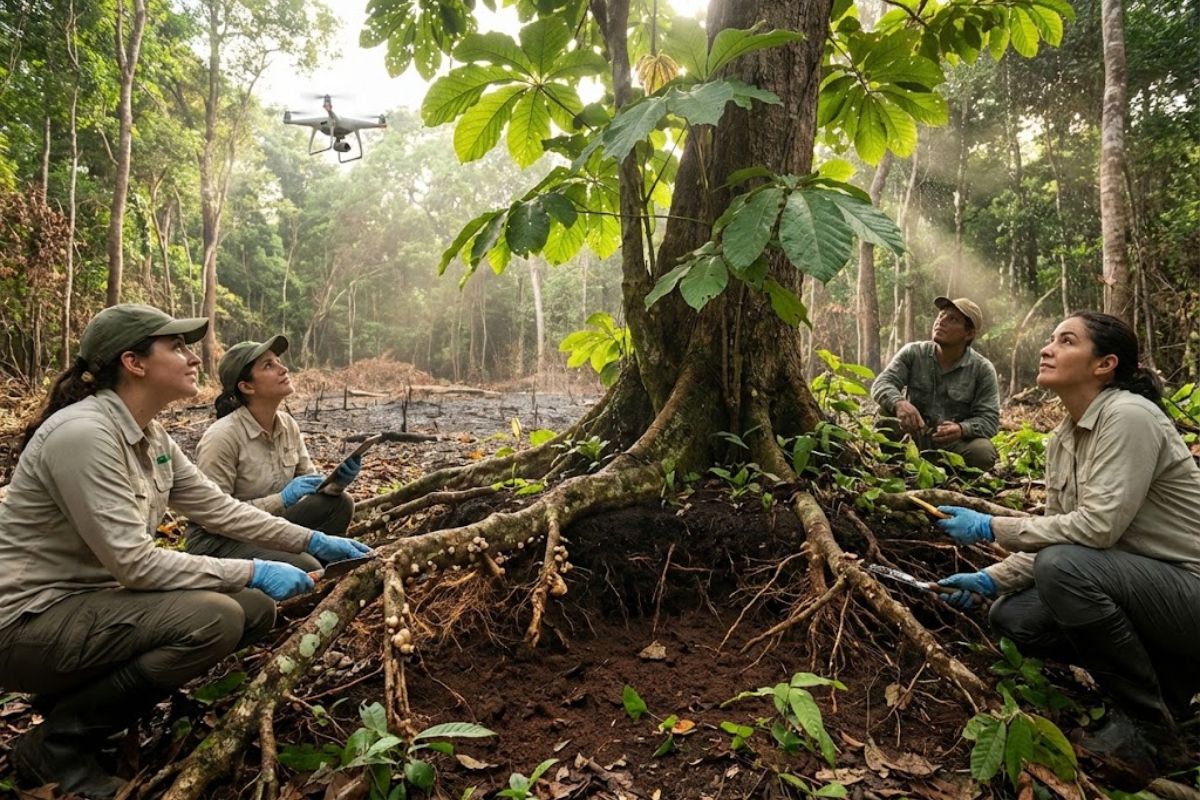


In Degraded Tropical Forests, Nitrogen-Fixing Trees Function as Biological Nutrient Factories, Recover Soil Fertility, Boost Biomass Growth, and Increase CO₂ Sequestration Without Industrial Fertilizers, Paving the Way for Faster, Cheaper, Resilient, and Climate-Smart Restoration at Scale in Tropical Countries.
Scientists monitoring the regeneration of trees in degraded tropical landscapes have observed a turning point: when nitrogen is available in the soil, forest growth consistently accelerates, especially in areas previously occupied by agriculture and livestock. This initial gain can redefine the entire pace of forest recovery.
In practice, the effect appears in a chain reaction. Young forests increase biomass, expand carbon storage in trunks and roots, and advance in ecological succession with less reliance on external intervention. Instead of a slow and uncertain process, restoration begins to operate with greater ecological efficiency and predictable outcomes.
The Factor That Decides the Speed of Recovery
Natural regeneration doesn’t always fail due to lack of seeds or rain. In many cases, it slows down because the soil has lost essential nutrients over years of intensive use. Nitrogen is at the center of this problem: it is a key element for proteins, chlorophyll, and plant DNA. Without sufficient nitrogen, the forest may sprout but does not gain traction.
-
China creates hypersonic engine that can make planes and missiles fly more than 6 times the speed of sound with less weight, more range, and without system change.

-
Mysterious object on Mars divides NASA and Harvard after Curiosity image reignites suspicions about what was really found on the planet.

-
Giant structures 14 meters beneath Egypt are revealed by satellites and expose a millennia-old secret buried in Buto.

-
Children have been making clay pieces for 15,000 years in Southwest Asia, and fingerprints preserved on 142 ornaments helped archaeologists prove this.

In degraded areas, this nutritional bottleneck is more pronounced in the early stages of growth. It was precisely here that researchers identified more robust responses: when the system receives biologically active nitrogen, young trees grow more vigorously and can even double biomass compared to scenarios with nutritional limitation.
In mature forests, on the other hand, the limitation tends to be less significant because the ecosystem is already more stabilized.
How Nitrogen-Fixing Trees “Manufacture” Natural Fertilizer

The mechanism is sophisticated and completely natural. Certain species, many of them tropical legumes, form associations with symbiotic bacteria in root nodules.
In these microenvironments, atmospheric nitrogen is converted into forms that are assimilable by plants. It’s as if part of the forest operates a biological fertility factory.
This process benefits not only the fixing species but the system as a whole. As the soil becomes enriched, other plants can establish more consistently.

The result is a more stable restoration, with greater functional diversity and lower risk of ecological stagnation. Practically speaking, planting trees with this capacity at the beginning of recovery can shorten stages that would normally take many years.
Carbon, Biomass, and Climate: Why the Impact Exceeds the Soil
As biomass increases, carbon also increases. Trunks, branches, leaves, and roots function as reservoirs of CO₂ removed from the atmosphere.
Therefore, accelerating the recovery of tropical forests is not just a local landscape goal: it is a global climate strategy. More forest growth in less time means more carbon stored more quickly.
There is also a relevant point of cost and feasibility. Fertilizing large expanses of forests in restoration is operationally difficult, expensive, and environmentally risky.
The planned use of nitrogen-fixing trees leverages the logic of the ecosystem itself to restore lost functions. Instead of imposing continuous external inputs, the strategy activates internal self-regulating processes, yielding ecological and economic gains in the medium term.
Where This Strategy Works Best and What It Does Not Solve on Its Own
The potential is greater in tropical areas degraded by agricultural use, especially when the soil has suffered prolonged impoverishment.
Fixing species can act as a “recovery trigger,” preparing the ground for other trees and a more complete succession. This is not a miraculous species, but intelligent ecological design.
At the same time, the strategy does not eliminate structural challenges. Restoration depends on a combination of species selection, protection against new disturbances, initial management, and continuous monitoring. If there is pressure from fire, grazing, illegal logging, or severe soil compaction, the nutritional gain may be insufficient to sustain a long-term trajectory.
Real progress arises when nitrogen fixation becomes a central piece of an integrated recovery plan.
The evidence points to a shift in focus: restoring forests is not just about planting seedlings, but rebuilding ecological functions that sustain growth over time.
Nitrogen-fixing trees show that recovery can be faster, more robust, and more efficient in capturing CO₂, provided the management respects soil conditions and the succession dynamics.
In your view, what should be the priority in degraded areas of your region: to plant any species quickly, or to invest in projects that choose trees capable of restoring the soil from the beginning? And if you have seen an area regenerate, what weighed more in the outcome: management, time, or species selection?






Qual o nome destas espécies de arvores