





 English
  Francês
  Alemão
  Italiano
  Japonês
  Norueguês
  Portuguese
  Spanish
  3 min of reading


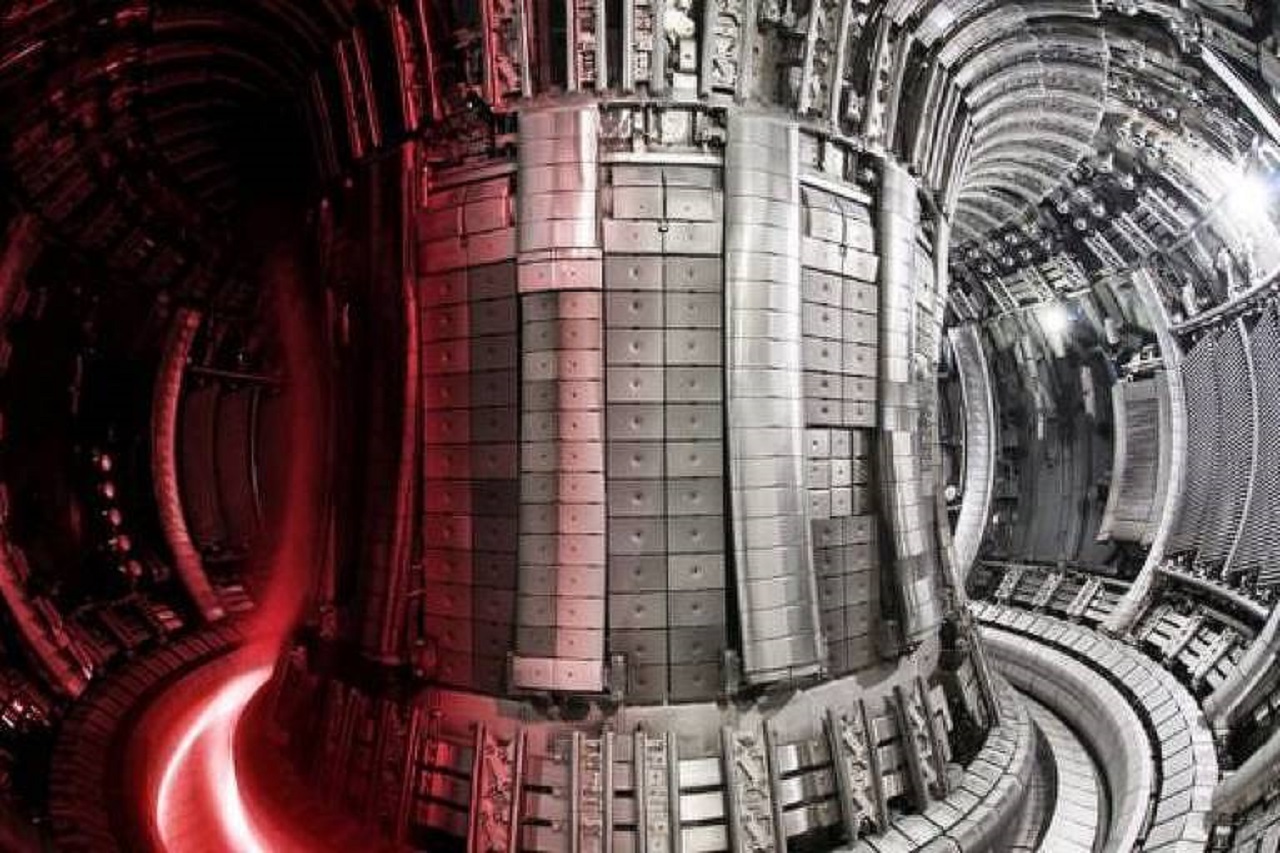
Scientists In The United Kingdom Have Started Using Hydrogen In Nuclear Fusion, And Thanks To This Combination It Was Possible To Produce 11 MW Of Energy In Just 5 Seconds
Scientists from a laboratory in Oxfordshire, United Kingdom, announced an advancement in creating a nuclear fusion process for renewable energy generation. The Joint European Torus (JET) laboratory, which includes studies from Europe on these matters, conducted tests that fused two forms of hydrogen, generating 59 megajoules of energy in five seconds. This result corresponds to 11 MW and is more than double what was achieved in similar tests in the 1990s.
Read Also
Nuclear Fusion From Hydrogen Shows Positive Results
The operations chief of the reactor laboratory, Joe Milnes, believes that the scientists’ experiment is a procedure that puts everyone one step closer to nuclear fusion energy. Joe emphasizes that the researchers demonstrated they can create a mini-star from hydrogen inside a machine and sustain it for five seconds, achieving high performance.
-
With 160,000 m² of collectors, an area larger than 20 football fields, Silkeborg, in Denmark, hosts a solar thermal plant that heats 19,500 homes and could become the largest solar heating plant in the world.

-
A study reveals the expansion of renewable energy procurement in Brazil and shows how companies are taking advantage of opportunities to reduce expenses, ensure energy efficiency, and strengthen strategic environmental commitments.

-
Mato Grosso do Sul excels in the sugar-energy sector: the state reaches a milestone of 22 operating mills and accelerates the production of clean energy in MS with a focus on sustainability.

-
National energy dilemma: Brazilians support clean energy but reject increases in tariff costs to finance the sustainable transition.

Until now, the renewable energy generated is not very significant, being able to boil around 60 kettles of water. However, its importance lies in the success of its tests, as the project will serve as a basis for a larger hydrogen nuclear fusion reactor for the ITER project in France.

According to Ian Chapman, CEO of JET, the scientists’ experiments in the Oxfordshire laboratory served as an example for the production of renewable energy with the combination of hydrogen; otherwise, there would be real concerns about whether ITER could meet its goals. This was something dangerous, and the fact that the scientists succeeded was due to the competence of the people and their confidence in scientific pursuit.
Nuclear Fusion Plants Using Hydrogen Could Replace Fossil Fuels
The ITER project, in southern France, has the backing of a consortium of governments, including the United States, Russia, China, and members of the European Union, for the first profitable application of nuclear fusion using hydrogen.
The estimate from the supporting countries is that it will be used on a large scale starting in 2050. If successful, hydrogen nuclear fusion plants would replace the primary source of pollution: fossil fuels, given that renewable fusion energy would not generate greenhouse gases, but rather small amounts of short-lived radioactive waste.
However, in the scientists’ studies from 1997, the laboratory used carbon-based materials that absorb tritium, a radioactive element. In the current tests, new coatings made of tungsten and beryllium were used.
Understand How Scientists Produced Renewable Energy By Combining Hydrogen
Nuclear fusion is based on the principle that energy can be generated from a process where atomic nuclei are placed against each other, and for this, scientists developed a solution where plasma generated from two hydrogen isotopes is maintained within a toroidal magnetic field.
Thus, they are exposed to high temperatures such that no substance can withstand it. This also happens in the core of the Sun, where immense gravitational pressures allow this to occur at temperatures of approximately 10 million degrees Celsius.









Seja o primeiro a reagir!