





 Portuguese
  English
  Spanish
  3 min of reading
  0 comments


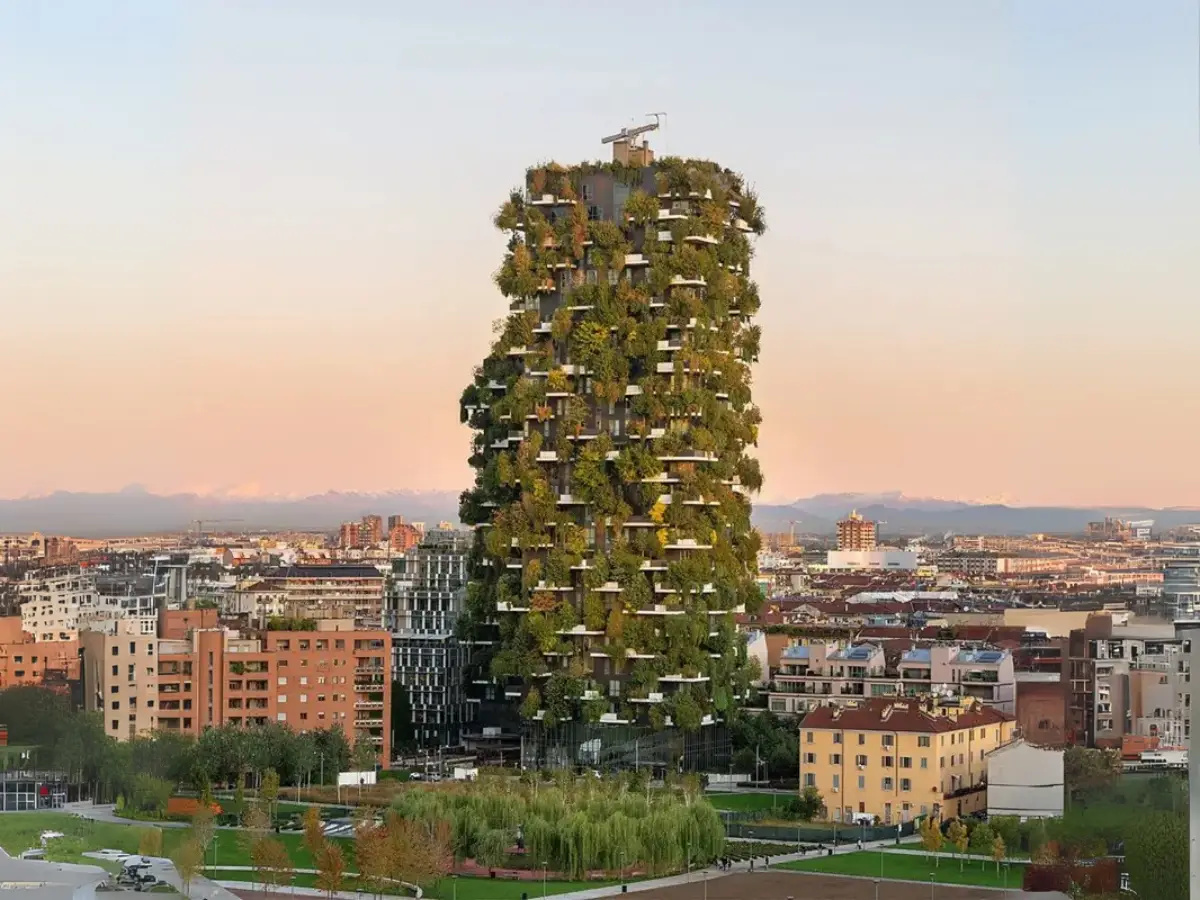
Urban Innovation: How Vertical Forests Combine Bioarchitecture, Sustainability, and Well-Being
Do you want to change the gray appearance of the city and, on top of that, combat heat, pollution, and climate crises? That’s how Stefano Boeri, in 2007, came up with an idea in the glass desert of Dubai: to create “green” skyscrapers, covered with plants, able to cater to both people and wildlife. The result is vertical forests, an innovation that revolutionized bioarchitecture and is changing the face of urban centers around the world.
Bosco Verticale in Milan: Surprising Result Was the First Vertical Forest in the World
In Milan, Boeri built two towers that are not just buildings, but ecosystems. At 110 m and 76 m, they house 800 trees, 4,500 shrubs, and 20,000 plants of 100 species, covering a green area equivalent to 5 hectares of park, on just 1,000 m² of land.
This vegetation cover reduces temperatures by up to 3 °C in the units, regulates internal temperatures, absorbs CO₂ and dust, generates oxygen, and enhances urban infrastructure in terms of well-being, sound insulation, and microclimate.
The sophisticated structure includes 3 m deep concrete balconies, special containers, smart irrigation with gray water, and solar energy on the roof. Maintenance is performed by professionals, the so-called “flying gardeners,” who take care of the vegetation at heights.
-
Friends have been building a small “town” for 30 years to grow old together, with compact houses, a common area, nature surrounding it, and a collective life project designed for friendship, coexistence, and simplicity.

-
This small town in Germany created its own currency 24 years ago, today it circulates millions per year, is accepted in over 300 stores, and the German government allowed all of this to happen under one condition.

-
Curitiba is shrinking and is expected to lose 97,000 residents by 2050, while inland cities in Paraná such as Sarandi, Araucária, and Toledo are experiencing accelerated growth that is changing the entire state’s map.

-
The lack of welders, electricians, and operators becomes a structural threat in 2025, with the construction industry and manufacturing already suffering from delays, cost pressures, and labor shortages in Brazil.

Sustainable Evolution in Cities
New projects explore materials with a lower environmental impact. In Paris, La Forêt Blanche is primarily made of wood to reduce embodied carbon. In Utrecht (Wonderwoods), starting in February 2025, there will be a mixed-use building with 200 apartments, 360 trees, and 50,000 plants, ensuring awarded urban biodiversity at last MIPIM.
Entire Cities of Green
The concept has gone to Africa (the first vertical forest in Cairo this year) and public housing in the Netherlands, the Trudo Vertical Forest, with limited rents to validate economic sustainability.
Benefits of Green in the Concrete Jungle
- Quality of Life: constant presence of plants reduces anxiety and depression levels by up to 40%, according to a Dutch study; in poor areas, the reduction can be 10%.
- Urban Functionality: buildings filter air, dampen noise, strengthen microclimates, and minimize the heat island effect.
- Ecological Infrastructure: green roofs and gray water systems aid in drainage, prevent flooding, and reduce demand for air conditioning.
Experts’ Perspective
Stefano Boeri states: “We must imagine a dual movement: citizens toward the forest and trees toward the city.”
Francesca Cesa Bianchi, architect, adds about Wonderwoods: “A multipurpose and highly biodiverse architecture, open to the daily life of citizens, plants, and birds of Utrecht.”
The World Green Building Council emphasizes that, although these structures require more materials, such as concrete, the gains in operational sustainability exceed this cost, especially when low-carbon materials and innovative solutions are adopted.
Even Being Emblematic Projects, Questions Arise:
- The extra embodied carbon (concrete, heavy structures) can negate benefits if the compensation is not calculated.
- The reliance on specialized expertise for maintenance may limit autonomy and create cost barriers.
- Environmentalists remind that these vertical forests do not replace extensive green areas; parks are still essential.
The Look to the Future
Boeri is already planning other green cities: Liuzhou (China) for 30,000 inhabitants and Cancún (Mexico) as a smart city, without combustion cars. The World GBB and researchers of nature-based solutions point out that bioarchitecture integrated into cities is crucial to combat climate change and promote urban sustainability in a measurable way.
Vertical forests are redefining the paradigm of urban construction. No longer mere symbols, they are an active part of the infrastructure, combining bioarchitecture, sustainability, and quality of life. Even with challenges to overcome, they point to a clear path: densely populated cities can also be densely green.
Did you like the article? Comment below what you think about bringing forests to the tops of cities, and don’t forget to share it with those who also enjoy urban innovation!









-

Uma pessoa reagiu a isso.