





 Portuguese
  English
  Spanish
  6 min of reading
  0 comments


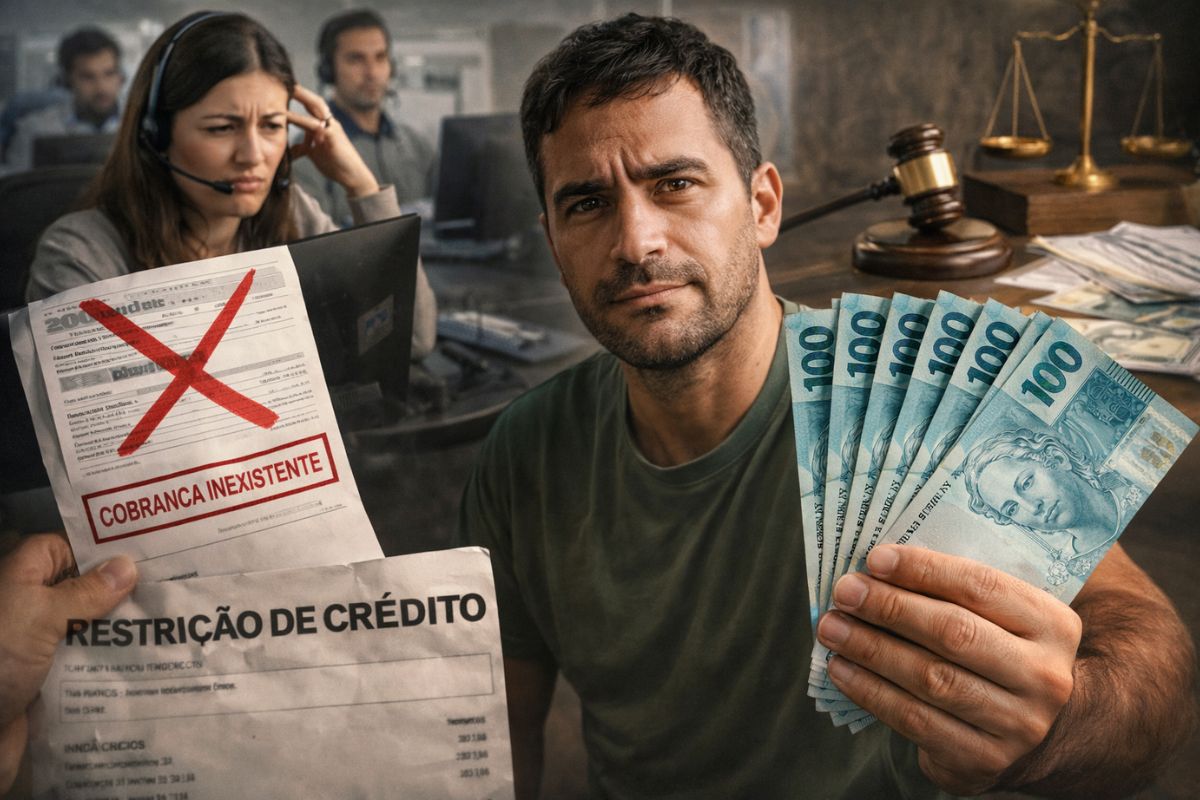
Court Ruling Condemns Telecom Company to Compensate Client R$ 10,000 for Nonexistent Bill, Phantom Charges on Invoice, Frustrating Calls to Call Center, Improper Credit Reporting, and Proven Productive Waste. Case Becomes Example to Punish Repeated Abuse, Protect CPF, and Reinforce Rights of Harmed Brazilian Consumers.
In a decision announced in December 2025, the Court ordered a telecom company to pay R$ 10,000 in moral damages to a customer who never contracted the billed line but saw their name negatively impacted by a nonexistent debt, after several unsuccessful attempts to resolve the issue through the call center.
In practice, the process transformed the phantom charges, persistent invoices, and improper credit reporting into concrete evidence of abuse, humiliation, and violation of the consumer’s credit honor. The case reinforces the trend among courts that treat this type of failure as presumed moral damage, rather than mere inconvenience, whenever the CPF is improperly listed in delinquent registries.
How the Court Transformed a Phantom Charge into a R$ 10,000 Judgment
According to the ruling, the Court recognized that the telecom company not only generated a nonexistent bill but continued the collection after being informed repeatedly that the service had never been contracted.
-
China, Brazil, and India together control the largest rare earth reserves on the planet and are now at the center of a geopolitical dispute that could determine who will dominate technology and the global economy in the coming decades.

-
While thousands continue to lack water and sewage on the coast of Piauí, the government inaugurates a R$ 5.5 million international portal in Barra Grande and bets on global visibility.

-
Lula’s government opens 13,000 positions for teachers in Brazil and creates more than 24,000 federal jobs, with an impact of R$ 5.3 billion by 2026.

-
A Chinese electric vehicle technology giant wants to invest up to R$ 200 million in a city in Santa Catarina, and the mayor returned from China with a signed document that guarantees the immediate opening of a CNPJ and the start of operations in Brazil.


The insistence culminated in the inclusion of the consumer’s name in credit protection agencies, which constituted improper credit reporting and moral damages.
The judge highlighted that the honor and credit of the consumer are protected legal assets, and sending the CPF to the delinquent registry for a nonexistent debt constitutes a serious illicit act.
In these cases, the understanding of damage in re ipsa prevails, that is, presumed, dispensing with proof of additional financial loss, because the very credit restriction already violates the dignity of the harmed person.
The amount of R$ 10,000 was set considering the company’s repeated conduct, the duration of the negative registration, and the proven distress caused by unproductive calls to the call center.
The Court sought an amount that would have a compensatory character for the consumer and a pedagogical one for the telecom operator, avoiding the trivialization of baseless charges.
When An Incorrect Charge Becomes Improper Credit Reporting and Moral Damage
Not every bill with an irregular amount automatically generates a large indemnification. In many cases, a specific error is corrected, and the situation is treated as a daily inconvenience.
The scenario changes, however, when the failure evolves into improper credit reporting, meaning that the company sends the consumer’s CPF to Serasa or SPC for a debt that simply does not exist.
In this hypothesis, the Court tends to understand that there was a direct violation of financial reputation, impacting the ability to obtain credit, finance goods, or even secure employment in sectors that consult delinquent registries.
The mere presence of the name on lists of bad payers is sufficient to presume moral damage and justify financial reparation.
In the case under review, the nonexistent bill was treated as evidence of systemic negligence, and the negative registration as proof of abuse.
Together, these elements dispelled the argument of mere administrative error and solidified the obligation to indemnify, including compensation for the time lost in dozens of calls to the call center.
The Ordeal of the Call Center and the Productive Waste of the Consumer
The decision also highlighted the so-called productive waste of the consumer, a theory increasingly used by the courts.
It is based on the premise that the time the citizen spends trying to solve a service failure, in calls, protocols, and trips to physical stores, is time subtracted from work, rest, and personal life.
The process demonstrated that the customer made successive calls to the operator’s phone support, registered protocols, insisted on clarifying that they had not contracted the line, and still continued to receive phantom charges.
This time invested to extinguish a fire created by the company itself was considered by the Court as an additional element to increase the indemnity.
By recognizing the productive waste, the Court makes it clear that large companies cannot transfer to the consumer the cost of correcting basic failures in registration, billing, and contract termination.
The citizen is neither the call center intern nor a free auditor of billing systems.
Step-by-Step to React Before Pursuing Legal Action
Although the case ended in a judicial ruling, the recommended path always begins through administrative channels. Organizing evidence from the first contact greatly increases the strength of the case if the dispute reaches the courts.
The basic steps include:
Operator’s Customer Service
Dispute the bill as soon as the error is identified, demand a detailed explanation, and request the recording of the call. It is essential to note the protocol number, date, and time of service.
Ombudsman
If the Customer Service does not resolve the issue within a few days, the customer should contact the ombudsman with reference to the original protocol, emphasizing that it is an improper charge or nonexistent bill.
Anatel or Consumidor.gov
If the problem persists, the consumer should file a complaint on official platforms, where companies tend to respond more quickly to avoid sanctions and negative monitoring by the regulatory agency.
Small Claims Court
If, despite everything, the charge continues or the name has already been negatively impacted, the path is to seek the Small Claims Court. For cases up to 20 minimum wages, it is possible to file a claim without a lawyer, presenting contracts, invoices, protocols, and any proof of negative registration.
Most Common Errors and Frauds Hidden in the Invoice
The decision regarding this case is not isolated. The telecommunications sector concentrates complaints about improper charges, uncontracted services, and lines opened without authorization. Some patterns are repeated and require the consumer’s constant vigilance:
Value-Added Services
Monthly charges for antivirus, games, horoscopes, or content subscriptions never requested. As a rule, they should be canceled and refunded, often double.
Phantom Line
Charges related to an unknown number associated with the victim’s CPF, often the result of fraud or improper registration. Here, in addition to disputing the charge, it is advisable to file a police report.
Wrong Loyalty Penalty
Charges for a penalty after the minimum contracted period or in situations of serious service failure, such as absence of signal or constant connection drop.
Charges After Cancellation
Issuing invoices months after the contract’s termination, without any justification. In such cases, the company needs to prove that the service was indeed rendered, not the other way around.
The case of the nonexistent charge judged by the Court fits into the most severe category, as it combined billing error, failure to correct, and improper credit reporting with a direct impact on the consumer’s credit history.
Right to Double Refund and CPF Protection
In addition to compensation for moral damage, the Consumer Defense Code guarantees double refunds for amounts paid unduly, with monetary correction and interest when the incorrect charge is settled by the customer.
Article 42 of the CDC is clear in protecting those who, under pressure or fear, end up paying what they do not owe.
To exercise this right, it is crucial to keep the payment receipt and associate it with the dispute protocol.
Without this document, it becomes more difficult to demonstrate concrete financial loss and demand the return of the undue payment.
In the case under review, the improper credit reporting was sufficient to substantiate the moral damage, but in many actions, the double refund is the central axis of the discussion.
The episode also reinforces practical lessons: regularly monitor the CPF status in credit bureaus, review recent invoices for strange charges, and keep customer service protocols stored for years.
In an environment of high digitalization and multiple services associated with the same line, any oversight creates room for phantom charges to become long and exhausting legal processes.
In light of this scenario, in your view, should the Court impose even higher compensation in cases of improper credit reporting and phantom charges, or are amounts around R$ 10,000 already sufficient to force operators to change their behavior?










Seja o primeiro a reagir!