





 Portuguese
  English
  Spanish
  6 min of reading
  0 comments


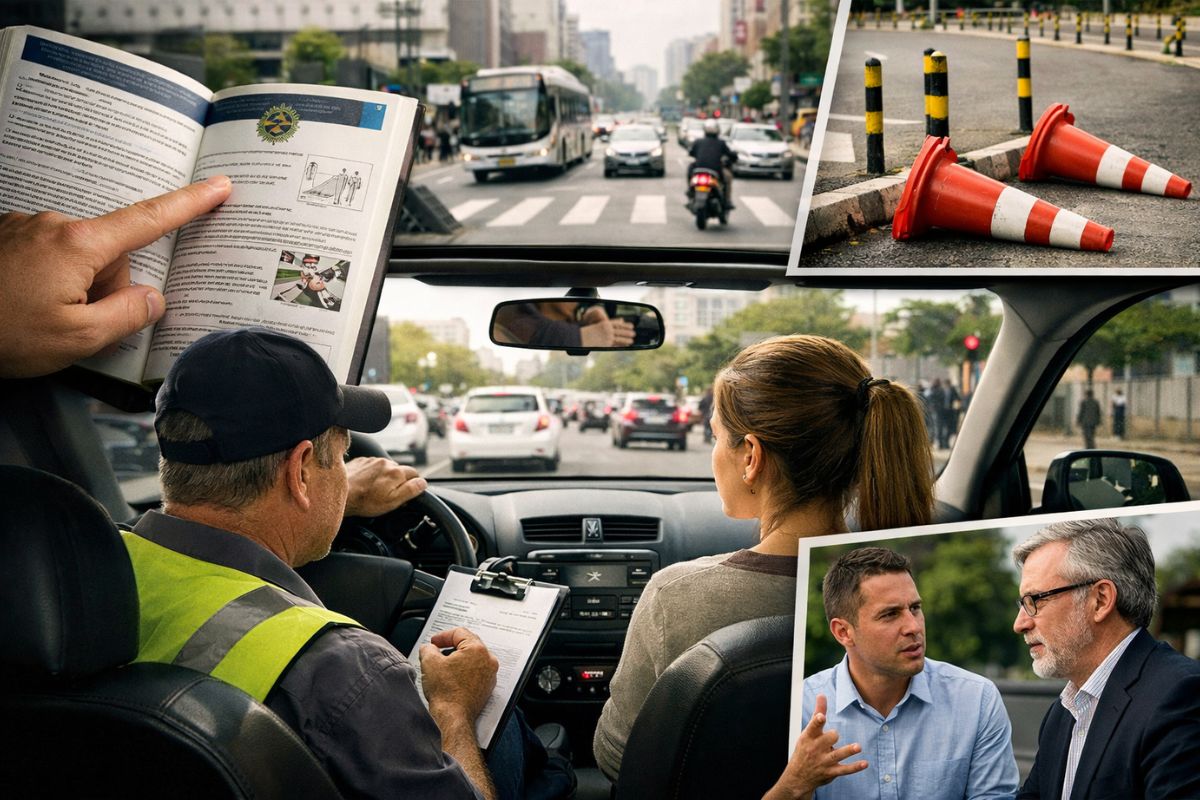
The National Document Redefines How the Candidate Will Be Evaluated on the Street, Reduces the Weight of the Isolated Maneuver and Opens Space for States to Remove the Circuit’s Parking Placement. While Some Detrans Adopt Immediate Changes, Others Wait for Technical Guidance, and the Discussion About Safety Gains Strength with Automatic Cars and New Emotional Requirements.
The National Traffic Department (Senatran) this Sunday (1st) Circulated a New Manual to Guide the Practical Test for Obtaining a Driver’s License and, with that, Changed One of the Most Sensitive Points of the Process: What, Ultimately, Should Define Whether Someone is Ready to Drive. The Proposal is to Standardize Criteria, Reduce Distortions Between States and Bring the Evaluation Closer to What Happens Outside the Controlled Circuit, in Real Traffic.
In Practice, the Change is Not “a Switch that Turns On and Off” Across the Country on the Same Day. The Parking Maneuver is No Longer Mandatory in Some States, but the Candidate Still Needs to Complete the Course by Parking, and There are Detrans that Continue to Require the Maneuver for Now. The Result is a Scenario that Mixes Quick Adaptation, Administrative Caution and an Uncomfortable Public Discussion: Does Modernizing the Test Produce Better Drivers, or Just Reduce a Stage that Many People Fear?
What Changes When the Practical Test for the Driver’s License Gains a National Manual
The New Brazilian Manual of Vehicle Driving Tests Attempts to Organize Something that, for Decades, has been Perceived as Unequal from One Place to Another. The Idea is for the Practical Test to Stop Being a “Mechanical Ritual” Centered on Memorized Movements and Start Measuring Driving Performance with More Meaning, Such as Attention to the Environment, Risk Reading, Respect for Rules and Interaction with Others Sharing the Road.
-
The largest food company on the planet, JBS, has just opened a 4,000 square meter laboratory in Florianópolis to develop customized proteins that modulate muscle mass gain, immune response, and metabolic performance.

-
After nearly 30 bids and competition among industry giants, a Spanish company purchases one of the largest airports in Brazil for almost R$ 3 billion and takes over the management of Galeão in a concession that will last until 2039.

-
The Federal Revenue Service now automatically cross-references everything you declare with data from banks, credit cards, brokerage firms, and insurance companies, and any discrepancy between your income and your expenses triggers an alert in seconds.

-
Amid global tensions, Brazil blocks the United States’ proposal at the WTO and paves the way for a trade crisis and possible retaliations.


This Does Not Mean a “Easier Test” by Definition, but Rather a Test More Coherent with Real Situations. A Candidate Can Execute a Perfect Parking Maneuver in a Designated Space and Still Exhibit Insecurity in Turns, Lateral Distance, Decision Making, and Self-Control Under Pressure.
The Manual Tries to Capture This Type of Competence, which is Usually What Makes a Difference When the Street Stops Being Predictable.
Parking: Why It Ceased to Be an Obligatory Step in Several Places
The Most Noteworthy Point is that Parking Loses Its Status as an Obligatory Step in Part of the Country. The Technical Justification is Direct: Evaluating Only an Isolated Maneuver, in a Controlled Space, May Say Little About How the Driver Behaves in Everyday Traffic.
The Focus Shifts from “Hitting the Cone” to “Driving Responsibly”, Which Includes Observing Pedestrians, Cyclists, Signage, Priority, Compatible Speed, and Predictability.
At the Same Time, Parking Continues to Exist in the Real World, and It is Exactly for This Reason that the Topic Divides Opinions. Parking Involves Spatial Awareness, Fine Control of the Vehicle, Patience, and Context Reading, Including Avoiding Disrupting the Flow of Traffic.
What Changes is Where and How This Skill Appears in the Evaluation: the Manual Reinforces the Completion of the Route with Parking, as the Closing of the Exam, Even When the “Classic” Parking Maneuver Leaves the Center Stage.
Real Traffic in the Center: What is Observed on the Street
The Practical Test Now Values a Route on Public Roads, Because It is There that Decisions Arise that Differentiate a Prepared Driver from Someone Who Simply Memorized a Circuit.
Sustained Attention, Respect for Signage, Safe Distance, Correct Use of Turn Signals, Positioning in Lanes, Intersection Reading, and Behavior in Conflict Situations are Included as Elements that Can Be More Richly Evaluated When There is Real Traffic.
Another Important Point is the Emotional Aspect. Those Who Drive Know: the Steering Wheel Requires Technique, but Also a Cool Head. The Manual Highlights that Emotional Control is Part of What Impacts Safety, Because a Common Mistake Among Beginners is Getting Lost in Their Own Nervousness, Accelerating Poor Decisions, or “Freezing” in the Face of an Unexpected Event.
Instead of Measuring Only the Precision of the Maneuver, the Exam Now Seeks Signs of Driving Maturity, Placing More Weight on Behavior.
States at Different Rhythms: Who Has Already Changed and Who is Still Waiting
Some States Have Adopted the Removal of Parking as an Obligatory Step and Expanded the Focus of the Route on Public Roads. Among the Examples Cited, São Paulo Recently Dropped the Requirement, and Sergipe Also Removed the Obligation. Amazonas, Espírito Santo, and Mato Grosso do Sul Appear as Cases Where the Evaluation Shifts to a Route Defined by the Detran, Without Dependence on Specific Maneuvers in the Traditional Format.
There is Also a Fact That Often Surprises Those Who See This as “Absolute Novelty”: the Federal District Stopped Applying the Parking Test There in 2004.
And There is Gradual Transition, as in Mato Grosso, Where the Change Was Announced with Scaled Implementation Until February 10.
At the Same Time, Many Detrans Reported That They Were Awaiting Technical Guidelines Before Changing the Model, Which Helps Explain Why the Country, for a Period, Tends to Coexist with Different Criteria.
Automatic Cars in the Test: A Detail That Changes What Being Licensed Means
Another Change That Gained Strength Was Allowing Candidates to Take the Test with Automatic Vehicles in Some Places, Such as São Paulo. This Relates to the Real Fleet: According to the National Institute of Metrology, Quality, and Technology (Inmetro), the Brazilian Vehicle Labeling Program Indicated 121 Models and Versions with Manual Transmission Among 769 Available, Which Represents 15.7% of the Total Cited.
This Point Is Deeper Than It Seems. If the Car That the Person Will Drive in Daily Life is Automatic, Demanding Mastery of the Clutch as an Absolute Condition May Seem Disconnected from Reality.
On the Other Hand, Some See the Risk of Diminishing Practical Training, Especially if the Migration to Automatic Occurs Without Pedagogical Compensations, Such as More Training in Traffic Reading, Braking, Defensive Driving, and Decision Making.
The Debate That Divides: Modernization of the Exam or Less Prepared Driver
In the Public Discussion, Two Legitimate Concerns Arise That Do Not Always Interact with Each Other. On One Side, Traffic Law Experts Warn That Parking is Routine, Influences Flow and Safety, and Removing a Step Without Compensation in Training May Enable Drivers with Insufficient Vehicle Control. The Fear is Simple: The Test Changes, But the Street Does Not Forgive.
On the Other Hand, Those Who Work with Traffic Psychology Tend to View the Process as a Whole.
The Critique, in This Case, Is Not Just “Parking Yes or No,” But the Risk of Successive Changes Without Time to Measure Results, Especially When There Are Parallel Discussions About Practical Lesson Load and Training Formats.
In This View, the Problem is Not Adapting the Exam, But Doing So Without Monitoring Rejection Rates, Accidents, and Driving Quality Over Time.
What to Do If You Are Getting Your Driver’s License Now
For Those Who Will Get Their Driver’s License, the Practical Rule is: Follow the Standard of Your Detran and Understand What Format is Valid in Your State. Even Where Parking is Not Mandatory as an Isolated Step, Parking Remains Part of the Route and Still Requires Control and Spatial Awareness. And, in the Model More Connected to Real Traffic, Making Mistakes Due to Lack of Attention, Signage, Priority, or Defensive Posture May Carry More Weight Than Before.
It is Also Worth Adjusting Expectations About “What to Study.” Preparation Cannot Be Just Memorizing Movements.
Train What Supports Safe Driving: Intersection Reading, Speed Control, Safe Distance, Use of Mirrors, Anticipating Risks, Respect for Pedestrians and Cyclists, and Calm Under Pressure. In an Exam That Observes Behavior, the Candidate is Evaluated as a Driver, not as Someone Who Just Executes a Choreography.
If the Practical Test for the Driver’s License Needs to Measure Real Traffic, Should Parking Remain Mandatory Across the Country or Does it Make Sense to Become Just Part of the Final Parking of the Route? In Your State, Does the Exam Still Require Parking as a Separate Step? And, Honestly: What Was the Most Difficult Part for You, the Maneuver or Dealing with Nervousness on the Street?








-

Uma pessoa reagiu a isso.