





 English
  Francês
  Alemão
  Italiano
  Japonês
  Norueguês
  Portuguese
  Spanish
  5 min of reading
  0 comments


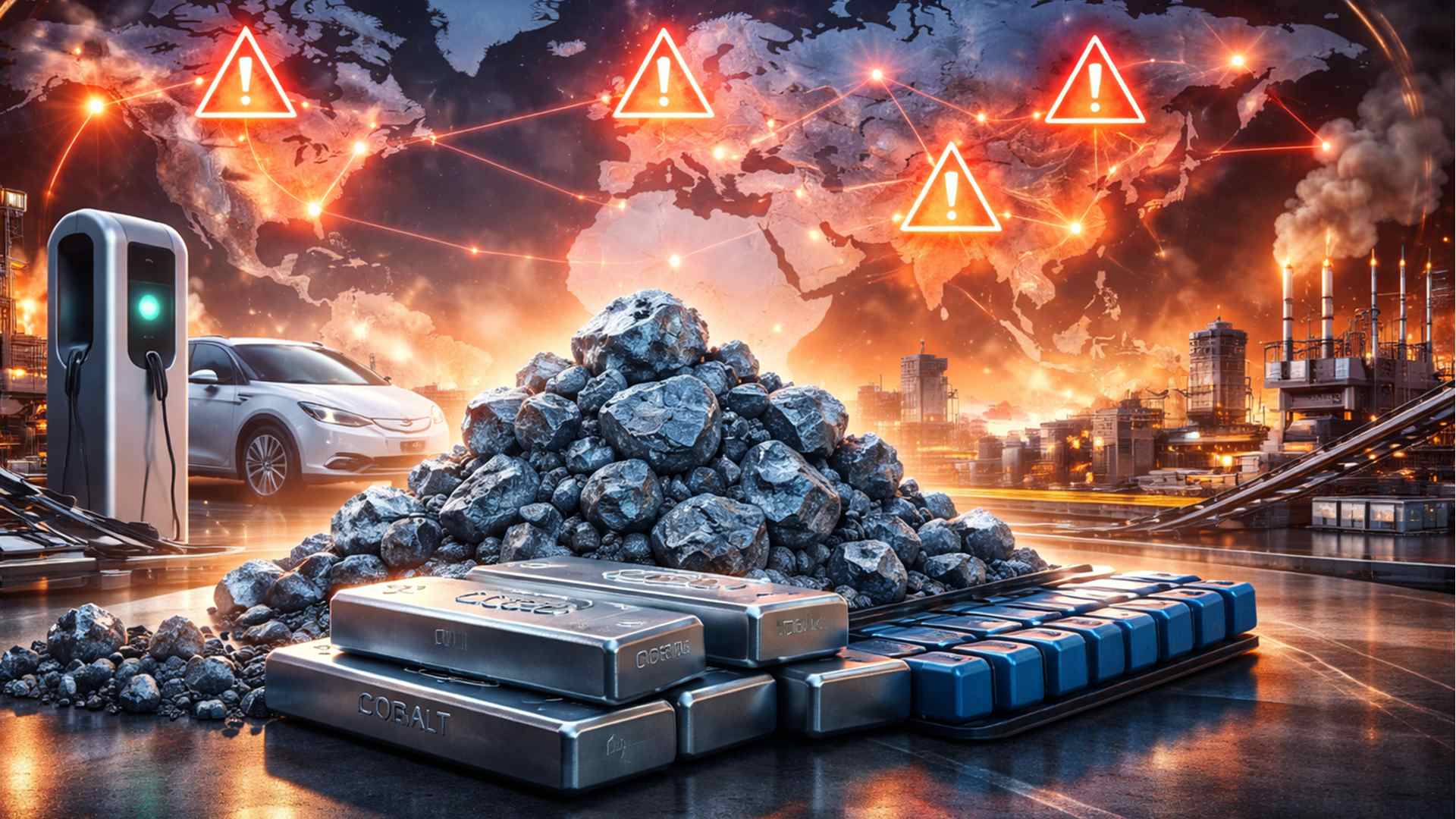
Published study in Environmental Science and Ecotechnology shows that localized shocks in the global cobalt supply chain can spread among 230 countries, reach refining and manufacturing, and cause cascading effects on batteries, electric vehicles, and the energy transition
A study published in the journal Environmental Science and Ecotechnology warns that the global cobalt supply chain, a key input for lithium-ion batteries and electric vehicles, may experience sudden and widespread collapses when localized shocks spread among countries and production stages, increasing risks for the energy transition.
Cobalt concentrates risks that go beyond isolated interruptions
According to the research, systemic risks related to cobalt are not limited to isolated failures in one country or production stage. The study shows that disturbances initiated at a single point in the network can cross borders and life cycle phases, causing widespread failures throughout the supply structure.
The researchers combined material flow analysis with a multilayer shock propagation model. From this methodology, they concluded that risks concentrate in the early stages of the chain but reach greater intensity at the bottlenecks of refining and manufacturing.
-
The climate in 2026 may surprise with extremes even more intense than in 2025, with heatwaves, out-of-season cold, and irregular rainfall in Brazil.

-
Astronomers identify 45 rocky planets that could harbor life, and one of them is just 4.2 light-years from Earth, making it the closest neighbor with the potential to have liquid water on its surface.

-
Archaeologists discover 43,000 ostraca in Egypt with tax lists, drawings, religious texts, and everyday notes that reveal what life was like in ancient Athribis before Cleopatra.
-
China showcases laser defense systems that target drones flying very low and attempts to address a flaw that has been concerning armies worldwide.


According to the authors, shock pathways spread horizontally among countries and vertically among production stages, both through direct and indirect routes. This mechanism can prolong interruptions, generate cascading effects across multiple stages, and lead to sudden and nonlinear ruptures.
The conclusion of the study is that traditional assessments, focused only on the national level, underestimate the real vulnerability of the cobalt supply system. For the authors, improving resilience requires coordinated strategies on a systemic scale.
Demand growth increased network complexity
The global expansion of electric vehicles and energy storage systems has considerably increased the demand for cobalt. This advance, according to the study, has intensified concerns related to supply security, geopolitical concentration, and environmental and social impacts.
The research notes that conventional approaches to assess critical minerals often focus the analysis on isolated countries, materials, or trade flows. This focus, according to the authors, ignores the close relationships between the supply chain and the production chain that shape the functioning of the system.
Recent events, such as export restrictions, trade disputes, and pandemic-related disruptions, are pointed out as demonstrations that localized shocks can propagate through global production systems.
The study argues that current analytical tools still struggle to simultaneously track the propagation of risks across multiple economies and multiple production stages.
This limitation reinforces, according to the researchers, the need for a broader, network-based approach to examine risks in the cobalt supply chain.
The proposal of the work is precisely to fill this gap with a framework capable of tracing hidden interdependencies and their cascading effects.
Global network connects 230 countries in six production stages
In the study, researchers from the Chinese Academy of Sciences, Peking University, and the University of Southern Denmark examined global cobalt flows between 1998 and 2019.
They built a multilayer supply chain network and applied an iterative shock propagation model to analyze the displacement of disruptions among countries and across six stages of the life cycle.
These six stages include mining, refining, manufacturing, use, and recycling. The team mapped a network that interlinks 230 countries in connected production phases, combining material flow data associated with trade with a dynamic shock model.
With this structure, the researchers simulated how supply shortages or demand drops in one part of the system could trigger cascading failures at other points. The result, according to the study, constitutes one of the most detailed assessments ever produced on systemic risk in the global cobalt supply chain.
The analysis shows that disruptions circulate through direct and indirect pathways, crossing trade routes and national production chains. Although mining, especially in highly concentrated extraction regions, appears as a recurring source of risk, the most severe impacts concentrate at the “bridges” of refining and manufacturing, where dense connections amplify failures.
Hidden fragility appears in a network much denser than physical trade
One of the central results of the study is the identification of a “network of avalanches” formed by potential failures. According to the authors, this network is about four times denser than the physical trade network, revealing a broad set of hidden dependencies in the global system.
The research points out that China and the United States exhibit high systemic fragility. This means, according to the work, that disruptions in these countries can trigger a widespread collapse along the supply chain.
The study also highlights the situation of countries with relatively low production but high exposure to the system. In these cases, vulnerability to random disruptions is high, while the response capacity appears to be insufficient.
In the landscape of the last two decades, the authors state that global cobalt supply risks have increased. The fluctuations observed over the period, according to the study, were driven by increasing concentration and imbalances between supply and demand.
Implications for public policy and energy transition
The researchers describe the cobalt supply chain as a “robust yet fragile” structure. In practice, this means that the system can absorb small random interruptions but remains highly sensitive to targeted shocks at critical points.
The study states that measures such as the formation of national stockpiles or the relocation of production can reduce risks for specific countries.
At the same time, the authors warn that this type of initiative can also shift vulnerabilities to other parts of the global network.
To enhance resilience, the researchers advocate for coordinated strategies that consider the connections between production stages, rather than just isolated national responses. Without this broader perspective, efforts to secure critical minerals for the energy transition may inadvertently increase global supply instability.
The conclusions also have implications for energy policy, governance of critical minerals, and industrial planning.
According to the study, the developed structure can help in creating early warning systems, strengthening international cooperation, formulating shared stocking strategies, expanding refining and production capacity, and more broadly assessing the effects of trade restrictions or decoupling processes.
The research also states that the approach can be applied to other essential materials for batteries and clean energy technologies.
In summary, the work argues that a stable transition to a low-carbon economy will depend not only on the availability of resources but also on the management of the complex global networks that connect these materials.







Seja o primeiro a reagir!