





 Portuguese
  English
  Spanish
  11 min of reading
  0 comments


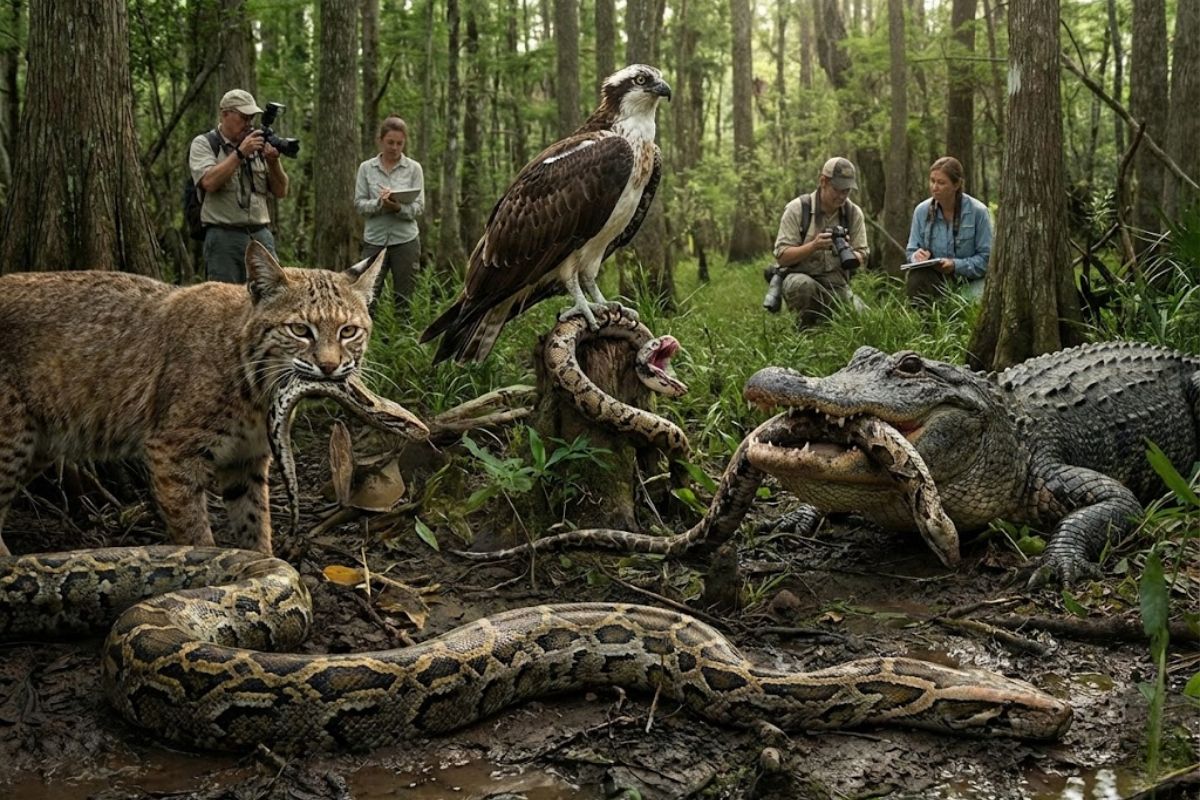
After Locating Decapitated Snakes on Trails, Researchers Tracked Loki, a Nearly 4 Meter and Over 20 Kg Snake Used as a “Judas Snake” with GPS. The Camera Showed a Bobcat Returning to the Corpse. Alligators, Birds, and Even Other Snakes Also Frequently Attack Eggs and Offspring.
In the Heart of the Everglades, What Shocked Researchers the Most Was Not Just Finding Dead Snakes. It Was Finding Headless Snakes, with Their Neck Mutilated and Bodies Covered by Pine Needles, as if Someone Had Executed a Precise Strike on the Most Vulnerable Point.
The Scene Became a Symbol: Loki, a Male Snake of Nearly 4 Meters and Over 20 Kg, Monitored in an Experiment. The Deliberate Death of Loki Undermined the Idea That These Invasive Snakes Had No Real Enemies in Florida and Exposed a Rare Ecological Turn, with Native Predators Learning to Attack One of the Ecosystem’s Most Aggressive Invaders.
The Find That Became an Alert About Decapitated Snakes

The Team Reached Loki Because He Was Not Just an Ordinary Animal. He Had Been Released with a Specific Purpose, Carrying a Tracking Device to Guide Researchers Through Critical Areas. When the Signal Suddenly Stopped, and the Animal’s Body Temperature Dropped, It Became Clear That This Was Not a Normal Displacement.
-
With a cost per shot close to zero, the DragonFire laser could change naval warfare in 2027 and provide British ships with nearly unlimited defense against drones.

-
A British startup creates tires that generate electricity in electric vehicles when passing over potholes, speed bumps, and cracks.

-
Scientists have created robots made with living cells that have their own nervous system, swim on their own, explore the environment, and self-organize without any genetic engineering, and now they want to do the same with human cells.

-
Students create a solar-powered ambulance that operates without a plug, without fuel, and still keeps medical equipment running in remote areas.


The Body Found Did Not Suggest a Simple Disordered Attack. The Decapitation Pointed to Force, Technique, and Calculated Risk, Something Difficult to Reconcile with the Narrative Repeated for Years that Burmese Pythons Roamed Florida Practically Without Capable Predators to Face Them.
How Invasive Snakes Conquered the Everglades
Burmese Pythons Have Become What Many Researchers Have Come to Treat as an Ecological Catastrophe.
The Oldest Records Cite Few Dispersed Individuals Since the 1930s, but the Turn Happened When Florida Consolidated as a Hub for Exotic Animals.
From the 1970s Onward, the Presence of Snakes as Pets Exploded, Alongside Monkeys, Parrots, Lizards, and Other Species Out of Their Natural Habitat.
The Problem is That the Young Python Seems “Manageable.” It Is Described as Beautiful and Docile When Small, with Brown-Golden Patterns. Then It Grows.
An Adult Can Reach 4 to 5 Meters and Weigh 20 to 40 Kg, a Size That Makes Domestic Maintenance Unfeasible. The Result Was Predictable: Thousands of People Opted to Release Them into the Wild, Precisely in a Place with a Warm Climate, Shallow Water, and Countless Hiding Spots.
There Was Also a Scale Trigger. In 1992, Hurricane Andrew, a Category 5 Storm, Destroyed Areas Around Miami and Triggered a Mass Escape Linked to a Reptile Breeding Facility, Releasing Hundreds of Hatchlings.
In 2000, It Was Confirmed That Burmese Pythons Were Already Successfully Breeding in the Wild. By 2010, the Number Surpassed 30,000.
Even Today, Estimates Remain Broad, Ranging from 30,000 to Over 300,000, Precisely Because Counting Snakes in a Maze of Water, Vegetation, and Channels Is Practically Impossible.
In the Everglades, These Snakes Grow Faster, Become Larger, and Are More Difficult to Detect. Many Individuals Reach 6 Meters, Can Weigh as Much as a Cow, and Move Silently.
The Physical Capability Is Also Alarming: Measurements of Mouth Opening Showed That a Python Can Ingest an Entire Deer Weighing 77 Pounds, With an Opening That Can Reach 10 Inches, Approximately the Diameter of a Dinner Plate.
Inside, the “Engine” Also Shifts Gears: the Heart Can Expand Up to 40% After a Meal to Pump Blood for Digestion, and Digestive Enzymes Can Increase 40 Times.
This Efficiency Translates to Ecological Impact Because There Is No Selectivity. For These Snakes, Any Vertebrate Can Be Food.
Predation Has Already Been Associated with at Least 24 Species of Mammals, 47 Species of Birds, and Various Native Reptiles, Including Marsh Rabbits, Raccoons, Foxes, and Even Alligators. In a Collapsing Portrait, a 90% Decline in Raccoons Has Been Documented in Certain Areas, Near Extinction of Marsh Rabbits, Disappearance of Over 99% of Opossums in the Distribution Area, and Severe Declines in Foxes and Ground-Nesting Birds.
And the Risk Does Not Stop with Fauna: the Everglades Are Not “Just a Swamp,” But a Large Natural Water Filtration System That Supplies Over 9 Million People. When the Food Chain Breaks, the Entire System Changes.
The Judas Snake Strategy and Why Loki Was So Important
To Understand Why Loki Was There, It Is Necessary to Understand How One Attempts to Address an Invasion That Breeds Too Quickly.
A Female Can Lay 20 to 50 Eggs Per Clutch. If Some of These Hatchlings Survive, the Population Growth Becomes a Losing Race for Any Control That Relies Solely on Finding Adult Animals in the Wild.
That Is Why Researchers Started to Explore an Instinctive Reproductive Behavior of the Snakes Themselves. During the Mating Season, Males Can Accurately Track Female Pheromones.
The Strategy Was to Transform a Healthy Male into a Guide, with a GPS Tracker, to Lead the Team to Nesting Locations Where Females Would Protect Dozens of Eggs. The Mission Was Clear: Locate Breeding Areas, Record Data, and Destroy Eggs Before a New Generation Could Hatch.
Loki Was the Perfect Infiltrator, Exactly the Type of Strong and Active Male Who Would Fulfill This Role. When He Died Before Completing the Mission, the Loss Was Not Just of a Monitored Animal. It Was Evidence That Something in the Ecosystem Was Reacting Unexpectedly to the Invasive Snakes.
The Bobcat and the Adaptation That No One Expected to See
The Decisive Step Was Discovering Who Returned to the Site. The Trail Camera Recorded the Return of a Bobcat, a Wild Feline That Weighs About 22 to 33 Pounds and Stands Less Than Half a Meter Tall. Still, It Was Able to Bring Down an Adult Python.
The Bobcat Is Described by Well-Defined Characteristics: Short Tail with a Black Tip, Spotted Coat Ranging from Gray to Reddish, Prominent Ears, and Distinct Facial Marks.
They Typically Live Up to 14 Years, Use Shelters Such as Hollow Trees, Dense Vegetation, and Rocky Crevices, and Mainly Hunt at Night.
Females Tend to Remain in a Smaller Area, Around Six Square Miles, While Males Cover Territories About Five Times Larger. In Warm Periods, They Hunt Rabbits, Squirrels, and Raccoons. In Cold Periods, They Hunt Birds, Especially Migratory Ones. When Necessary, They Resort to Carrion.
What Made the Case Even More Symbolic Is That the Story Does Not Start with Loki.
In 2021, in the Big Cypress Preserve, a Camera Recorded Behavior That Many Ecologists Interpreted as “Evolution in Real Time”: a Bobcat Approached a Python Nest, Smelled the Eggs, Opened Some with Its Teeth, Crushed Others, and Covered Everything with Grass, a Pattern Described as Never Before Recorded.
Three Days Later, It Returned and Confronted a Female Python Weighing Over 50 Kg and Longer Than 4 Meters. A Python Attack Can Kill a Cat in Under a Second, but the Bobcat Backed Off Just in Time and Continued Returning to the Area for Weeks.
This Detail Is Crucial. It Was Not an Isolated Encounter, but Repetition, Testing, Learning, and Persistence, Signaling That Native Predators May Be Adjusting Their Behavior and Taking Advantage of Opportunities to Attack Invasive Snakes at Different Stages.
When Snakes Became Prey: Alligators, Birds, and Other Species Enter the Game
The Bobcat Is Not Alone in This Reaction. Below the Water, American Alligators, Dominating the Everglades for Thousands of Years, Also Enter the Confrontation.
There Are Video Records of a 10-Foot Alligator Dragging a Python Weighing 90 to 110 Pounds Underwater and Shaking Until It Broke Its Spine.
In a Study with GPS-Tracked Pythons, More Than 14% Simply “Disappeared,” and the Identified Explanation Was Straightforward: They Were Inside the Stomach of an Alligator.
Still, the Confrontation Is Risky. Pythons Can Also Kill Young Alligators by Constriction, While Alligators Are Very Effective at Killing Young Pythons, in a Logic Described as Attacking the Next Generation.
In the Sky, the Combat Follows Another Logic. Birds with Much Sharper Vision Detect Hatchlings as Easy Prey. Owls Can Lift a Python of About 3 Feet with Claws Capable of Exerting Up to 220 Newtons of Force.
Herons Use Their Beaks Like Knives, Piercing the Head in a Single Strike. When Each Female Python Lays 20 to 50 Eggs per Clutch, Aerial Predators End Up Becoming a Decisive Defensive Line, Because They Pressure Exactly the Stage When the Population Can Explode.
There Are Also Smaller Predators That Have Become Relevant. Native Snakes Like King Snakes, Known for Hunting Other Snakes and for Their Natural Resistance to Venoms, Expanded Their “Menu” When Pythons Appeared.
A 2022 Record Describes a GPS Device from a Hatchling Python Appearing in the Feces of a King Snake After 48 Hours, Evidencing Predation. There Was Even a Recorded Case of a Viper Preying on a Marked Python, Treated as Rare Documentation of Behavior.
And, in Specific Cases of Mysterious Deaths, Even Florida Black Bears Appear as a Plausible Hypothesis in Carcasses with Large Bite Marks and Tracks Nearby.
The Associated Description Is of Opportunism: They Do Not Actively Hunt Pythons, But They May Attack When They Encounter a Wounded, Weak, or Cold Animal, With Sufficient Strength to Strike the Vulnerable Neck Area.
The Result of This Mosaic Is What Makes Decapitated Snakes So Intriguing. They Suggest That, Gradually, Different Predators Are Finding Ways to Exploit Weaknesses, Whether by Direct Attack to the Neck or by Continuous Pressure on Eggs and Hatchlings.
The Cold as a Silent Enemy and the Threat of the Super Python
However, There Is a Brake That Does Not Depend on Teeth, Beaks, or Claws: the Cold. No Matter How Powerful They Are, Pythons Carry the Vulnerability of Tropical Reptiles.
When the Temperature Drops Below 15°C, the Body Slows Down Like a Machine Losing Battery. Below 10°C, They Almost “Shut Down,” With Minimal Reaction. The Cold Wave of 2010Showed the Extreme Effect: Hundreds Froze in Coiled Positions, Falling from Branches Like Logs.
But Nature Not Only Punishes, It Also Selects. Some Individuals Survived and Began Carrying Variations That Increased Cold Tolerance.
Between 2018 and 2023, Another Factor Elevated the Alert: Burmese Snakes in Florida Started to Hybridize with Indian Snakes. The Indian Ones Are Associated with Regions with More Pronounced Winters and Greater Cold Tolerance, While the Burmese Ones Are Larger and More Aggressive.
Accidental Crossbreeding Would Have Produced the So-Called Super Python, Described as Stronger, Smarter, and Capable of Withstanding Cold, Something That a “Pure” Burmese Python Could Not.
The Strategic Implication Is: If Cold Tolerance Spreads, the Invasion Frontier May No Longer Be Limited to Florida, with the Potential to Advance to States Further North, Such as Georgia, Alabama, and Even Regions of South Carolina, Increasing the Risk of an Ecological Catastrophe in Unprepared Areas.
Human Control Against Snakes and Why It Is Not Enough on Its Own
Even with Native Predators Learning and Cold Imposing Limits, Human Intervention Remains a Central Part of the Dispute.
In 2017, a Ban on the National Importation of Invasive Species Was Established, Along with Strengthened Removal Programs, Including the Python Challenge, Which Pays by the Hour and Offers Cash Prizes Based on Size, with Maximum Rewards Reaching US$ 30,000.
From 2017 Until Now, Over 14,000 Snakes Have Been Removed. Still, Numbers Are Described as Insufficient Because Reproduction Occurs Faster Than the Ability to Locate Animals in the Field, Especially in an Environment Where Snakes Move Discreetly and Hide Easily.
In This Context, the Most Emblematic Figure Becomes Professional Hunter Donna Khalil, Introduced as the First Certified Python Hunter in the United States and Described as Someone Who Has Eliminated Over 1,000 Snakes. When Florida Launched a Pilot Program in 2017, Thousands Applied, and Only 25 Were Chosen. In Three Months, Donna and Her Team Captured 163 Pythons, Many Over 16 Feet and Weighing More Than 130 Pounds, a Result That Accelerated the Transformation of the Pilot Program into a Permanent One.
The Working Method Was Described as a Duel of Silence, Light, and Instinct. Donna Drives a Blue Ford F-150 with a Steel Observation Platform Mounted in the Pickup Bed, Designed by Her, to Stand for Hours in the Darkness. And
She Claims That Upon Noticing Movement, There Are Just a Few Seconds to Identify the Python and Decide to Act. The Physical Risk Accompanies the Routine: Dozens of Bites, Bite Marks on Arms and Legs, Scars, and Accounts of Confrontations with Pythons Almost 6 Meters Long.
Despite This, The Pay Is Described as Close to Minimum Wage When Considering Expenses, Reinforcing That, for Her, the Motivation Is Protecting Her Own Home.
With the Expansion of the Program, She Began Training New Hunters, Including Tanya Tutons, Seen as a Close Partner.
This Human Effort, However, Does Not Eliminate the Central Point: the Scale of Snake Reproduction Still Exceeds the Speed of Control, No Matter How Organized and Persistent It Is.
The Bet on Snakes That Help Without Becoming a New Problem: the Eastern Indigo
Among the Most Strategic Responses Is a Proposal That Strays from the Obvious: Reintroducing Native Snakes Capable of Reducing the Survival of Python Hatchlings.
The Eastern Indigo Snake Is Described as the Longest in North America, Harmless to Humans, but at the Top of the Food Chain Among Snakes.
It Feeds on Various Other Snakes, Including Venomous Ones, with Natural Immunity to Venom and High Attack Speed. Instead of Prolonged Constriction, It Swallows Live Prey Quickly, Reducing Risk.
The Most Important Point Is the Focus on the Right Target. The Indigo Is Not Described as a Predator of Adult Pythons, and This Makes It Useful: It Concentrates Energy on Hatchlings, When Pythons Are Most Vulnerable and When the Invasive Cycle Can Be Interrupted.
In 2025, a Large-Scale Reintroduction Operation Was Held, Releasing 42 Indigo Snakes into a Longleaf Pine Forest Where the Species Had Disappeared Decades Earlier.
Just a Few Months Later, Cameras Recorded Young Indigos, Interpreted as Evidence of Successful Reproduction in the Wild, a Milestone Treated as Positive in Conservation.
The Ecological Justification for This Bet Is That the Indigo Is Not Invasive: It Reproduces Slowly, Lives Solitarily, Moves a Lot, and Does Not Disrupt the Ecosystem, Helping to Restore It.
There Are Also Field Reports Documenting Indigos Consuming Several Python Hatchlings in a Single Morning, Reducing the Chance of Them Reaching Adulthood.
What Decapitated Snakes Really Reveal About the War in the Everglades


Decapitated Snakes Do Not Mean That the Invasion Has Been Overcome. They Indicate Something More Subtle and Therefore More Relevant: The Ecosystem Has Started to “Respond.”
Bobcats Have Started Attacking Eggs, Returning to Nests and Confronting Larger Females. Alligators Pressure Young Ones and, in Some Cases, Swallow Adults. Birds Turn Hatchlings into Routine Prey.
Other Native Snakes Incorporate Young Pythons into Their Repertoire. And the Cold Remains a Natural Barrier, Even though Threatened by Hybridization and the Super Python.
At the Same Time, the Scale of Reproduction and the Difficulty of Control in a Swampy Environment Keep the Dispute Open for Decades.
These Decapitated Snakes Show That Nature Is Learning Quickly Enough to Curb Pythons, or Does Florida Still Mainly Rely on Human Hunters to Prevent a Larger Collapse?







-

-

-

-

4 pessoas reagiram a isso.