





 Portuguese
  English
  Spanish
  3 min of reading
  0 comments


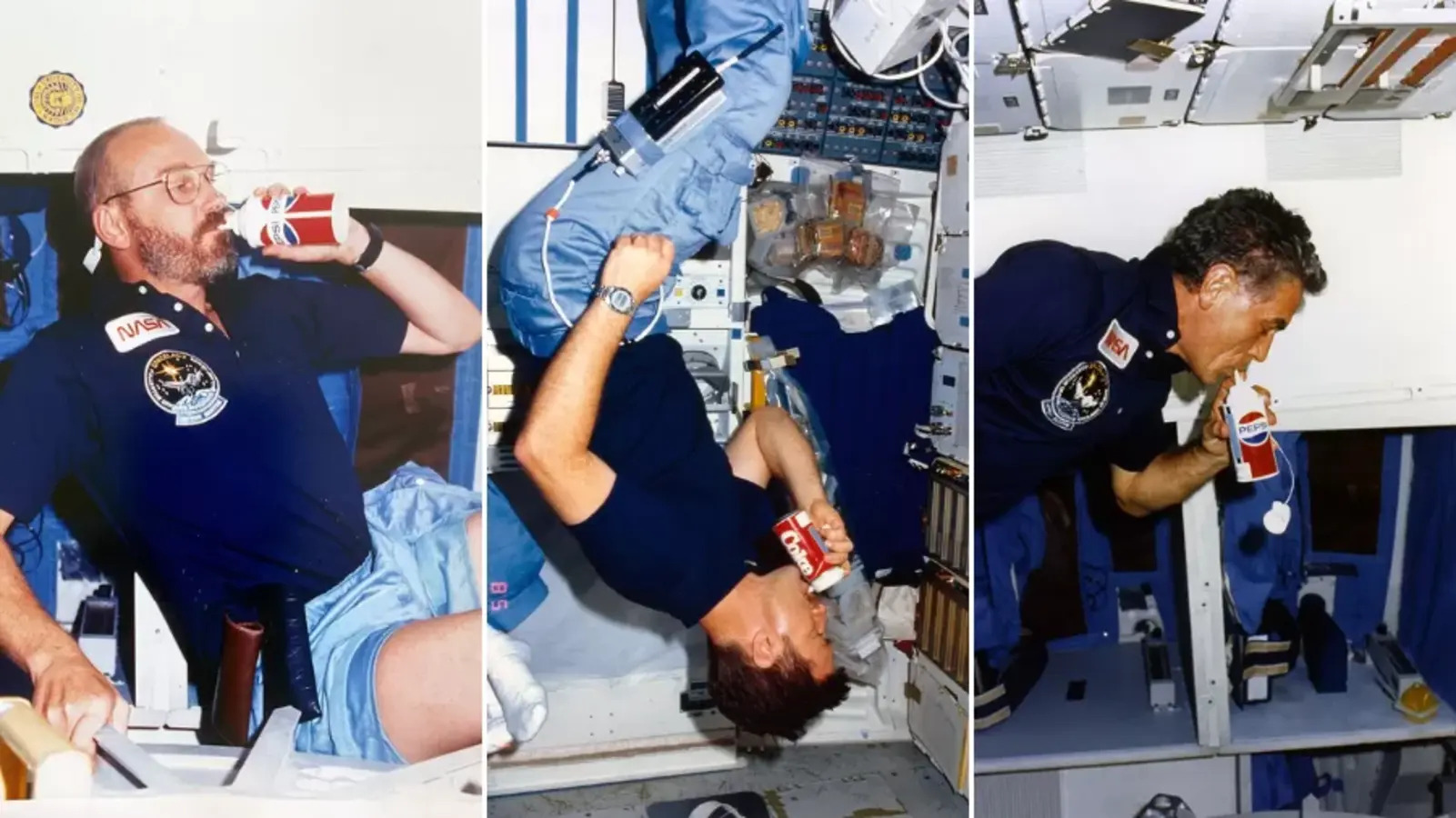
In The 1980s, Coca-Cola and Pepsi Competed to Send Soft Drinks to Space in a Contest Involving NASA, Politics, and Marketing Strategies
Coca-Cola and PepsiCo have been competing in the global market for decades. One of the most curious battles occurred in the 1980s when the companies set their sights on a new milestone: being the first soft drink in space. The race involved marketing strategies, political disputes, and direct negotiations with NASA.
Opportunity in Space
In the early 1980s, NASA was transitioning between the Apollo missions and the space shuttle era. Despite technological advancements, onboard food was still limited.
Astronauts received freeze-dried and thermostabilized foods, and beverages were also a challenge. The lack of refrigeration made consuming liquids during missions difficult.
-
With over 14 million baskets of earth moved, an ancient North American metropolis built a monumental pyramid of 30 meters and established a city with 20,000 inhabitants nearly a thousand years ago.
-
A 1,900-year-old treasure emerges from a Roman house destroyed by fire and sealed since antiquity in Romania, with coins and metals fused among the ashes.

-
The Brazilian colonial city that stopped in time and shares territory with a rocket launch base.

-
79-year-old woman challenges limits, visits 193 countries in the world after 56 years of planning and reveals the behind-the-scenes of a global journey that few have managed to accomplish.


Coca-Cola saw this as a business opportunity. The company offered to test soft drinks in zero gravity, aiming to improve the consumption experience in space and strengthen its image.
In addition to the commercial aspect, there was also a political motivation: at the time, Ronald Reagan, a Pepsi supporter, had defeated Jimmy Carter, who preferred Coca-Cola.
The Reaction of Pepsi
In 1984, Brian Dyson, President of Coca-Cola North America, announced negotiations with NASA to install vending machines in space.
The revelation sparked an immediate reaction from PepsiCo. Max Friedersdorf, the company’s vice president and former advisor to Reagan, pressured NASA to allow their participation.
In a letter, he noted that Pepsi was associated with the Republican Party, while Coca-Cola was linked to the Democratic Party.
The pressure had an effect. A month later, NASA suspended the project. However, the agency maintained interest in Coca-Cola’s proposal, imposing technical requirements for the packaging: it had to be pressurized and have a special valve for use in microgravity.
Development of Packaging
Between 1984 and 1985, Coca-Cola invested about US$ 250,000 in developing the container. The company hoped to participate in a flight scheduled for April 1985, but the launch was canceled because NASA claimed the process didn’t follow the rules, failing to notify competitors.
Even without confirmation, Coca-Cola announced participation in a flight planned for July. This irritated the agency, which interpreted the action as publicity.
The slip opened the door for Pepsi’s inclusion. NASA banned advertising and contracted both, imposing a tight deadline for Pepsi to create its packaging.
Astronauts compared Pepsi’s prototype to a can of shaving cream.
Dispute in The White House
The inclusion of both companies generated new conflicts. Two weeks before the launch, Coca-Cola appealed to the White House to exclude Pepsi.
The issue involved senators, executives, and lobbyists, but the government transferred the decision to NASA, which kept both brands on the mission.
The dispute annoyed the crew. To avoid favoritism, the seven astronauts split into two teams: one to test Coca-Cola and the other for Pepsi. They would also alternate their photo and video recordings.
First Soft Drink in Space
In July 1985, the space shuttle Challenger, on mission STS-51F, launched with the soft drinks onboard.
The mission focused on experiments in solar physics, astronomy, and atmospheric science, but also reserved moments for drink testing.
Coca-Cola was evaluated first. The astronauts sprayed the beverage directly into their mouths. It was warm, with a little foam, but tasted similar to Earth’s.
Next, the team responsible for Pepsi tried their version. Small spheres of the drink floated around the shuttle, being able to be blown and spun in the air.
Result and Forgetting
Upon returning to Earth, each company claimed victory. Coca-Cola presented itself as the first soft drink in space since it was tested first. Pepsi highlighted its performance and the innovation of the experience.
Despite the disputes, the project did not continue. According to The New York Times, the initiative was forgotten by both NASA and the manufacturers.
Nearly 40 years later, carbonated drinks are not part of the regular menu for astronauts in orbit.
With information from UOL.tilt.





-

2 pessoas reagiram a isso.