





 Portuguese
  English
  Spanish
  4 min of reading
  0 comments


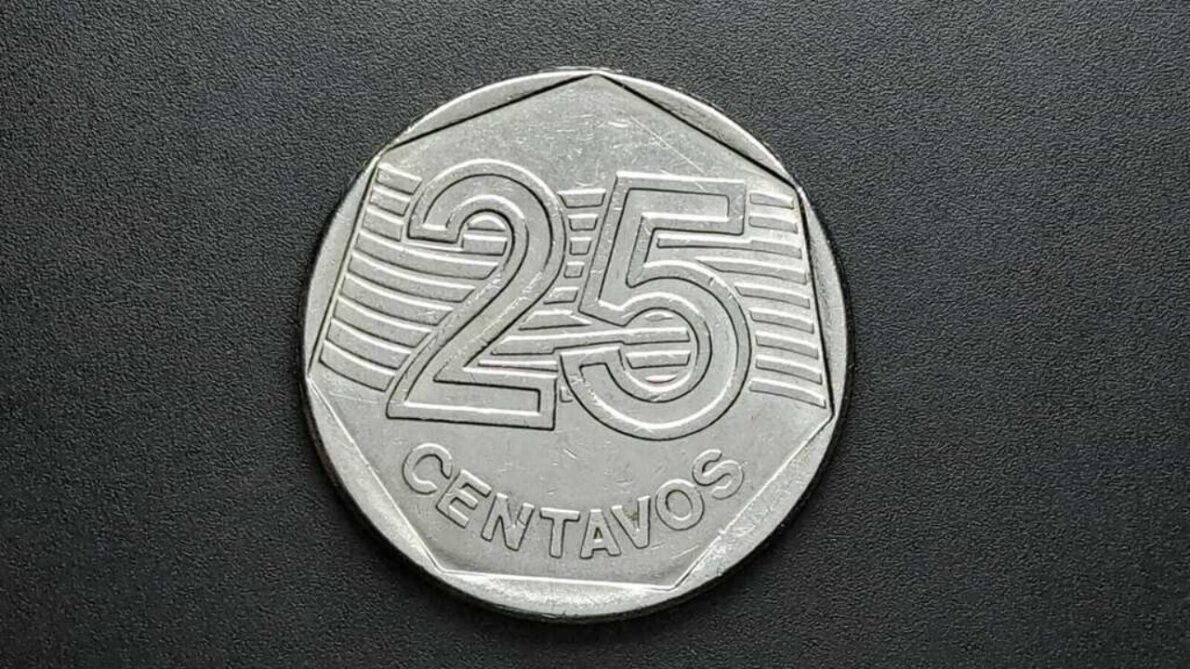
Know How A 25-Cent Coin From The Real Plan Can Be Worth More Than R$ 2 Thousand And Discover Which Details Increase Its Value.
Many Brazilians are unaware that a simple 25-cent coin can be worth much more than its face value. In some cases, the value of a coin can exceed R$ 2 thousand. This surprise has caught the attention of collectors and numismatists, who seek rare coins with special characteristics.
The Real Plan And Its Historical Coins
The coin of 25 cents that can reach this appreciation was issued by the Central Bank (BC) during the Real Plan, launched in 1994.
Three decades later, some of these coins continue to circulate, and some specific pieces have rare characteristics that make them valuable.
-
Larger than entire cities in Brazil: BYD is building a 4.6 km² complex in Bahia with a capacity for 600,000 vehicles per year, but the discovery of 163 workers in conditions analogous to slavery has shaken the entire project.

-
With an investment of R$ 612 million, a capacity to process 1.2 million liters of milk per day, Piracanjuba inaugurates a mega cheese factory that increases national production, reduces dependence on imports, and repositions Brazil on the global dairy map.

-
Brazilian city gains industrial hub for 85 companies that is equivalent to 55 football fields.

-
Peugeot and Citroën factory in Argentina cuts production by half and opens a layoff program for more than 2,000 employees after Brazil drastically reduced purchases of Argentine vehicles.


One of the most sought after is the 25-cent coin with the so-called “inverted reverse,” a minting error that significantly increases its value in the collector’s market.
The Real Plan was a landmark in the Brazilian economy, launched on February 27, 1994, with the main goal of controlling the hyperinflation that had plagued the country.
The program was implemented by the government of former president Itamar Franco, with the collaboration of economists like Fernando Henrique Cardoso, who at the time was the Minister of Finance.
In addition to stabilizing the economy, the Real Plan introduced a new currency in Brazil, the real, which continues to circulate to this day.
The coins issued at the beginning of this phase have great historical value and, in some cases, also have numismatic value, such as the 25-cent coin.
The first family of coins from the Real Plan was produced with materials such as stainless steel, and the 25-cent coins have details that can increase their value.
Collectors are especially interested in the first series issued by the Central Bank, which feature rare minting errors, such as the “inverted reverse.” Coins with this type of defect have a high value in the market.
Characteristics Of The Rare 25-Cent Coin
The 25-cent coins from the first family of the Real Plan, issued from 1994, have some specific characteristics.
They are made of stainless steel, have a diameter of 23.5 mm, a weight of 4.78 g, and a thickness of 1.40 mm.
The edge of these coins is smooth and their axis follows the coin reverse pattern (EH). On the obverse, we find the Effigy of the Republic, accompanied by the word “BRAZIL” and the date of issuance, while on the reverse is the value of the coin, surrounded by a seven-sided polygonal border. These coins continue to circulate to this day.
What Is The Inverted Reverse?
A 25-cent coin with an inverted reverse has a different alignment from the standard required in Brazil.
Normally, Brazil adopts the horizontal axis (EH) system for minting its coins.
This means that when the coin is rotated from bottom to top, the faces should be aligned correctly.
However, in coins with an inverted reverse, the reverse appears upside down when the coin is turned, indicating a minting error.
This type of error is rare and considerably increases the market value of the coin. To identify a coin with an inverted reverse, simply hold the piece by its face and rotate it.
If the other side is inverted, the coin may be worth much more than its face value. These pieces can be sold for amounts exceeding R$ 2 thousand, depending on the condition and other factors.
In addition to the inverted reverse, other characteristics can influence the value of a coin, such as the degree of preservation.
Well-preserved coins, without signs of wear, are more valued by collectors. However, even coins in less than ideal conditions can reach high values if they have the minting error.
How To Determine The Value Of A Rare 25-Cent Coin?
Estimating the exact value of a 25-cent coin with a minting error is a complex task since the number of coins with this defect is not officially recorded.
As expert Plínio Pierry explains, “defining commercial value for these coins is relatively complicated, especially because they were produced with errors during the minting process and there are no records of the number issued.”
Still, there is a growing demand for rare coins among collectors, which causes the value of these pieces to constantly rise.
Experts suggest that, to sell a rare coin, it is important to seek guidance from numismatists or participate in specialized auctions.
In addition to the 25-cent coins with inverted reverses, other coins from the Real Plan may also have high numismatic value, especially if they are commemorative editions or present other manufacturing errors.
The market for rare coins continues to grow in Brazil, with collectors willing to pay high prices for pieces that stand out for their particularities.









-

-

-

3 pessoas reagiram a isso.