





 Portuguese
  English
  Spanish
  3 min of reading
  0 comments


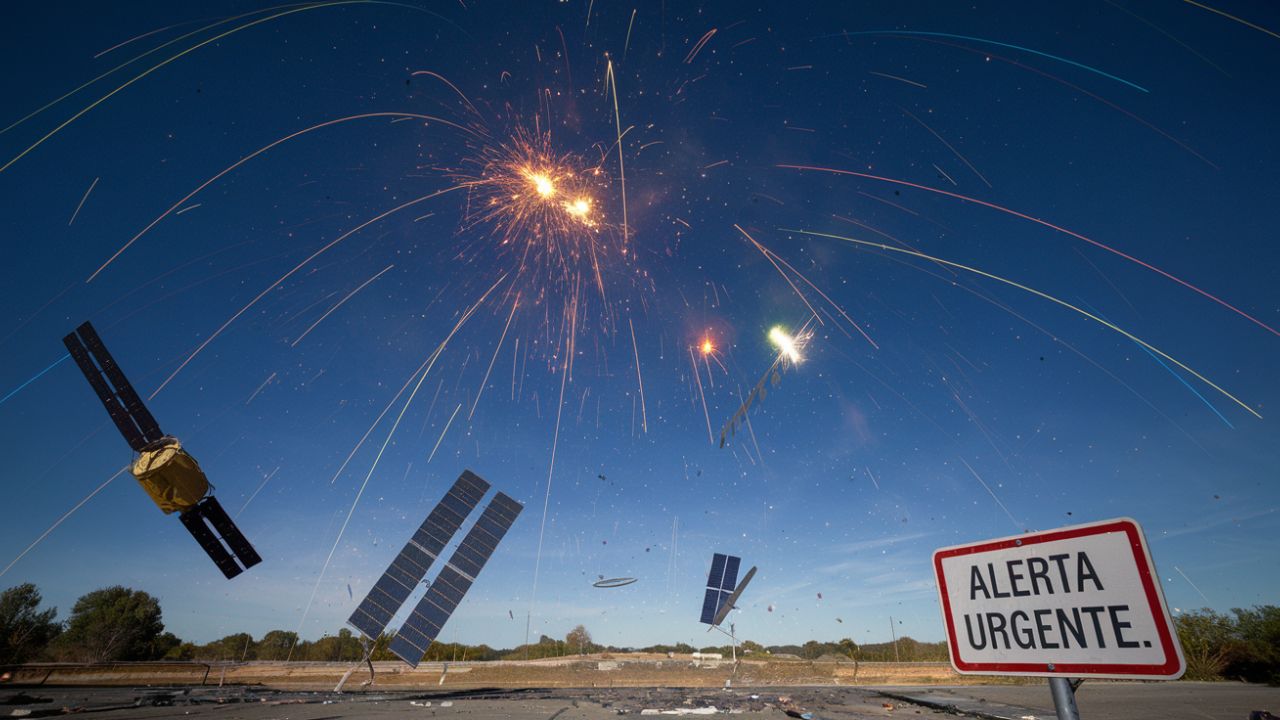
Experts Warn: Over 130 Million Pieces of Space Debris Orbit the Earth at Speeds of Up to 18,000 mph. Space Collisions Can Take Down Satellites, Cut Communications, and Render Parts of Space Useless.
Space collisions are no longer a distant risk. Imagine an invisible minefield around the Earth, with debris traveling at absurd speeds, ready to cause catastrophic damage. This scenario, theorized for the first time as the Kessler Syndrome, is increasingly close to becoming a reality.
Recently, the International Space Station (ISS) had to maneuver to avoid a piece of space debris, reinforcing the warning from experts: we are heading towards a crisis that could render entire areas of space useless and directly impact our lives.
What Is Kessler Syndrome?
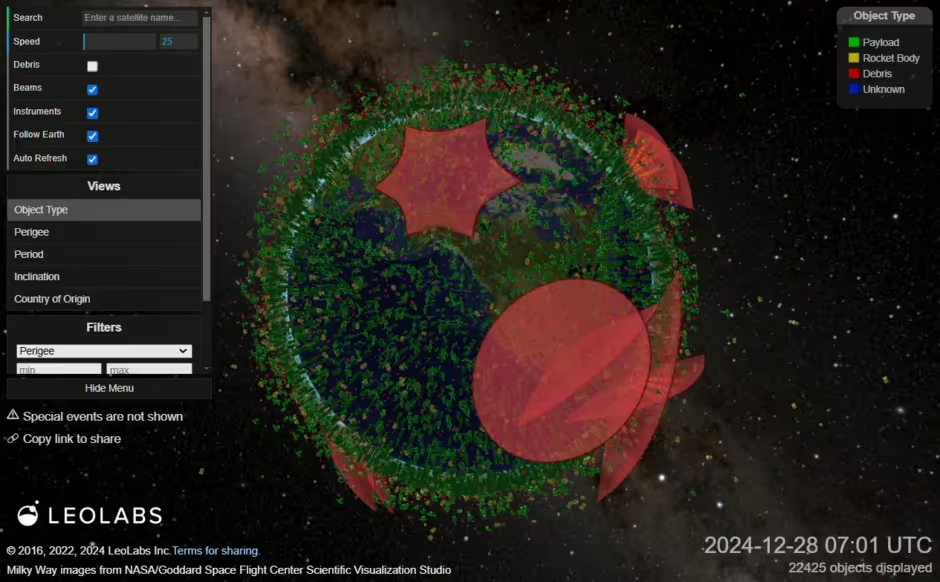
In 1978, scientist Donald J. Kessler described a grim future: collisions between debris would create a chain reaction, filling Earth’s orbit with dangerous fragments. This would make it impossible to operate satellites and even conduct space missions.
-
Something is happening around the Earth: Inside the huge explosion of fireballs in 2026

-
A hot air bubble coming from Argentina expands over Brazil, causing thermometers to exceed 38 degrees with a thermal sensation of 40 degrees in late March, affecting 6 states at once.

-
The radish leaf that almost everyone throws away has more polyphenols, flavonoids, and fiber than the consumed root, and a 2025 study showed that the leaf contains compounds that protect the intestine, combat inflammation, and may inhibit the growth of cancer cells.

-
A planet that seemed to defy the laws of physics has intrigued scientists for decades, until the James Webb revealed what is really affecting Saturn’s rotation.

Imagine throwing a rock at already cracked glass; each impact creates new cracks. The same happens in space: a collision generates thousands of fragments, each capable of triggering new accidents. It’s a domino effect, but in a vacuum.
Satellite Failures and Global Communication
Satellites are the silent heroes of our digital age. They keep Wi-Fi, TV, navigation systems, and even emergency calls functioning. A single impact can take down these connections, plunging entire regions into technological darkness.
Life in space is also not safe. The ISS has had to perform numerous maneuvers to avoid debris. A direct impact could depressurize entire areas, putting astronauts’ lives at risk.
Overcrowding of Earth’s Orbit
Currently, over 130 million pieces of space debris orbit the Earth. From broken satellites to rocket remnants, each fragment travels at speeds of up to 18,000 mph, or seven times faster than a bullet.
Even tiny particles, like flecks of paint, can pierce metal at high speed. It’s like an invisible rain of bullets circling the planet, increasing the chance of space collisions.
Initiatives to Control the Problem
Experts like Dr. Vishnu Reddy highlight the lack of regulation as a critical problem. Without clear rules, space has become a “lawless land,” with uncontrolled satellite launches.
Companies and space agencies are developing solutions like nets and capturing robots to clean up orbital debris. Nevertheless, efforts are still insufficient in the face of the exponential growth of the problem.
The Role of Private Companies
Giants like SpaceX, with over 7,000 satellites in orbit, need to adopt more sustainable practices. Responsibility does not lie solely with governments, but also with the companies profiting from space.
Just as we are concerned about global warming, space debris also requires global attention. Awareness campaigns and investments in research could be the turning point to prevent chaos.
The crisis of space collisions is no longer science fiction. If we don’t act now, we will face a future where parts of Earth and space become unusable. It’s time to think of space as a shared resource and protect it as we protect our own planet. After all, the sky is not the limit, but our responsibility.






-

-

-

3 pessoas reagiram a isso.