





 Portuguese
  English
  Spanish
  4 min of reading
  0 comments


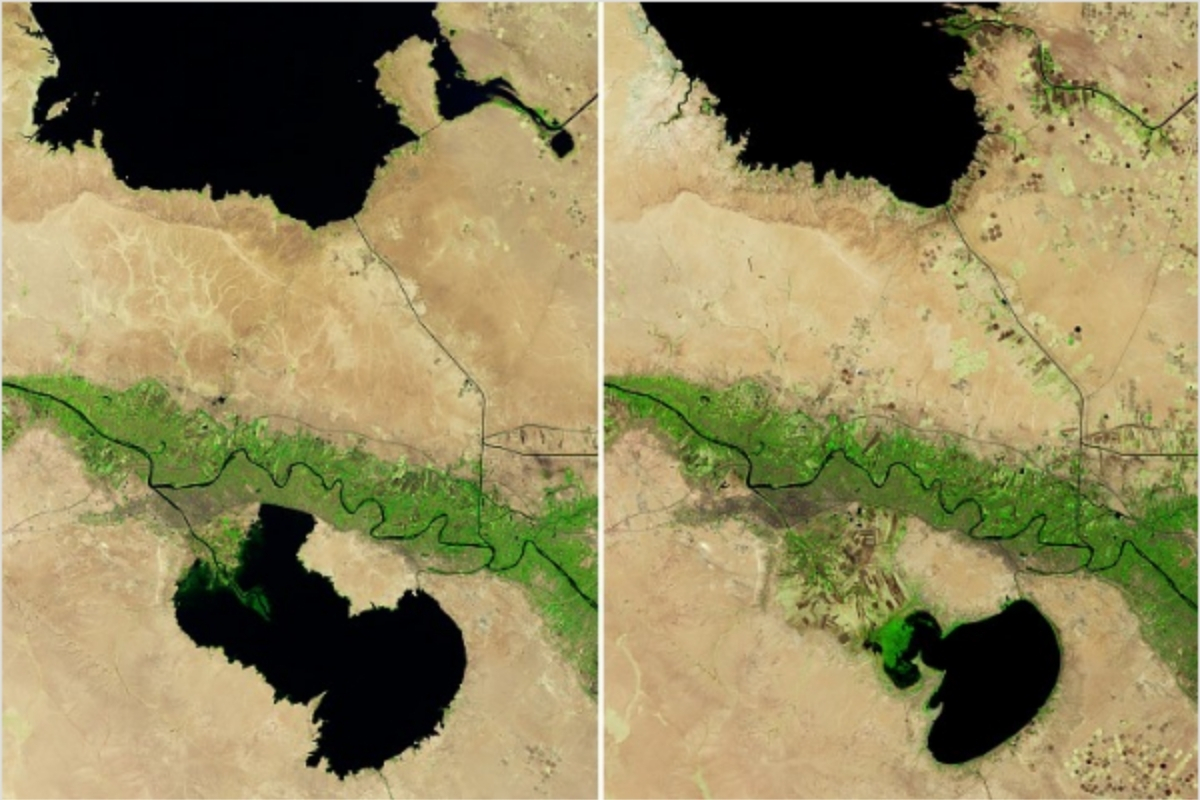
Water crisis gains scale in Iraq with the partial collapse of large reservoirs, and satellite images captured by NASA reveal the dimension of retraction between 2020 and 2025, with direct effects on irrigation and supply
The main reservoirs in Iraq have entered a critical phase after several years of drought, lower rainfall, and reduced water flow from rivers. The effect is already visible in the fields, cities, and water resource management.
The loss of water gained momentum between 2021 and 2025, with a direct impact on irrigation, supply, and regional balance. The satellite images captured by NASA reinforce the dimension of the problem and show that, in some cases, levels have reached their lowest points since satellite monitoring began.
Lake Tharthar registers the lowest level since 1992
The Lake Tharthar, the largest in Iraq, has experienced a sharp decline after years of weak water inflow from the Tigris River. The reservoir, which usually receives reinforcement during flood periods, has failed to recover volume consecutively.
-
Archaeologists open a tomb in Luxor and find 3,000-year-old papyri still sealed in a ceramic vessel, alongside colorful coffins stacked in 10 rows and linked to the mysterious singers of Amon.
-
Before the space shuttle existed, NASA put a “wingless airplane” made of wood to fly at over 190 km/h towed by a car and then launched from a C-47, and this strange experiment practically proved that it was possible to re-enter the atmosphere and land on a runway like a conventional airplane.

-
In Japan, a 150 kg humanoid robot named AIREC has begun testing to assist patients, change diapers, and alleviate a crisis where there is only 1 candidate for every 4.25 positions for elderly caregivers.

-
A cold air mass has already arrived in Brazil and is advancing in the coming hours with temperatures that may approach 0°C in the southern mountains and a risk of frost in the middle of April, surprising those who had not yet felt the autumn of 2026.

In October 2025, the lake reached its lowest level in the entire series monitored by satellite since 1992. The mark was more than 20 meters below the peak observed after the floods of 1993, showing the extent of the recent loss.

Lack of rain and snow weakens annual recovery
The normal pattern of the region depends on the melting of snow in the headwaters of the Tigris, located in Turkey and Iran, as well as seasonal rains. This cycle usually raises the reservoir level in spring when extra water arrives more forcefully.
But this mechanism has failed in recent years. The combination of little snow, less rain, and upstream water diversions prevented recovery in 2021, 2022, and 2023, even with a slight improvement in 2024.
Satellite images show the difference between 2020 and 2025
The satellite images captured by NASA reveal a visible change between September 2020 and October 2025. The area occupied by water has shrunk significantly, while previously flooded parts have dried up and are now being used for agriculture.
According to NASA Earth Observatory, the expansion recorded in 2019 was driven by exceptional rains over a short period. After that, the scenario reversed, and retraction began to dominate the landscape.
Ground measurements reinforce the gravity of the recession
Measurements taken on land confirm the same picture observed from space. In mid-October, the level of Lake Tharthar reached 38.5 meters above sea level, the lowest since the reservoir was built in 1958.
This data reinforces that the problem is not isolated. It is a prolonged loss, accumulated over years, with a direct effect on water security and management capacity in the country.
Habaniya also enters critical phase
The Lake Habaniya, fed by the Euphrates River, has undergone a similar process. After nearly filling in 2019, the reservoir lost strength until it reached a point where it could no longer return water to the river as it normally did.
On September 25, 2025, the level was at 42.05 meters above sea level. The stored volume was about 555 million cubic meters, well below the total capacity of 3.3 billion cubic meters. By mid-October, the level fell to 41.90 meters and the storage retreated to 511 million cubic meters.
Agriculture feels the impact and pressure increases in cities
The decline in water reserves is already affecting farmers in various areas of Iraq. To preserve water in cities, authorities have restricted agricultural crops and limited water use for irrigation, leading many producers to abandon areas or change their operations.
There has also been the use of large pumps to transfer water from Lake Tharthar to the Tigris River, in an attempt to relieve pressure on drier regions. The satellite images captured by NASA help to measure this transformation and show how scarcity has ceased to be merely environmental and has begun to affect economic and social routines.
Integrated management becomes a decisive point for the future
The most immediate response depends on winter rains, controlling withdrawals for agriculture, and water-saving practices. Still, the extent of the loss indicates that emergency actions alone are no longer sufficient.
On a broader horizon, the integration between the reservoirs of Habaniya, Razzaza, and Tharthar appears as a central piece to try to restore water balance. The retreat of these lakes pressures the country, weighs on agriculture, and changes the strategic reading of the region.









Seja o primeiro a reagir!