





 Portuguese
  English
  Spanish
 8 min of reading
  0 comments


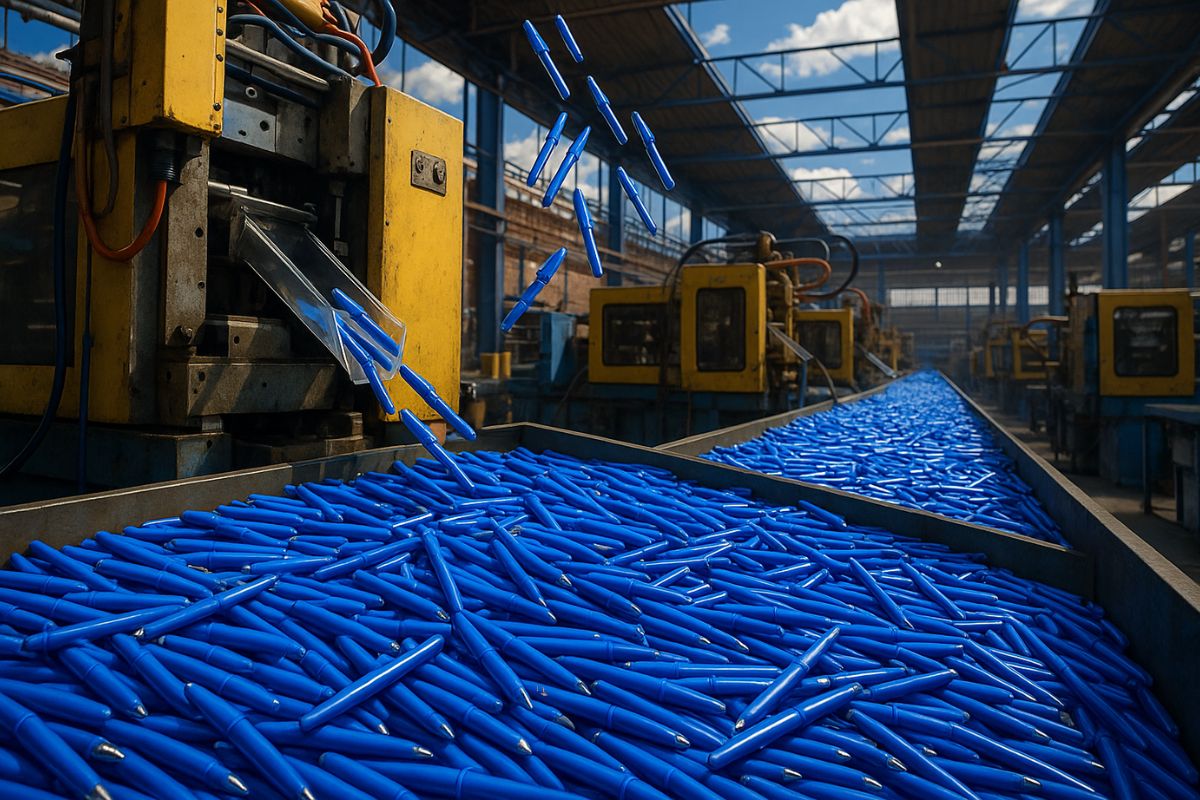
At The Factory In Manaus, The Blue Pen Goes Through Plastic Injection At 210 °C, Precise Extrusion, And Assembly With A Tungsten Tip And Golden Ink To Ensure 2 Km Of Continuous Writing Without Failures.
The blue pen that you use without thinking, to sign a document or jot down an idea, is the result of an extremely precise industrial process that starts with plastic pellets and ends with a tool capable of writing over 2 kilometers without failing. In Manaus, automated production lines, high-precision molds, and strict quality controls ensure that each unit functions as if it were a laboratory piece, not a disposable stationery item.
Behind the visual simplicity of the blue pen lies materials engineering, temperature control at 210 °C, geometries calculated in micrometers, and a not-so-obvious combination of plastics, metals, and a golden ink formulated to not fade from the paper. From the injection of the hexagonal body to the adjustment of the tungsten carbide tip, every step is designed for the writing to be continuous, uniform, and reliable until the last drop of ink.
Hexagonal Body Of The Blue Pen: From Pellet To Transparent Tube

The body of the blue pen starts with a plastic material called polystyrene, which arrives at the factory in Manaus in the form of small grains, visually similar to pellets.
-
After decades of failed attempts, Brazil is once again looking to space with an orbital rocket measuring 12 meters, weighing 12 tons, costing R$ 189 million, and scheduled for launch in 2026, in a new race to finally achieve autonomous access to orbit.

-
The Earth will plunge into a few minutes of darkness in broad daylight in August 2026, when a total solar eclipse transforms the sky into one of the most impressive astronomical phenomena in recent years.

-
How the terraforming of Mars can transform the planet: artificial aerosols can increase the temperature by up to 35°C in 15 years, creating conditions for liquid water.

-
Scientists drilled nearly 8,000 meters into the ocean floor above the fault that caused the 2011 tsunami in Japan and discovered that a layer of clay 130 million years old was responsible for making the wave much worse than any model had predicted.


These pellets are transported through pipes using vacuum to the injection machine, where they enter a metal screw.
Inside the screw, the polystyrene is gradually compressed and heated until it reaches about 210 °C, the temperature at which the plastic becomes pasty and homogeneous.
A plunger then pushes this melted plastic into a high-precision mold, with 32 identical cavities that simultaneously form 32 bodies of blue pen.
The mold remains closed for a few seconds so that the plastic takes the exact shape of the tube. Then, cold water circulates internally to speed up cooling.
In about 12 seconds, the cycle is completed, and the body of the blue pen comes out of the mold still hot, already with transparency similar to glass and an extremely smooth surface.
Molds, Hidden Marks, And Engineering Details

The quality of the blue pen does not come from a subsequent polishing, but from the mold itself.
The internal surfaces are machined and polished with microscopic precision so that the tube comes out shiny, without burrs and deformations.
This makes the mold one of the most expensive and critical components of the entire production line.
Being so strategic, the mold leaves small technical marks on the body of the blue pen: the identification of the injection machine and the specific hole through which the plastic entered the cavity.
These inscriptions allow tracking any defect back to an exact point in the process. If a batch has a problem, the team knows which position of the mold to investigate.
From a functional point of view, the body of the blue pen has two discrete engineering solutions.
The first is the small side hole, which prevents the formation of partial vacuum inside the pen, something that would prevent the ink from flowing correctly.
The second is the hexagonal shape. Instead of being perfectly cylindrical, the pen has flat sides that prevent it from rolling easily on the table, reducing the risk of constant drops in the school or office environment.
Caps And Small Caps: Three Plastics, Three Functions

The blue pen consists of more than just the transparent tube.
The main cap is made of another plastic, polypropylene, which is more opaque and significantly more flexible.
This flexibility is essential so that the cap “hugs” the body of the pen when fitted, ensuring a firm and repeatable hold over many cycles of opening and closing.
The color of the cap comes from the mixture of white polypropylene with solid dye pellets.
This material enters a large mixer, where a central screw pulls the raw material from bottom to top, quickly homogenizing the color.
Even with a large volume of white plastic, the final result is an intensely colored cap, without pink or faded tones.
Just like in the body of the blue pen, the cap is formed by injection in a specific mold, capable of producing about 140 pieces per cycle.
The small hole in the cap serves a safety function: if a child swallows the piece, the air channel prevents choking, allowing air to pass even if the cap is partially obstructing the airway.
At the back of the blue pen, a third plastic, polyethylene, is used in the small cap that closes the side opposite to the tip.
This component is small, lightweight, and needs a perfect fit, which is why it goes through sorting on a vibrating table.
The small caps move in a line through narrow channels, and any piece with burrs or geometric defects tends to jam, being automatically discarded.
How The Ink Cartridge Of The Blue Pen Is Born
The functional heart of the blue pen is the cartridge, the small tube that holds the ink. Unlike the body, it is not injected into a mold, but produced by extrusion.
Polypropylene is heated and pushed by a screw toward an extruder, which forms a continuous tube, similar to a soft plastic line.
Right after leaving the extruder, while the material is still warm and pliable, the tube passes through a vacuum chamber.
In this chamber, a negative pressure of about 0.1 bar makes the tube expand slightly, precisely defining its external and internal diameter.
Next, it passes through a tank with water for cooling over several meters until it solidifies completely.
At the end of the conveyor, a laser measurement system checks the diameter of the tube precisely.
Only then is the cartridge cut into segments of the appropriate length for the blue pen by a high-speed rotary knife, ensuring clean and repeatable cuts.
Each segment will then be treated as a future ink cartridge.
Golden Ink, Secret Formulation, And Behavior On Paper

The ink for the blue pen arrives at the factory in barrels weighing about 200 kilograms, already formulated and ready for use.
The composition is kept secret by the manufacturer, but visual inspection reveals a striking characteristic: the actual color is golden, and it only appears almost black when viewed in large volume.
To the touch, the ink is thick, oily, and markedly sticky, which explains why it is made to not come off anything and to not disappear from the paper over time.
Still, it needs to dry very quickly on the written surface.
When in contact with air, a thin layer dries in moments, as if a film forms over the written line.
To fill the ink into the cartridges of the blue pen, the system heats the reservoir and hoses, ensuring proper fluidity.
The small tubes are marked with the production batch and receive the exact dose of liquid ink on an automated line.
It is at this moment that small air bubbles can form, something that cannot remain within the cartridge if the goal is to achieve 2 kilometers of continuous writing.
Centrifuge, Bubble Elimination, And Reliability Of The Blue Pen
After being filled, the ink tubes of the blue pen are placed in an industrial centrifuge.
When the machine enters high rotation, the ink is pushed toward the tip, while air bubbles are displaced to the opposite end and expelled.
This process compacts the ink, eliminates internal voids, and drastically reduces the risk of failures during the pen’s lifespan.
In addition to ensuring that the ink flow is continuous to the last millimeter, this compaction also helps prevent leaks.
With fewer bubbles, the internal pressure becomes more uniform, and the ballpoint system operates within the range for which it was designed.
Meanwhile, the tip supports, molded in bronze-colored plastic, are produced in extremely high volume, and the injection scraps, such as channels and feeding “branches”, are immediately crushed and reincorporated into the process.
This makes this step practically 100% recycled, reducing waste and maintaining the dimensional standard of each piece that will receive the writing sphere.
Tungsten Tip: The Microscopic Detail That Makes The Blue Pen Write
At the end of the cartridge of the blue pen, the assembly transforms stagnant ink into legible strokes. A small metallic tube made of brass houses a tiny tungsten carbide ball of approximately 1 millimeter in diameter.
This material is chosen because it needs to be extremely hard to withstand millions of rotations over paper without deforming.
The internal design of the tip is millimetric. The sphere fits into a brass seat so that, at rest, it practically seals the passage of ink.
When the blue pen touches the paper, the sphere displaces slightly inside the tube, begins to rotate, collects ink from the interior, and transfers it to the surface. In this brief movement, a microspace opens for the ink to flow.
All tips of the blue pen undergo inline inspection, with scanning systems that check if a sphere is present, if the brass tube is intact, and if there is no obstruction.
Small defects in this tiny part would mean a new pen that already starts “failing,” which is incompatible with the goal of two kilometers of continuous writing.
Final Assembly And The 2 Km Of Continuous Writing
In the final step, the assembly line simultaneously feeds the body, cartridge, tip, front cap, and back cap of the blue pen.
Automated machines fit the cartridge into the body, secure the metal tip in the correct position, and close both ends with plastic caps.
The result is a product that seems simple but combines injected plastics at 210 °C, vacuum extrusion, golden ink with a secret formulation, tungsten carbide tip, and quality control at practically every stage.
Each blue pen that reaches the case or the office drawer carries an entire industrial chain “hidden” within an object weighing just a few grams.
Thanks to the combination of compacted ink, well-sealed body, precise geometry of the tip, and bubble control, the blue pen manages to achieve the mark of over 2 kilometers of continuous writing, maintaining a stable line from the first to the last centimeter of ink.
And you, have you noticed any difference between brands of blue pens when writing a lot, or do they all seem the same to you in everyday life?








Seja o primeiro a reagir!