





 Portuguese
  English
  Spanish
  6 min of reading
  1 comment


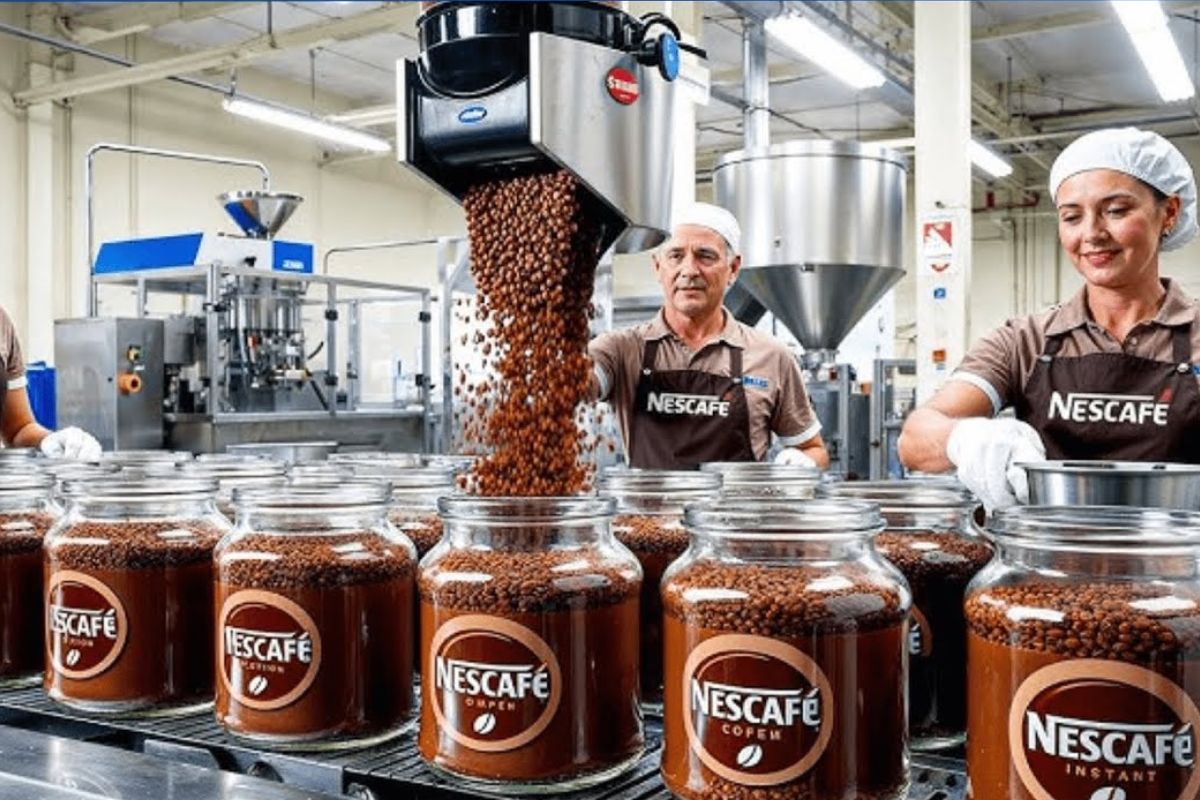


With An Excess Of Roasted Brazilian Coffee Beans, Factories Produce Concentrated Coffee, Freeze At Below 50 Degrees, And Dry By Sublimation To Create Nescafé Instant Coffee And Stable Soluble Coffee, An Instant Coffee That Can Be Stored For Up To 24 Months And Transported Globally In Sealed Pots In Kitchens And Barracks
On a planet that consumes 2.25 billion cups of coffee per day, the ability to transform production surpluses into a stable and easy-to-make product has become strategic. Since 1938, when Nestlé launched Nescafé instant coffee after a challenge made by the Brazilian government in 1930, instant coffee has become an industrialized way to utilize large volumes of beans, maintaining aroma and flavor with practicality.
During World War II, Nescafé instant coffee gained even more relevance by being included in the emergency kits of American soldiers, establishing itself as a quick drink, lightweight for transport, and prepared only with hot water. Today, the same technology that was born to deal with agricultural surpluses and military needs supplies home kitchens, offices, cafés, and logistics operations on virtually every continent.
From Brazilian Surplus To Global Nescafé Instant Coffee

The starting point of Nescafé instant coffee is the coffee bean itself, one of the most consumed beverages in the world and a cornerstone of Brazilian agriculture.
-
China is building a city in Brazil: a complex with an investment of R$ 5.5 billion comes to light, but allegations involving workers draw attention.
-
While Argentina buys old war equipment, Brazil is keeping an eye open and joins the select group of nations with advanced military technology by investing $5.2 billion, producing 36 Gripen fighters in the country, and reducing operational costs.

-
Brazil on alert? Why invading Brazil is a NIGHTMARE for the USA: 8.5 million km², 213 million inhabitants, Amazon covering 60% of the territory, trillion-dollar war, and resistance that even 13,000 aircraft could not control.

-
How to build a floating island from scratch with reeds, giant blocks, and stakes in the lake in a process that needs to be repeated almost every day.

It is estimated that global annual consumption reaches about 750 million bags of coffee, with Brazil being the largest producer and Nordic countries, such as Finland, Sweden, and Norway, leading in per capita consumption.
The idea of instant coffee has been part of the beverage’s history since the 17th century, when the first attempts to create more practical preparation methods emerged.
In 1890, New Zealander David Strang patented an early process for soluble coffee, and in 1901, Japanese chemist Satori Kato presented a more stable method at international exhibitions.
However, a product capable of combining industrial scale, stability, and consistent flavor was lacking, something that Nescafé instant coffee would offer a few years later.
In the 1930s, faced with large surpluses of Brazilian coffee, the Brazilian government challenged Nestlé to find a solution that would prevent waste.
After years of research, in 1938, Nescafé instant coffee was born, quickly standing out for preserving sensory characteristics close to filtered coffee.
From then on, the surplus of beans ceased to be merely a stock problem and became raw material for pots that would travel the world.
From Field To Factory: The Path Of Beans To Nescafé Instant Coffee

Before reaching the production lines of Nescafé instant coffee, coffee undergoes a long agricultural cycle. It all starts with the selection of seeds, usually from the Arabica and Robusta varieties.
The Arabica, cultivated at higher altitudes, produces coffees of higher sensory quality, while the Robusta is more resilient, with a higher caffeine content and adaptation to lower altitudes.
The seeds are removed from ripe fruits, washed, dried, and planted in germination beds. Then, the seedlings go to nurseries, in individual bags with nutrient-rich substrate and controlled irrigation, until they reach 20 to 30 centimeters.
Only then are they transplanted to the field, in spacing that favors light entry and facilitates harvesting.
The coffee tree thrives in the so-called coffee belt, between the Tropics of Cancer and Capricorn, in ideal temperatures of around 18 to 24 degrees Celsius.
The first flowering usually occurs between one and two years after planting, stimulated by periods of rain.
After pollination, the flowers take six to nine months to transform into ripe fruits.
Harvesting can be manual, selecting only the fruits at the ideal point, or mechanized, with machines that vibrate the branches and remove green, ripe, and dry fruits all at once.
In larger plantations, mechanized harvesting is gaining ground due to speed, while specialty coffee tends to rely more on manual harvesting.
After harvesting, the fruits undergo depulping, controlled fermentation, washing, and drying, reducing the moisture of the beans to around 10%.
This step is crucial to avoid mold and preserve the potential aroma and flavor that will be explored later in the roasting process.
Grains that have been processed and graded in sieves are sent in 60-kilo bags to large industries, where they finally enter the flow that culminates in Nescafé instant coffee.
Roasted At 200 Degrees: Developing Aroma, Flavor, And Industrial Standard

Upon arriving at the factory, the batches destined for Nescafé instant coffee undergo quality inspections and are processed through cleaning equipment that removes impurities and residues.
Then, the selected beans go to the roasting department, an essential step that transforms a green, neutral bean into dark, aromatic coffee ready for extraction.
In the industrial line, coffee beans are roasted at around 200 degrees Celsius for approximately 12 minutes.
The heat converts starches into sugars, triggers chemical reactions that form aromatic compounds, and alters color and flavor.
During roasting, some caffeine also begins to decompose, especially in darker profiles.
Keeping the beans in motion is essential to ensure even roasting and prevent burning the coffee, which would compromise the quality of Nescafé instant coffee.
Once the desired point is reached, the roasted coffee must be cooled quickly, usually with cold air, to stop the process and stabilize the sensory profile.
Then, the beans go through industrial grinders that turn them into a coarse powder, specific for large-scale extraction.
At this point, the coffee is still not Nescafé instant coffee, but the preparation of the liquid raw material is ready to begin.
From Liquid Coffee To Nescafé Instant Coffee Frozen At 50 Below
The roasted coffee powder goes to industrial extractors, where it is mixed with hot water under controlled temperatures and pressures.
It is like brewing coffee, but on a gigantic scale and with parameters adjusted to extract the maximum of soluble compounds, preserving a balance between body, aroma, and flavor.
The result is a highly concentrated liquid coffee.
This concentrated liquid undergoes a process of water reduction, through vacuum evaporation, which removes part of the liquid content at lower temperatures, helping to preserve sensitive aromatic compounds.
Next, the concentrate is spread on conveyor belts and frozen in minutes at around 50 degrees below zero, forming thin sheets approximately 8 millimeters thick.
Operators need to wear thermal clothing to work in these extremely cold environments.
The frozen sheets are broken into granules of 2 to 3 millimeters and placed in shallow trays, stacked in large vacuum chambers.
Inside these chambers, the water contained in the frozen crystals sublimates, going directly from solid to gas.
This sublimation drying method is what allows Nescafé instant coffee to better preserve the flavor and aroma of the original coffee, resulting in dry, stable granules ready to be packaged.
Pots, 24-Month Shelf Life, And Global Scale
With the Nescafé instant coffee now dry, the granules go to fully automated filling machines. Hundreds of glass jars move along conveyor belts and are filled in fractions of a second.
On high-capacity lines, up to 280 pots can be filled per minute, reaching about 175,000 pots in a single day of typical operation.
Once filled, the jars are hermetically sealed, protecting Nescafé instant coffee from moisture and excessive air contact.
Under these conditions, the product can maintain its quality characteristics for up to 24 months, as long as the pot remains sealed and is stored in a dry place, protected from direct heat.
Labels are then applied, and the boxes head to distribution centers.
At the end of this chain, millions of Nescafé instant coffee packages supply supermarkets, military warehouses, offices, homes, and cafés in different countries.
In extreme contexts, such as battlefronts or remote areas without infrastructure, a small jar allows for the preparation of dozens of cups with just hot water.
In domestic routines, the same technology that served soldiers in war today serves families seeking speed without giving up the flavor of coffee.
Knowing the entire journey, from bean in the field to Nescafé instant coffee with a 24-month shelf life in the jar, do you prefer instant coffee for its practicality or do you still think nothing replaces the ritual of freshly brewed coffee?








Favor rever está matéria, pois sou produtor e os dados de consumo e produção não está correto.