





 Portuguese
  English
  Spanish
  7 min of reading
  1 comment


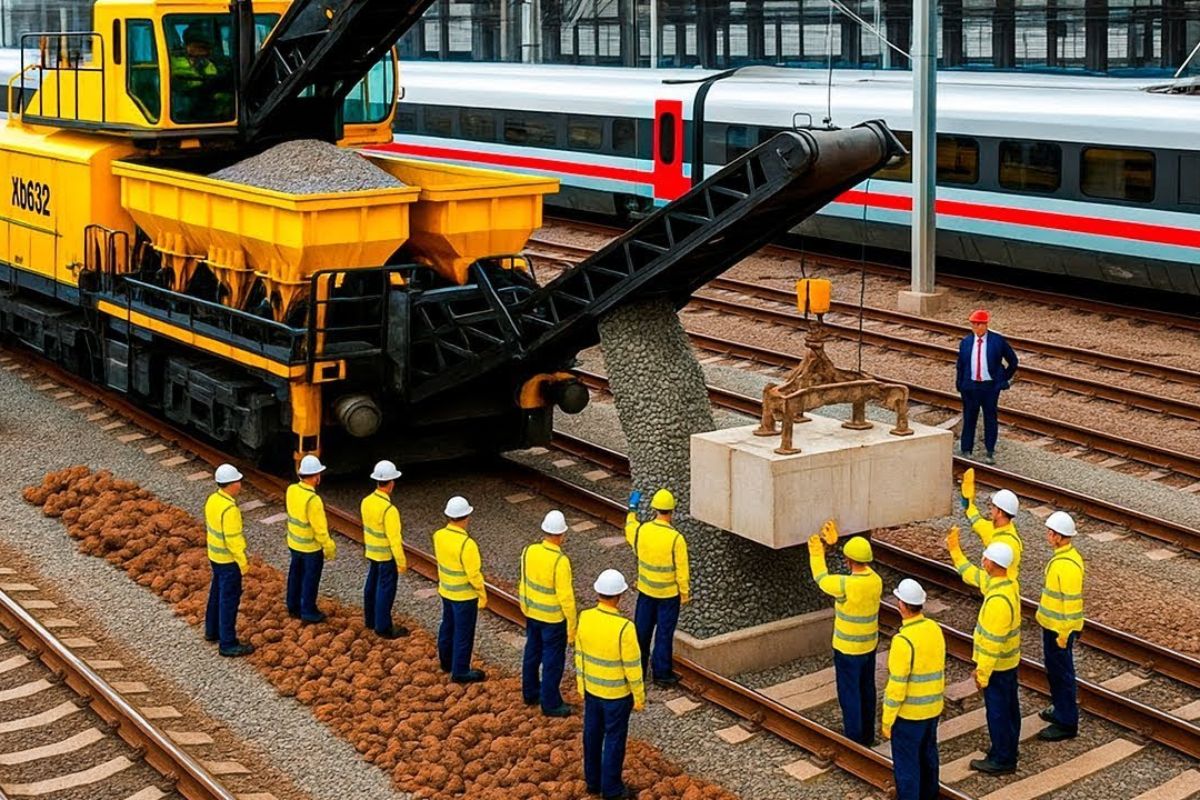


With Incandescent Steel, Giant Machines, and Perfect Welds, The U.S. Railroad Network Reveals Extreme Behind-the-Scenes Efforts to Keep Tracks Aligned and High-Speed Trains Running Always with Maximum Safety.
From the steel mill to the construction sites, the U.S. railroad network relies on micrometric tracks, precise track ballast, and robust concrete ties to support high-speed trains crossing the country with heavy loads, rigorous inspections, laser sensors, and computer-controlled welds daily without fail.
The U.S. railroad network, spanning over 225,000 kilometers, may look like just a mesh of tracks cutting across the map. Behind the scenes, however, there exists a true secret industry: incandescent steel, colossal machines, invisible welds, and precision measured in millimeters, all to ensure that freight trains and high-speed trains traverse the country without veering off course.
Behind every smooth journey lies a brutally technical process. Every rail goes through furnaces above 1600 ºC, continuous rolling lines, sensor-controlled heat treatment, and inspections by ultrasound and X-rays. After this, an army of machines comes into play, placing railway tracks over track ballast and concrete ties with a precision that would make a surgeon envious.
-
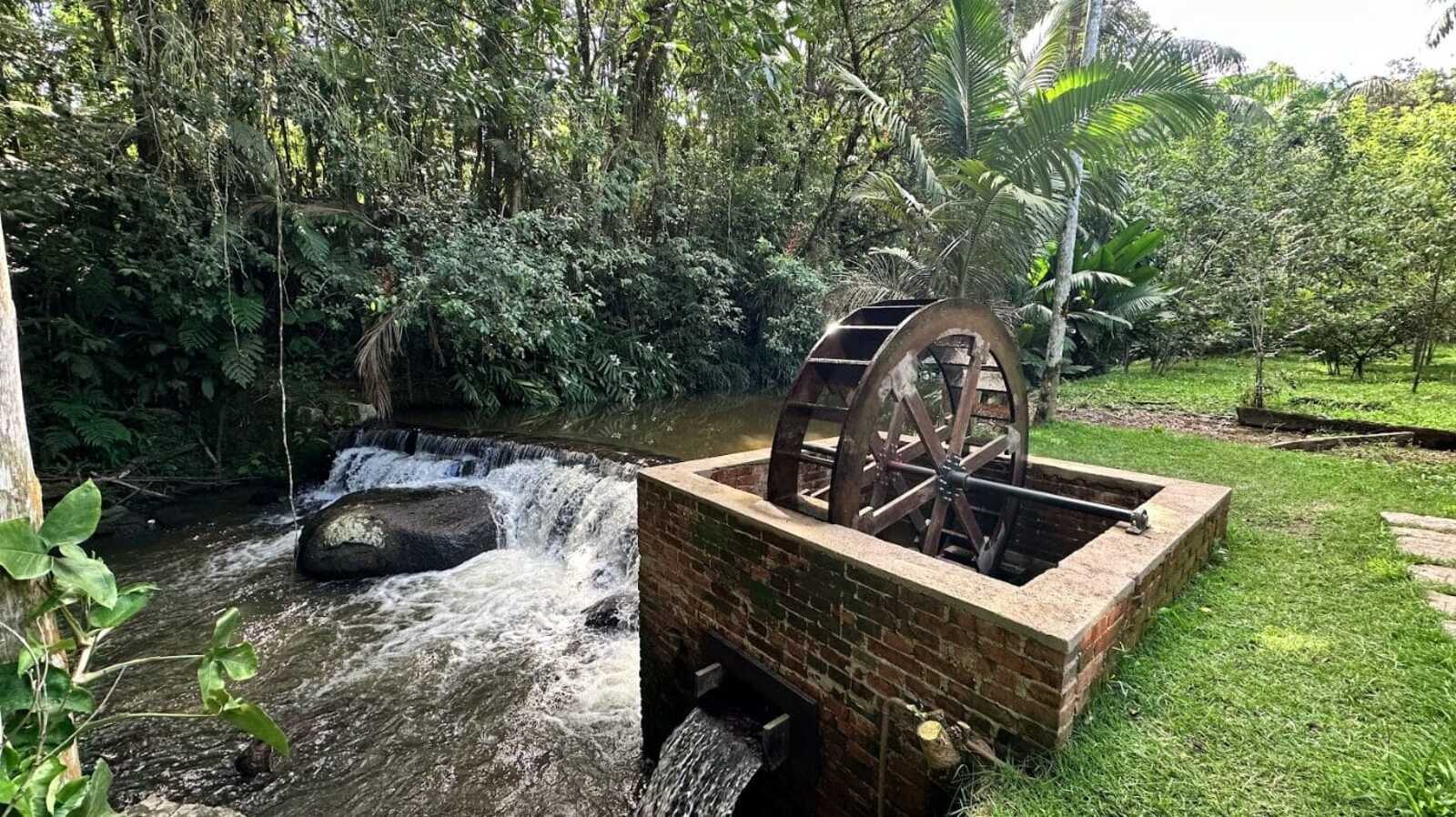
While restoring a historic mansion from 1910, a brick structure with an old turbine that generated energy from the Rio do Testo emerged, along with a hidden door and a rare floor concealed under layers of wax.
-
Italian researchers have detected what appears to be a second Sphinx buried under the sands of Egypt, and satellite scans reveal a gigantic underground megastructure hidden beneath the Giza Plateau for over 3,000 years.

-
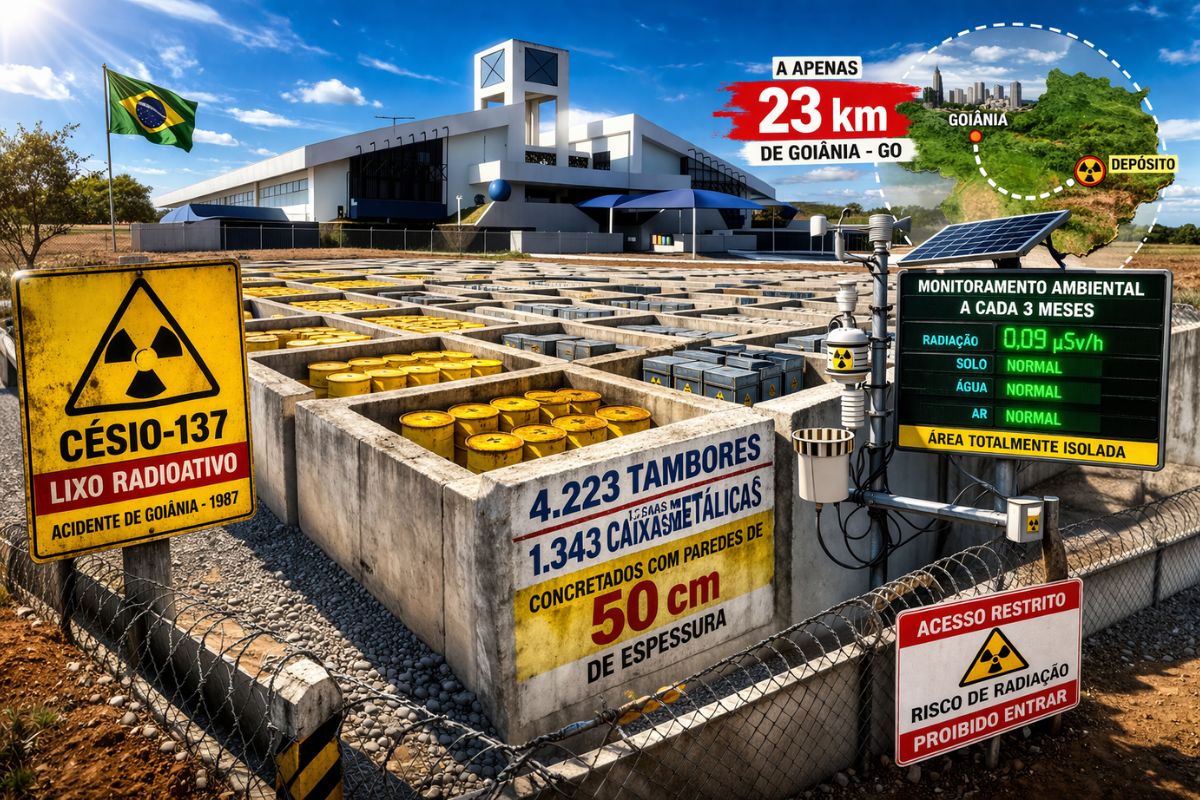
There are 4,223 drums and 1,343 metal boxes concreted with 50-centimeter walls that store the radioactive waste from Cesium-137 in the worst radiological accident in Brazil, just 23 kilometers from Goiânia, with environmental monitoring every three months.
-
Giant Roman treasure found at the bottom of Lake Neuchâtel in Switzerland reveals an advanced trade system, circulation of goods, and armed escort in the Roman Empire about two thousand years ago.


How the Rail That Supports the U.S. Railroad Network Is Born

Before touching the ground, the railroad tracks of the U.S. railroad network begin their lives inside gigantic steel mills.
In electric arc furnaces and blast furnaces operating above 1600 ºC, iron ore, coke, and additives are transformed into molten steel. Automated systems dose each component, and sensors monitor temperature and chemical composition in real-time.
Heat-resistant robots stir the incandescent metal to remove impurities, while elements like manganese and chromium are added at just the right moment to enhance strength and durability.
Nothing is “by eye” in this process; everything is measured and recorded. The steel is then poured into molds, forming ingots that will become the rails responsible for guiding high-speed trains and freight trains weighing thousands of tons.
The Rolling Process That Carves Micrometric Railroad Tracks

After casting, the ingots go to heating pits between 100 and 1260 ºC, where the internal structure is stabilized. Infrared sensors ensure that the steel does not cool too quickly, preventing future cracking.
Next, the blocks proceed to the rolling line, where giant rollers begin to “flatten” the steel until it takes on the classic profile of railroad tracks.
The process is divided into stages. In the roughing roll, large diameter rollers reduce the thickness and elongate the material. In the intermediate stages, stepped rollers rotate the billet to distribute tension and prevent distortions.
In the finishing stage, grooved rollers precisely shape the thick head, the thin web, and the wide base of the rail, always monitored by laser sensors measuring width, straightness, and contour. Any deviation is corrected immediately by the electronic control system.
From Incandescent Steel to Rail Ready for High-Speed Trains
When they come out of the rolling process, the rails are still incandescent and full of internal tension. They undergo a high-pressure water shower that controls the temperature without deforming the profile. Then, they enter heat treatment furnaces, operating between 480 and 590 ºC, in quenching and tempering routines that increase hardness and fatigue resistance.
This combination of rapid cooling and precise treatment is what allows the railroad tracks of the U.S. railroad network to withstand millions of load cycles without bending, a basic requirement for lines used by high-speed trains.
Each rail needs to withstand impact, vibration, and temperature variation without complaint.
Invisible Welds That Transform Rails into Continuous Steel Strips
A loose rail is just a piece of steel. To become a real railway, the rails are welded into huge segments, hundreds of meters long, forming the famous continuous bars. First, a system of rollers and laser sensors aligns the ends with a precision of less than 0.25 millimeter.
In resistance welding, a powerful electric current heats the rail tips to about 1480 ºC, fusing everything into a single piece under high pressure.
Next, a grinder removes excess metal, creating a practically invisible joint. Each weld has its temperature, pressure, and timing monitored, so that the joint has the same strength as the solid steel used in the U.S. railroad network.
In hard-to-reach areas, aluminothermic welding comes into play. A mixture of aluminum powder and iron oxide, when ignited, reaches approximately 2480 ºC, melting the steel and filling the gap between the rail tips.
After cooling, the weld is ground until smooth, ensuring that high-speed trains can pass through without feeling any bumps.
Track Ballast: The Bed of Stone That Holds Everything in Place

With the rails ready, the stage moves to the construction site. First, the subgrade is compacted with soil and gravel, at depths of up to 60 or 120 centimeters. On top of this goes the track ballast, a bed of crushed stones that looks simple but is extremely calculated.
Crushed granite or basalt rock, with stones between 3.8 and 5 centimeters, is dumped by special cars and spread by laser-guided ballast regulators.
Machines with blades, rotary brushes, and leveling boxes distribute and adjust the material, while vibratory compactors “shake” everything until the stones lock into one another.
This track ballast absorbs vibrations, ensures water drainage, and maintains the stability of the track, which is vital for the safety of the U.S. railroad network.
A standard line can consume thousands of tons of stone over just a few kilometers. Without it, the rail would sink, creating undulations that would endanger any train, especially high-speed trains that require a smooth track like a billiard table.
Concrete Ties: The Rigid Foundation of the U.S. Railroad Network
On top of the track ballast go the ties, responsible for maintaining spacing, alignment, and load distribution. Automatic machines lift ties weighing 270 to 320 kilograms with hydraulic claws and position them about 60 centimeters apart, installing thousands of pieces in a single shift.
There are still treated wooden ties, but concrete ties dominate modern tracks, especially where the demands are high, such as in sections used by high-speed trains.
Heavier and more durable, they can last over 50 years, supporting greater loads and ensuring that the railroad tracks remain firm even under heavy trains.
In some projects, pre-assembled panels of rails and concrete ties come directly from the factory, shortening the time when the section needs to be closed for maintenance.
How Railroad Tracks Are Laid Out Over the Route
With the track ballast spread and concrete ties aligned, it’s time to position the rails. Rails of 23 to 24 meters, weighing nearly 600 kilograms, are transported in special cars.
In many projects, the U.S. railroad network uses continuously welded rails in segments up to 400 meters long, released from the back of the train and pulled by hydraulic winches.
The workers guide the bars to slide over the ballast and fit into the ties. Temporary fasteners hold the rails in place while tensioning machines adjust the internal force of the steel, compensating for the expansion and contraction caused by temperature.
Only then do the definitive fastening systems come in, with base plates, rubber pads, clips, and anchoring screws tightened with a torque wrench.
Each piece helps keep high-speed trains stable, even when the outside temperature changes dramatically.
Alignment, Compaction, and Perfect Track Geometry
With everything mounted, the fine-tuning begins. Special compaction machines move slowly, lifting the track and tie assembly a few centimeters while vibrating teeth compact the ballast right below.
Meanwhile, laser sensors and gyroscopes measure elevation, tilt, and straightness of the track, automatically correcting any deviation of a few millimeters.
A stretch of 1.6 kilometers can be fully aligned and compacted in just a few hours, a gigantic gain compared to manual work.
The goal is clear: to ensure that the railroad tracks provide a continuous, smooth, and stable surface, a requirement of interest for both high-speed trains and long freight trains crossing the U.S. railroad network carrying grains, ores, and containers.
High-Tech Inspections Before the First Train Passes
Before any stretch is released, inspections go into hardcore mode. Ultrasonic equipment scans the rails for invisible internal cracks. Measurement systems mounted on special cars evaluate gauge, curvature, tilt, and height of the track, with tolerances just over 0.5 millimeter.
When all parameters are within standard, a test train accelerates from about 50 to 130 kilometers per hour, carrying sensors that monitor vibration, oscillation, and load in real time. Only after passing this battery of tests is the line cleared.
From then on, the U.S. railroad network continues rolling as if everything were simple, while in practice, every centimeter was built with a raw combination of industrial strength and millimeter delicacy.
In the end, behind every silent journey of high-speed trains lies a choreography of incandescent steel, track ballast, concrete ties, and invisible welds.
After knowing these behind-the-scenes efforts, would you have the courage to ride in the front row of a train at 300 kilometers per hour, or would you still prefer to just watch this engineering spectacle from the window?







Eu gosto é dos chineses, são bons em tudo que fazem.