





 Portuguese
  English
  Spanish
  7 min of reading
  11 comments


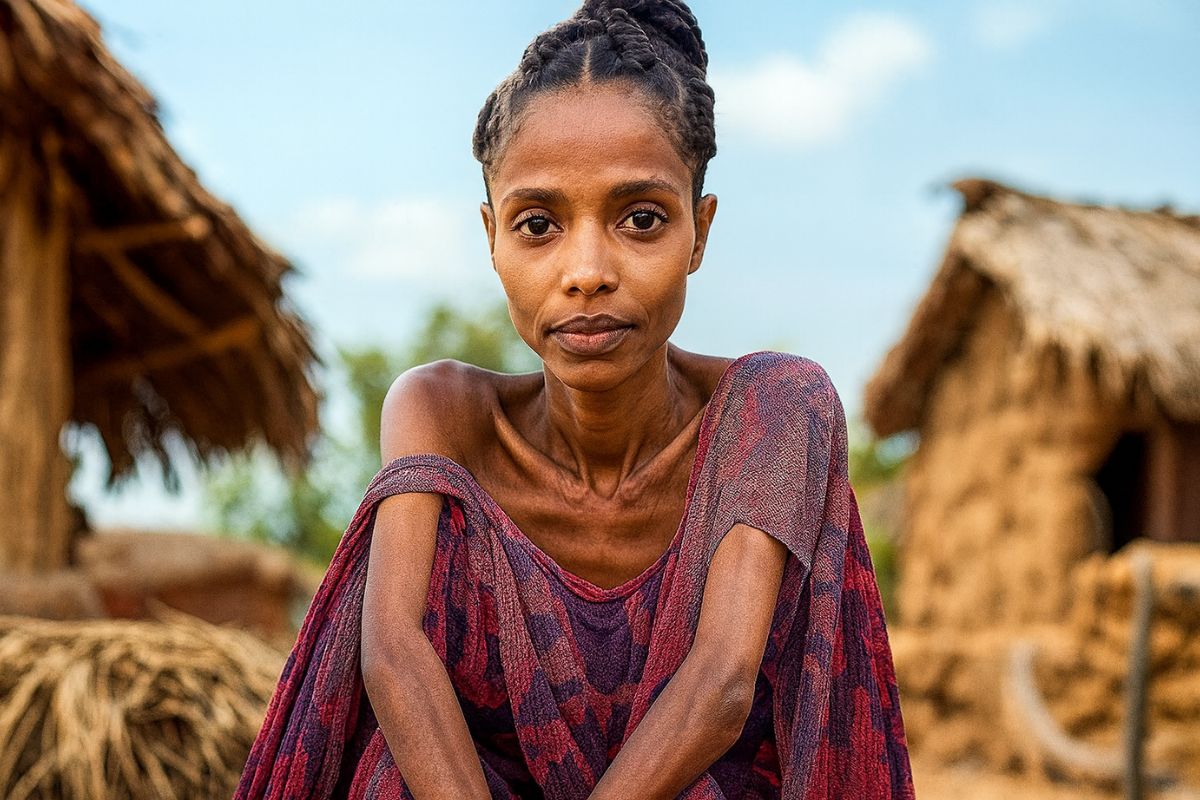


The Young Woman Who Has Not Eaten or Drunk for 16 Years Intrigues Doctors, Mobilizes a Village in Ethiopia, and Defies What Is Known About the Human Body
At 26 years old and living in a rural area of Ethiopia, the young woman who has not eaten or drunk for 16 years has become an enigma that connects medicine, faith, and global curiosity. According to reports from family members, neighbors, and healthcare professionals who have examined her, she maintains an active routine, stable health, does not eat, does not drink water, and claims not to have used the bathroom for over a decade and a half.
The story took on even more complex contours when the young woman who has not eaten or drunk began to be followed by medical teams in Ethiopia and Dubai, received attention from the country’s prime minister, and became a central figure in debates about the limits of human physiology. Amid skepticism, local testimonies, and the silence of tests that do not explain her condition, the case remains open: a narrative that confronts scientific knowledge without offering, for now, a conclusive answer.
The Journey to the Village of the Young Woman Who Has Not Eaten or Drunk

To understand who the young woman who has not eaten or drunk is, the starting point was the Ethiopian capital, Addis Ababa.
-
With emergency diversion to abandoned mining craters, engineers save villages from a devastating flood that was advancing through the desert and threatening to destroy entire communities in a matter of hours.
-
It seems simple, but it enriches: from R$ 500 to R$ 6,000 per piece and up to 10 days of handcrafted production, how is the couple from Praia Grande making a high income with hyper-realistic miniatures and turning a hobby into a money-making machine?

-
Artisanal well erupts with water in the sertão of Bahia, revealing a surprising flow with six active fissures underground and changing the landscape in the Bahian semi-arid region.
-
NASA published a photo taken from space of a mountain range in the interior of Goiás, and the whole world wanted to know what it was: beneath it lies the largest hot water spring on the planet, with temperatures reaching 70 degrees in the middle of the Cerrado.

From there, the team took a domestic flight to Jimma and then faced about four hours of dirt road travel in a rural route, near the border with South Sudan, passing through villages, simple wooden houses, heavy rain, and difficult access routes.
Along the way, the very magnitude of the challenge became evident.
People approached on the road did not know how to locate the young woman who has not eaten or drunk, despite earlier reports indicating that she was already a well-known figure regionally.
Only after successive stops, questions, and a combination of local directions was it possible to reach the house where she lives, in an isolated community surrounded by mountains, plantations, and a rural environment typical of the Ethiopian interior.
Who Is Muluwork, the Young Woman Who Has Not Eaten or Drunk for 16 Years

Named Muluwork, the young woman who has not eaten or drunk lives in a house more structured than the average in the village, on walled land with a relatively protected interior area.
According to local residents, this space was a gift from the Prime Minister of Ethiopia after the case gained national notoriety.
Inside the house, posters, ancient objects, and visual records of the young woman herself reinforce the construction of a narrative around her condition.
Muluwork claims she has not eaten since she was 10 years old, when, still at her family’s house, she began to reject all meals.
The young woman who has not eaten or drunk describes a total loss of appetite for food and water, reports that she feels no hunger or thirst, and says that since then, she has never ingested solid or liquid foods again.
She also states that she does not use the bathroom for physiological functions, only for personal hygiene.
At the same time, she maintains an active routine, walks, talks, receives visitors, and takes care of her young daughter.
Routine, Gardening Work, and Domestic Life Without Eating or Drinking
Upon observing the daily life of the young woman who has not eaten or drunk, one of the most striking points is her level of physical activity.
She walks around the property, organizes the yard, moves between rooms, receives guests, and conducts a sort of guided tour of her own house.
In the yard, she cultivates vegetables and plants that serve both for the nourishment of other family members and for medicinal use.
When asked who she produces those foods for if she does not eat, the young woman who has not eaten or drunk states that the harvests are meant for her sister, her daughter, and visitors.
She also enjoys cooking: prepares typical dishes such as injera and sides, controls the cooking time, adjusts texture, coordinates the preparation of dinners, and is often praised as “the best cook” in the house.
When asked if she feels hunger or the desire to taste the food, she responds that she has no appetite and does not feel the need to try what she prepares.
Medical Exams, International Travel, and a Clinical Enigma
The case of the young woman who has not eaten or drunk has not been restricted to local curiosity.
She was taken to the capital Addis Ababa, where she underwent examinations in a large hospital, and later traveled to Dubai, with the trip sponsored by the Ethiopian government.
In Dubai, she remained under medical evaluation for about a week, according to reports from the young woman herself and her companions.
The doctors reportedly examined her body for signs of recent food intake, traces of food in the stomach or intestines, and changes consistent with severe malnutrition.
According to reports, no traces of food were found in the digestive tract, and the young woman was described as clinically stable, although professionals questioned her mental state given the incompatibility between her described condition and what is known about human needs for food and water.
However, the diagnosis was not categorized into a clear medical category, keeping the case in the realm of the unexplained.
Faith, Community, and the Construction of a “Living Miracle”
The young woman who has not eaten or drunk identifies as an Orthodox Christian and regularly attends church, participating in services on Sundays and integrating into the region’s religious life.
She reports that she does not even drink the holy water offered at the ceremonies, maintaining consistency with her total abstinence from liquids.
For Muluwork, her condition is an act of God, something she accepts as part of her identity, without wishing for “healing” or a return to eating.
Among neighbors, the perception approaches a mix of admiration and normalization.
Residents claim to have never seen her eat or drink, and some describe her as hardworking, devoted to the garden, a good host, and a person of strong faith.
There are also some who believe that the young woman who has not eaten or drunk has prophetic dreams, as reported by her sister, and that her visions come true.
A circle of narratives forms around her, reinforcing the story of a “unique case,” albeit without a satisfactory biological explanation.
Skepticism, Limits of the Human Body, and Unanswered Questions
From a physiological standpoint, there is no technical consensus supporting prolonged survival without any food and water intake, especially for years.
Therefore, the story of the young woman who has not eaten or drunk is met with skepticism by many, including the very documentarian who visited her, who alternates between doubts and the strength of testimonies collected in the village.
Testimonies from residents, family members, religious leaders, and those who accompanied Muluwork during exams support the version that she does not eat.
At the same time, established knowledge about the need for energy, nutrients, and hydration to maintain vital functions points to something not adding up in this equation.
The central question remains open: what is behind the described condition, and to what extent do the reports fully capture the reality of what happens in the daily life of the young woman who has not eaten or drunk?
The Point Where Science, Narrative, and Belief Meet
The story of the young woman who has not eaten or drunk illustrates how extreme cases end up positioned at the boundary between science, belief, and community narrative.
On one side, there are exams, trips, government attention, and prolonged observation by people who swear they have never seen her eat or drink.
On the other side, there is the entire body of medical knowledge which argues that it is not viable, under normal conditions, for a human being to go so many years without food and liquid intake.
In this intersection, the young woman becomes, for many, a religious “sign,” an example of faith and resilience. For others, she is an enigma that requires more investigative rigor, continuous monitoring, and detailed clinical documentation.
While none of these fronts offers a definitive answer, Muluwork’s case continues to be reported and debated as a challenge to everything currently understood about the human body and its basic needs.
The trajectory of the young woman who has not eaten or drunk for 16 years, living in a rural Ethiopian village, surrounded by neighbors who confirm her behavior and by doctors who have not provided a clear explanation, remains one of the most unsettling accounts when the topic is physiological limits, faith, and collective perception.
At 26 years old, with an active routine and a discourse consistent with what she advocates, she remains at the center of an enigma that, for now, raises more questions than answers.
In light of this story, which directly confronts what is accepted as possible for the human body, the question remains for you to reflect and comment: do you tend to believe in the version of the young woman who has not eaten or drunk, or do you think there is still a lack of rigorous investigation to explain what really happens in her daily life?








Não há dúvidas de que ela realiza a fotossíntese. Acho que os médicos deveriam procurar os cloroplastos em suas células.
Eu como médico e cristão que sou estou abismado.Somente,o poder de Deus Jeová,poderá atuar nesse caso para um resposta verdadeira!
Não acredito.
E quem liga?
Muito interessante. Um caso que merece uma atenção mundial,porque se for verdade, pode ser um salto evolucionista na condição humana.