





 Portuguese
  English
  Spanish
  4 min of reading
  0 comments


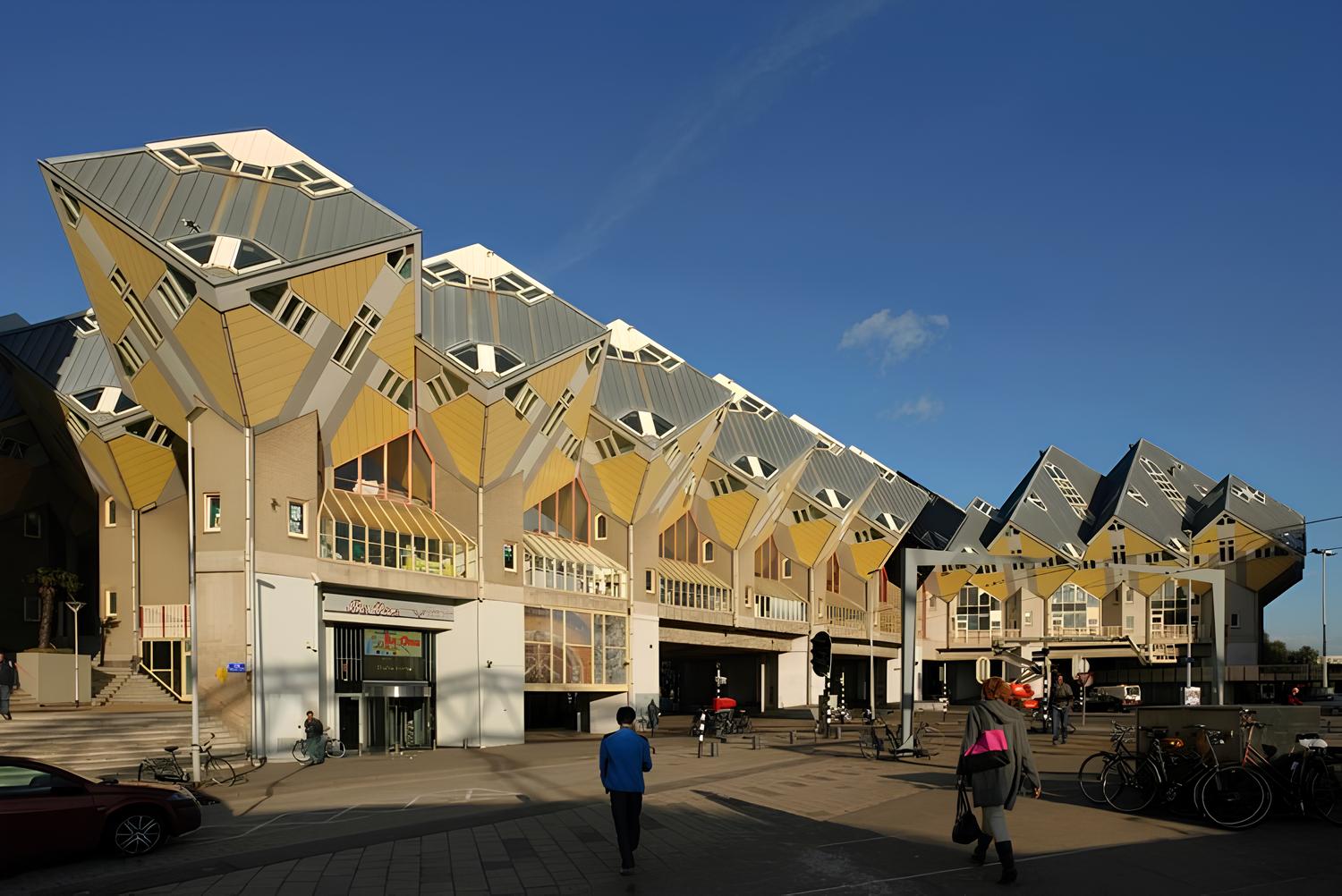
With 38 Cubes Inclined at 54.7°, the Houses of Rotterdam Create a Futuristic Geometric Forest That Challenges Gravity and Became a Global Symbol of Innovative Architecture.
In the heart of Rotterdam, Netherlands, there are residences that seem to defy everything we understand as structural logic. Suspended on hexagonal pillars, turned exactly 54.7 degrees and formed by 38 habitable cubes, the iconic Cube Houses are today one of the boldest architectural experiments ever built in Europe. Designed by Dutch architect Piet Blom and completed between 1977 and 1984, these structures were envisioned as an “urban geometric forest”: each house represents a tree, and the whole set forms the forest. The concept, which seemed impossible on paper, became reality and changed the landscape of the city forever.
The visual impact is so great that, while walking among the suspended cubes, tourists report the sensation of being inside a futuristic setting, where impossible angles and slanted lines confuse the perception of depth and balance. The houses are not just works of art — they are fully functional residences that attract visitors from all over the world.
Piet Blom’s Revolutionary Concept: Transforming Houses into Trees and Cities into Forests
For Blom, architecture should be more than shelter; it should provoke, generate new forms of coexistence, and reinvent the way we move through urban spaces. His concept was based on two principles:
-
With over 14 million baskets of earth moved, an ancient North American metropolis built a monumental pyramid of 30 meters and established a city with 20,000 inhabitants nearly a thousand years ago.

-
A 1,900-year-old treasure emerges from a Roman house destroyed by fire and sealed since antiquity in Romania, with coins and metals fused among the ashes.
-
The Brazilian colonial city that stopped in time and shares territory with a rocket launch base.
-
79-year-old woman challenges limits, visits 193 countries in the world after 56 years of planning and reveals the behind-the-scenes of a global journey that few have managed to accomplish.


- each house is a tree;
- the urban set is the forest.
The inclined cube was the answer to this vision: by rotating it 54.7°, Blom broke traditional aesthetics and created shapes that seemed impossible to inhabit. The hexagonal pillar functions as the trunk; the cube, as the canopy; and the set, as a densely distributed grove over the city center.
The original idea was to transform degraded urban spaces into places of social interaction, striking aesthetics, and fluid circulation. Rotterdam, devastated by World War II, became fertile ground for this radical experimentation.
How the Structure Works: High-Precision Engineering
Despite the chaotic appearance, the houses are supported by hexagonal pillars designed to bear the weight of the inclined cubes. The precise rotation of 54.7° creates a load distribution that requires advanced structural calculations.

Inside the cubes, everything is inclined: walls, windows, upper floors. The rooms were designed with geometric cuts that take advantage of the slanted corners and make it feasible to live there. Each unit has:
- about 100 m² distributed over three floors;
- living room with large diagonal windows;
- angled kitchen;
- two or three bedrooms;
- narrow stairs connecting the levels;
- ceilings that create unusual optical effects.
The internal experience is, for many, disorienting, but striking.
The Walk Between the Cubes: The Sensation of Walking Inside a Work of Art
The set of houses was built over an elevated passageway, forming a corridor between the suspended modules. There, the visitor has the sensation of:
- walking under blocks that seem to float;
- being inside an enlarged futuristic model;
- seeing the sky cut by radical angles;
- experiencing the “geometric forest” envisioned by Blom.
This unique perspective transformed the location into a permanent tourist attraction.
One of the houses — called Kijk-Kubus — operates as a museum and allows visitors to explore the interior and understand up close what it’s like to live in a space where almost nothing is perpendicular.
Why They Became a Global Symbol of Urban Innovation
The Cube Houses of Rotterdam gained international recognition for several reasons:
Successful Experimental Architecture
Few radical projects become functional and durable.
Smart Use of Post-War Urban Spaces
The project revitalized a destroyed area of Rotterdam.
Unmistakable Design
The inclined geometry transformed the neighborhood into a visual icon.
Unconventional Housing Solution
The houses were designed for real use, not just as art.
Global Reference in Architectural Education
Universities around the world study their structure and concept.
The Cultural and Tourist Impact
Rotterdam, known as one of the most modern cities in Europe, found in the Cube Houses a trademark. The set:
- appears in architecture documentaries;
- is studied in urban planning courses;
- appears in viral tourism videos;
- has become the most photographed postcard of the city.
Additionally, part of the houses is occupied by residents, while others house shops, cafes, hostels, and the Kijk-Kubus museum.
Conclusion: One of the Most Visionary Architectural Sets on the Planet
The inclined houses of Rotterdam go beyond a futuristic aesthetic — they represent the fusion of art, engineering, and urbanism. Their 38 cubes rotated at 54.7°, supported by hexagonal pillars, challenge gravity and completely reshape the experience of being in the city.
The “urban geometric forest” created by Piet Blom not only survived the decades — it became one of the boldest and most influential architectural expressions in Europe, proving that vision, daring, and precision can reinvent even the most basic concept of housing.








Seja o primeiro a reagir!