





 Portuguese
  English
  Spanish
  6 min of reading
  6 comments


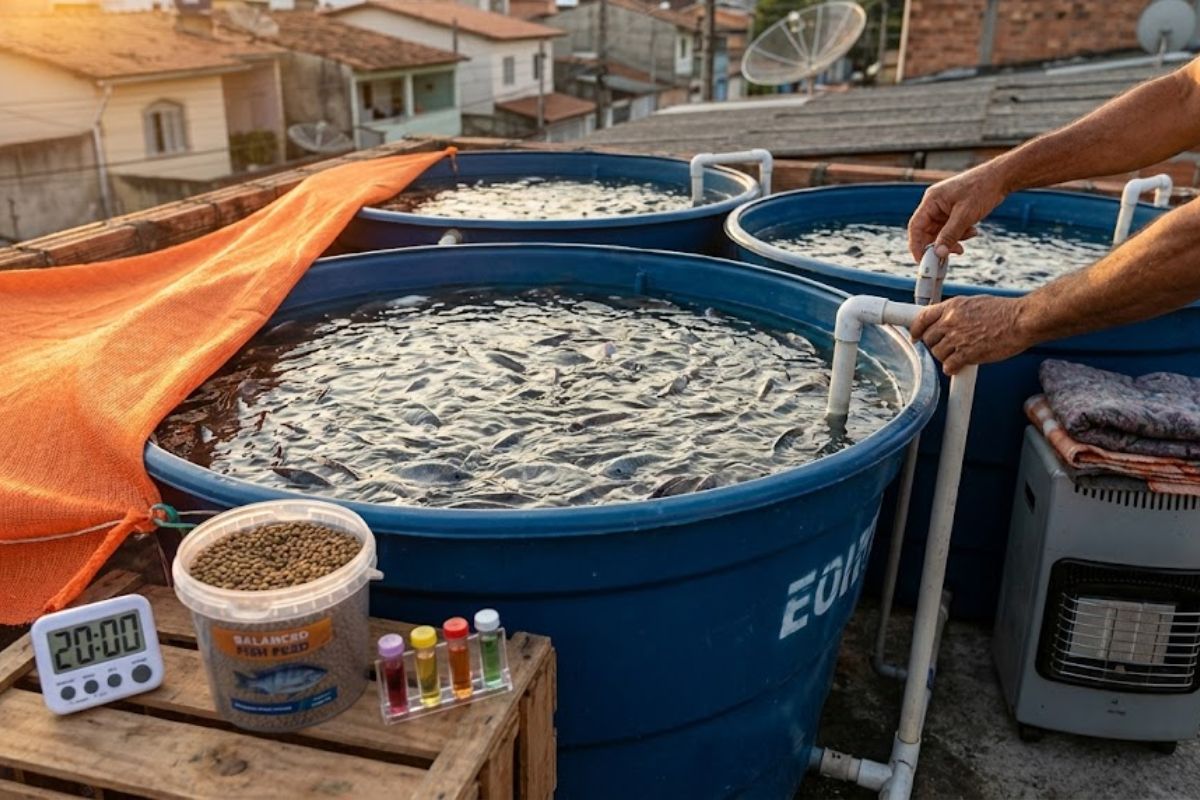


In Practice, The Creation of Fish in Water Tanks with Tilapias Depends on Chlorine-Free Water, Rigorous Control of Water Temperature and Simple Aquaponics Planning, Guiding Beginners on Density, Cold Management and Quick Routine to Keep the Stock Healthy Year-Round Without Loss of Valuable Fish
The creation of fish in water tanks has ceased to be just a backyard curiosity and has become a real alternative for producing protein at home, especially with tilapias, which adapt well to compact and low-cost systems. The model is simple: a 1000-liter tank, well-dimensioned filtration, chlorine-free water, and constant attention to water temperature.
More than improvisation, this structure can be treated as a small professional system, even integrated into aquaponics, where plants help filter the water and take advantage of the nutrients generated by the fish. With proper management, it is possible to maintain 50 tilapias per 1000-liter tank, taking care of everything in about 20 minutes a day, without requiring prior experience in fish farming.
How Many Tilapias Fit in a 1000-Liter Tank

The first doubt for those starting in fish farming in water tanks is the density: how many animals to put without ruining the water or losing the stock.
-
Russia cut fertilizers, China cut fertilizers, and oil prices soared with the war in the Middle East: sugarcane producers in the interior of São Paulo are seeing costs explode from all sides and warn that the effects will take months to be absorbed.

-
It does not come from flowers, is produced only every two years, and more than 90% goes straight to Europe: meet the bracatinga honeydew honey from Santa Catarina, considered one of the rarest in the world and overlooked by Brazil itself.
-
They said no to 26 million dollars and would do it all over again: mother and daughter from Kentucky reject a million-dollar offer from a mysterious company that wants to build the largest data center in the state on more than 2,000 acres of rural land.

-
While corn requires rain and is expensive, sorghum produces almost the same volume per hectare at a cost up to 80% lower and uses less water, and it is revolutionizing dairy farming in the Triângulo Mineiro, where producers save hundreds of reais per hectare.

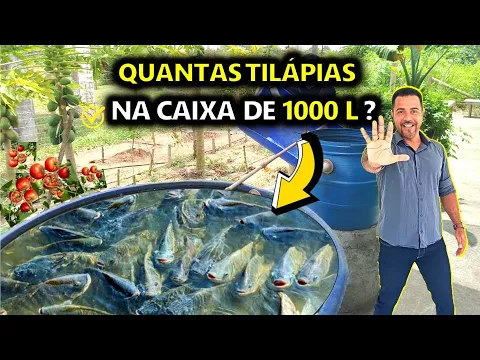
The practical rule presented by the professor is 1 fish for every 20 liters of water, which means 50 tilapias in a 1000-liter tank.
Working with tilapias up to 500 grams, this system results in about 25 kg of fish per cycle, which is considered a safe density for beginners.
Reaching this weight takes around 5 months, during which the producer can both consume and sell, if they have a market.
At more advanced levels, it is possible to reach 35 or 40 kg per tank, but the requirements for filtration, oxygenation, and water monitoring increase significantly.
Chlorine-Free Water and Partial Exchanges: How to Not Kill the System

Those who do not have a well often ask if they can use water from the sanitation company.
The answer is yes, as long as it is turned into chlorine-free water before entering the fish tank.
Chlorine harms the tilapias as well as the beneficial bacteria in the biological filter, which are essential for converting toxic compounds.
The recommendation is to let the treated water rest for about 48 hours in a separate water tank, uncovered and exposed to the sun.
Since chlorine is a gas, it evaporates naturally. After that, this chlorine-free water can be used for partial exchanges, known as TPA.
The ideal is to remove 15 to 25% of the water twice a week, emptying the settler, discarding the waste, and replenishing with new water.
For small daily replacements, due to evaporation or plant consumption, tap water can go directly in since the volume is too low to cause an impact.
Sun, Shade and Control of Water Temperature

Another critical point in fish farming in water tanks is exposure to the sun.
In very hot regions, leaving the tank exposed to direct sunlight all day long raises the water temperature too much, reduces dissolved oxygen, and encourages algal blooms, making the system green and unstable.
The technical solution is partial shading.
The tank can be positioned in a location that gets sunlight in the morning and shade in the afternoon, combined with a shading screen of about 50%.
The ideal water temperature range for tilapias is between 25 and 30 ºC.
Below 25 ºC, appetite drops; below 15 ºC, growth is affected; around 9 ºC, mortality is very likely.
A simple thermometer with an internal sensor solves monitoring, as long as it is protected from rain and always submerged in water.
Daily Routine of 20 Minutes: What Really Needs to Be Done
Despite its technical appearance, the system does not require hours of daily work.
In the routine described by the professor, taking care of fish farming in water tanks takes about 15 to 20 minutes a day.
During this time, he checks the pump, cleans the protective grate with a small brush, observes the settler, feeds the tilapias, and checks the thermometer.
Twice a week, a partial water exchange is carried out, emptying the settler, washing the filter foam, and replenishing with chlorine-free water.
Checking parameters like pH and ammonia can be done once or twice a month, or whenever there is a strong smell of ammonia or strange behavior from the fish.
In well-dimensioned systems and with the correct density of tilapias, these tests tend to be more preventive than emergency.
How to Protect Tilapias in Extreme Cold
In winter, water temperature is the main enemy of tilapia, a tropical species that cannot endure extreme cold.
The guidance is to keep the tank open during the day, only with a screen to prevent the fish from jumping, taking advantage of as much sun as possible.
At night, the tank should be covered and, if possible, covered with a tarp to retain accumulated heat.
During extreme cold, the recommendation is to avoid handling the fish, as any injury heals much slower, opening doors to infections.
Those who do not use plants in the aquaponics system can apply 1 kg of salt for every 1000 liters of water as a preventive measure, helping to strengthen the immune system and combat parasites.
Electric heaters and thermostats, besides being inefficient for large volumes, significantly increase the electricity bill and are therefore not the first choice in this type of project.
Aquaponics and Higher Weight Gain with Knowledge
For those who master the basics of fish farming in water tanks, aquaponics is the next natural step.
By integrating plants and biological filtration, the system improves water quality, reuses nutrients, and reduces the need for more aggressive exchanges.
This creates a more stable environment for tilapias and opens up space for densities of 35 to 40 kg of fish per 1000-liter tank, provided that filtration and oxygenation are carefully designed.
At these levels, management errors can be costly: without chlorine-free water, without control of water temperature, and without adequate filtration, the risk of total loss increases greatly.
Therefore, it is recommended for beginners to stick to about 50 tilapias, with 25 kg final weight, and gradually increase density as they gain experience, adjust the filter, improve aeration, and learn to read the behavior of the fish.
Why Fish Farming in Water Tanks Became an Entryway
The combination of hardy tilapias, affordable water tanks, a 20-minute routine, and the possibility of integrating aquaponics has made this model an entryway for small urban and rural producers.
In small spaces, it is possible to produce a significant amount of protein, test the local market, and understand in practice how a recirculation system works.
From a technical standpoint, the secret lies not in expensive equipment, but in respecting the recommended density, ensuring chlorine-free water, controlling water temperature, and maintaining discipline in partial exchanges and system cleaning.
With this, fish farming in water tanks ceases to be a risky bet and becomes a planned, scalable, and educational project for anyone looking to start in aquaculture.
And you, have you thought about starting a fish farm in a water tank with tilapias at home or at your farm, or are you still facing some specific doubt about water, temperature, or aquaponics?







Onde posso comprar o filtro e ateador e qual a melhor marca custo benefício ?
(73)991450001
Tenho um sistema com duas caixas de 1k. Minha dificuldade é aquecer a água no inverno
Faz um aquecedor solar simples, tem projeto no YouTube. Se não for suficiente, faz um aquecedor com um queimador de óleo usado.
Estou desenvolvendo um app pra ajudar os produtores, em breve lançarei.
A minha dúvida é precisa de licença ambiental para criar tilapias em sistema de recirculaçáo de água?
Vc não deve precisar se for algo pequeno, mas se partir pra escalas maiores, com certeza é melhor estar “dentro da lei”, ainda mais agora 🤦♂️
Estou desenvolvendo um app pra ajudar os piscicultores, em breve lançarei!!